These are the 10 most dangerous Kansas City area streets for pedestrians, bike riders
As a regular bike commuter, there are streets Michael Kelley tries to avoid riding on in the Kansas City metropolitan area.
“I struggle especially with riding along very wide streets where traffic is encouraged to speed,” said Kelley, policy director of the advocacy group BikeWalkKC. “So Prospect, for example, I rarely ride along Prospect.”
Add Broadway, 39th Street and 75th Street to that list too.
The more lanes you have on a street, the more dangerous it is, according to the Kansas City Vision Zero Action Plan report. That’s especially true for pedestrians who have more lanes to cross and cyclists who have to battle with traffic that is going 30 to 40 mph, if not faster.
“We know that wider streets encourage more reckless driving, especially more speeding — and speed kills,” Kelley said.
Last year, 43 pedestrians and cyclists were killed in traffic crashes in the Kansas City metropolitan area, the highest number in the last 10 years, according to data from the Mid-America Regional Council.
To understand where the danger was, The Star analyzed traffic crash and injury data to see which streets across the metropolitan area were the most dangerous for pedestrians and cyclists.
The Star found that, with one exception, the streets with the most injuries and deaths were in Kansas City. The top three were Independence Avenue, 39th and Prospect.
The data also showed that while bicycle and pedestrian crashes made up just slightly over 1% of all traffic crashes, pedestrians and cyclists accounted for nearly 16% of all traffic deaths in the metro.
“I think that is not unique to the Kansas City area, but it’s certainly a concern here,” said Ron Achelpohl, director of transportation and environment for MARC.
The most dangerous streets are in the historic urban core of Kansas City, the data showed. That’s where there’s more routine pedestrian and bicycle activity.
It is significant because Kansas City’s Vision Zero Action Plan report found that Black people are twice as likely to be killed in traffic crashes in Kansas City as white people.
“We know that there’s an inequity component to traffic violence in that it disproportionately harms Black and brown people — Black Americans and Native Americans in particular,” Kelley said.
If you live or walk in a lower income community, you are more likely to become a victim of traffic violence, he said.
Many of the streets cut through neighborhoods where there are more households that rely on transit and walking as their primary means of getting around because they don’t have access to a vehicle, Achelpohl added.
“So there’s probably a tie there to the characteristics of the neighborhoods in addition to the characteristics of the roadways themselves,” he said.
In May 2020, the Kansas City City Council passed its Vision Zero resolution with the goal to eliminate all traffic deaths and serious injuries by 2030 and increase safe and equitable mobility for everyone.
Safety improvements and projects are already planned or in the works to address conditions on some of the more dangerous streets in the city as part of Vision Zero, said Sherae Honeycutt, public information officer for Kansas City Public Works.
Kansas City has taken a good step in the right direction, Kelley said.
But he added: “We are going to have to do more to ensure that pedestrians, cyclists and other vulnerable road users are protected.”
Here’s a look at crashes at the 10 most dangerous streets in the metro based on where pedestrians and cyclists were hurt or killed over the past 10 years:
Independence Avenue in Kansas City
Independence Avenue is the most dangerous street in the Kansas City area for pedestrians and cyclists.
Since 2012, five pedestrians and cyclists have been killed there, according to the data. Another 101 people have been injured.
Most of the people were injured or killed along a three-mile stretch between The Paseo and Beacon Avenue. The area near Elmwood Avenue and Van Brunt Boulevard was one of the most dangerous, accounting for one pedestrian death and 14 injuries.
On March 4, 2013, 42-year-old Luis Carlos Robledo-Sanchez was killed when he was run over at Cypress Avenue. Several months later, a 40-year-old pedestrian was killed at Montgall Avenue.
On September 22, 2015, a 46-year-old pedestrian died near Bales Avenue.
On April 3, 2016, 32-year-old Anthony P. Saluto died when an eastbound Lexus swerved into the lane where Saluto was riding a bicycle and struck him at Forest Avenue. He died from injuries suffered in the crash.
Joseph Lasala pleaded guilty to involuntary manslaughter and was sentenced in 2018 to at least 120 days in prison. Afterward he was placed on probation for five years.
On Nov. 29, 2019 — the day after Thanksgiving — 65-year-old Gary L. Davis of Kansas City was killed when he was struck crossing the street at the intersection of Elmwood Avenue.
Kansas City plans to redesign Independence Avenue at Van Brunt as part of its Vision Zero initiative.
39th Street
The second most dangerous street in the metro area was 39th Street, which had 80 pedestrian and cyclist injuries in the past 10 years.
The intersections with the highest number of people hurt were Troost Avenue, where 10 people were injured, Prospect Avenue, which had nine injuries and Broadway, which saw eight people injured.
On Jan. 6, 2019, a 21-year-old pedestrian was injured near Genessee Street.
Four months later, a 38-year-old cyclist was injured at Broadway Boulevard.
Since 2020, 10 pedestrians have been injured on the street near Baltimore, Broadway, Brooklyn, Holmes, Oakley, The Paseo and Prospect.
Kansas City will install a crosswalk at 39th and Genessee streets in November, Honeycutt said. The city is also planning to redesign 39th Street. Although the design isn’t complete, the street likely would drop from four to three lanes with a turn lane.
The changes would feel like 31st Street, which has had a lane reduction between Main and Troost.
Prospect Avenue
Five pedestrians were killed and 72 cyclists and pedestrians were injured in crashes on Prospect Avenue since 2012.
The greatest number of pedestrians injured were near the intersections of 31st, 35th and 39th streets, which accounted for 21 people injured.
The most recent pedestrian death was on Aug. 18, 2018, when 33-year-old Andrea Mitchell of Kansas City died of injuries suffered in a hit-and-run crash at 38th Street. Mitchell had been crossing the street when she was hit, and the driver left the scene without stopping.
Broadway
One pedestrian was killed and 73 were injured during the time period examined by The Star. No injuries were counted among cyclists.
The areas with the highest number of injuries include 38th and 39th streets, which each had nine pedestrian injuries, followed by Westport Road with six and 10th Street and 47th Street with five pedestrian injuries each.
In December of last year, 41-year-old Tami N. Knight was killed when a firetruck collided with a Honda CRV at Westport Road and the force of the crash sent the vehicles careening into her before slamming into a building. The Honda’s occupants, Jennifer San Nicolas and Michael Elwood, were also killed.
Westport Road is undergoing a study through Midtown KC NOW, Honeycutt said.
Troost Avenue
The deadliest street for pedestrians is Troost Avenue, where nine people have died over the past 10 years. All of the deaths occurred between 51st Street and 82nd Terrace — which is less than four miles.
During that time, an additional 53 pedestrians and cyclists were injured on Troost.
The areas with the highest number of injuries included 57th Street, which had six, 75th Street, which had four, and 55th Street, which had three.
On June 2, 2012, 51-year-old Stephen C. Reddy was killed when he was struck by a drunk driver as he walked along Troost near 79th Terrace. The driver fled, but a witness forced him to pull over near Bannister Road and Wayne Avenue.
Aldo D. Campillo-Rivera was charged and pleaded guilty in 2013 to driving while intoxicated and leaving the scene of an accident. He was sentenced to 180 days in jail and placed on five years of probation, according to court documents.
Two people were killed in 2019. Kathleen K. Tripp, 65, was killed on March 13 at 55th Street when a delivery truck turned and struck her as she was crossing the street. The truck had entered the intersection under a green traffic signal before initiating a left turn.
Three months later, 59-year-old Mark D. Hovey was killed when a driver of a dark gray Chevrolet Impala ran off the road near 67th Street and crashed into a RideKC bus shelter. The pedestrian was sitting on a bench at the time of the crash. The driver fled, but later turned himself in.
On June 24, 2020, a 58-year-old pedestrian died when he was run over by a RideKC bus at 51st Street. The pedestrian had been a passenger who fell or tripped after getting off the bus. The pedestrian ended up under the bus and the right rear tires ran over him.
Two more pedestrians were killed in traffic crashes on Troost last year. Kim Ruff, 52, of Kansas City died Jan. 6 at 72nd Street while walking in or trying to cross the street. The driver stopped.
On Oct. 27, a 61-year-old woman was killed as she was crossing at 82nd Terrace. The driver left the scene.
The city is redesigning 82nd Terrace and Troost as part of Vision Zero. The city plans to re-do curb ramps, repaint the crosswalks and add push button stations, Honeycutt said.
31st Street
Over the past 10 years, 53 cyclists and pedestrians have been injured on this street.
Ten people were injured at Prospect Avenue. Six were hurt at Troost and five at Myrtle Avenue.
Crashes hurt nine pedestrians and a cyclist in 2018. Eight people were hurt in 2019, including a 31-year-old cyclist on June 3 at Roanoke Road and a 36-year-old pedestrian on June 16 at Benton Boulevard.
Last year, four people were injured, including a 25-year-old pedestrian on Nov. 20 at Montgall Avenue.
The intersections of 31st and Troost and 31st and Prospect will be redesigned as part of Vision Zero, Honeycutt said.
“We are receiving great feedback on the improvements made along 31st Street from Main to Troost,” she said.
The street went on a “road diet” and was reconfigured to have one lane in each direction with turn lanes a intersections with signals. On-street parking was added as well as curb bump-outs to preserve sight distance and reduce pedestrian crossing distances.
The upgrades were completed in September.
Main Street
Two pedestrians have died in traffic crashes on Main since 2012. Another 50 people have been injured in pedestrian and bicycle crashes.
Twenty-six of those injuries occurred along a stretch of Main from 37th to 45th streets.
The deaths included a 21-year-old pedestrian killed July 20, 2018, at 43rd Street.
On June 21, 2020, 23-year-old Zahara Kathawalla was killed at 43rd Street as she was struck by a hit-and-run driver who was racing another vehicle down Main. The driver later turned herself in.
Shabazz L. Frencher pleaded guilty in March to one count each of drunken driving that resulted in the death of Kathawalla and leaving the scene of a fatal crash. Prosecutors dropped involuntary manslaughter and driving on a revoked or suspended license. She was sentenced to eight years in prison on the drunken driving charge and seven years on the leaving-the-scene charge. They are to run concurrently.
The city’s current focus on Main is the Streetcar expansion, Honeycutt said. Once construction is complete, it will look for possible improvements.
U.S. 24/Independence Avenue in Independence
The only street to make the list of Top 10 most dangerous streets for pedestrians and cyclists that wasn’t in Kansas City is U.S. 24/Independence Avenue in Independence.
Four pedestrians and one cyclist have been killed on U.S. 24. An additional 40 people have been injured.
Some of the more dangerous areas include a stretch of U.S. 24 from Claremont Avenue east to Noland Road where 13 cyclists and pedestrians were injured, including three fatally, and from Missouri 29 east to North Viking Drive, where 11 pedestrians and cyclists were injured, including two seriously.
On Aug. 11, 2019, 30-year-old Misty M. Collins was struck and killed as she was walking along the shoulder near Kiger Road. The driver fled.
The next year, a 15-year-old cyclist died from injuries suffered in a crash on Oct. 18 at Noland Road.
12th Street
One pedestrian was killed and 44 other pedestrians and cyclists were injured along 12th Street in Kansas City.
A stretch of 12th Street, from Broadway to Locust Street through downtown Kansas City, accounted for 18 of those who were injured.
Other areas with a high number of injuries include Benton Boulevard, which had five, and the stretch from Jackson Avenue to Hardesty Avenue, which had seven.
On July 13, 2020, 58-year-old Brian Anderson was found lying injured in the street at Hardesty Avenue. He was taken to a hospital where he later died. Police said they later found the vehicle that hit him — a pickup which was pulling a trailer — and identified the person driving.
Protected bike lanes are to be installed next summer along 12th Street, from Grand Boulevard to Charlotte Street, Honeycutt said.
Linwood Boulevard
Rounding out the Top 10 is Linwood Boulevard, where 37 pedestrians and cyclists were injured and one pedestrian was killed.
The areas with the most injury crashes included Main Street, which had five, Brooklyn Avenue, which had four, and Gillham plaza and road, which had four combined.
On Dec. 5, 2019, a 63-year-old pedestrian was killed at Poplar Avenue.
In 2021, pedestrians struck and injured on this street included a 21-year-old at Poplar, an 8-year-old at Brooklyn Avenue and a 73-year-old at Van Brunt Boulevard.
Bicycle, pedestrian crashes the past 10 years
Since 2012, 315 pedestrians and cyclists have died in more than 6,100 traffic crashes in the Kansas City metropolitan area, according to data from the Mid-America Regional Council.
Another 5,410 cyclists and pedestrians have been injured.
The number of people dying or injured in pedestrian and bicycle traffic crashes is growing.
There’s a whole host of reasons for the increase, Kelley said.
“Much of our region’s roadway system has been designed in a way which prioritizes vehicle throughput,” Kelley said. “That means we’re building wide roads to get as many cars through as possible.”
That comes at the expense of vulnerable road users like pedestrians, cyclists, transit users and people with disabilities.
“All of this was exacerbated by the pandemic because while fewer drivers were on these roads, the ones who remained had much more space to drive recklessly and many of them acted accordingly,” Kelley said.
The pandemic lockdowns appear to have made speeding and risky driving the new norm, a study released in June from the Insurance Institute for Highway Safety found.
“Another growing issue is that vehicles have become larger and heavier,” Kelley said. “This means that drivers are less likely to see pedestrians and cyclists, especially if they are children, but also that they’re hitting these vulnerable road users with more force.”
‘We are going to have to do more’
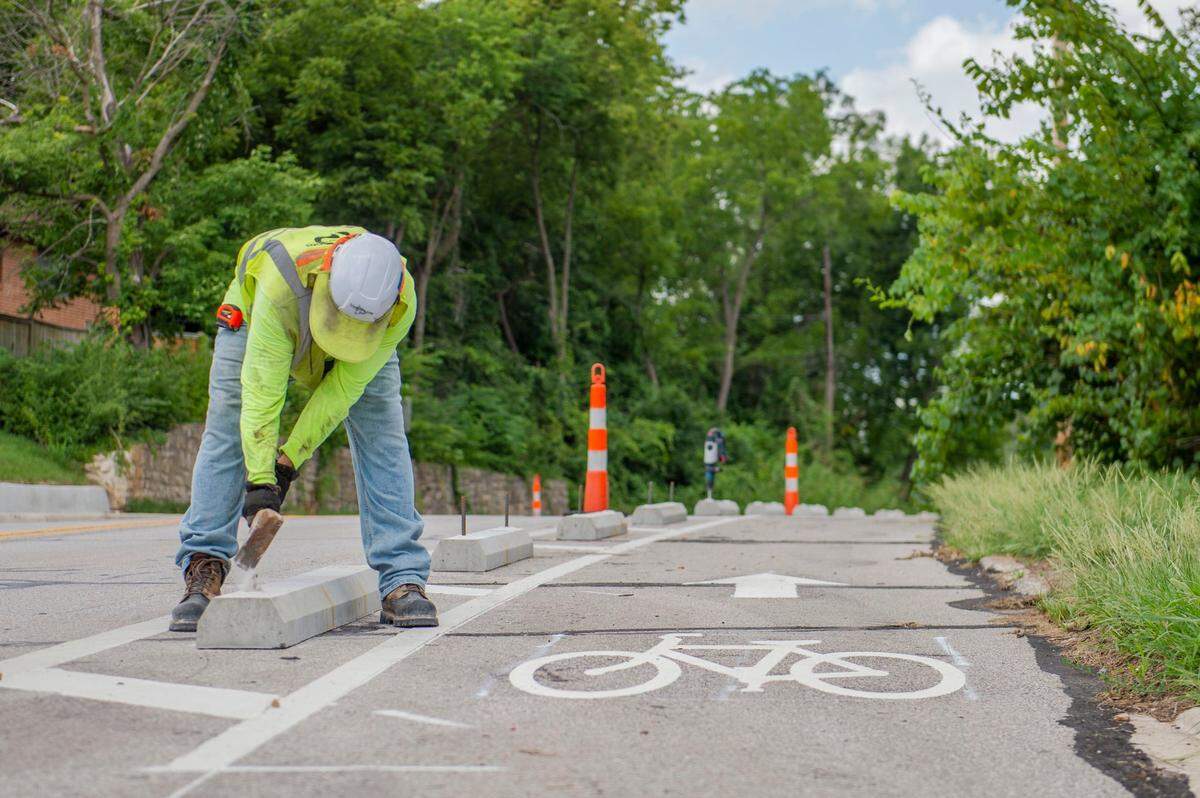
At the end of October, Kansas City celebrated adding more than 30 miles of protected bike lanes in two years.
“It’s really exciting and shows the eagerness of the city to change the footprint of our city from being car-centric to allowing for other modes,” said Bailey Waters, chief mobility officer for Kansas City Public Works, at the celebration.
The bike lanes change the tone of the street because it slows cars down and it makes drivers realize that there are people walking, shopping and biking in the area.
“It’s not a place to go through or to speed through,” she said. “It really changes the dynamic of the road from being a place for cars to a place for people.”
The bike lanes aren’t just for cyclists. Kansas City has passed an ordinance which specifically says that people who use wheelchairs, push strollers and walk can use them, too.
MARC, the metropolitan planning organization for the bistate Kansas City region, tries to reinforce “complete streets” design principles on the transportation projects they work on with the local governments and state departments of transportation, Achelpohl said.
The organization has identified strategies for local governments on how to improve pedestrian and bicycle safety in its Transportation Safety Plan 2022-2027. Those strategies appear to be popular among the users.
“Recently as we have seen more kind of new infrastructure, particularly for bicyclists in the region, we’re starting to see more people take advantage of that infrastructure and things like the cycle path on Gillham Road in Kansas City,” he said.
Defining top dangerous streets
To determine the most dangerous streets in the Kansas City metro area, The Star requested 10 years of traffic crash data from the Mid-America Regional Council, which gathers data from the Kansas and Missouri departments of transportation.
The data, from 2012 to 2021, includes crashes from the eight county area — Leavenworth, Johnson, Miami, and Wyandotte counties in Kansas and Cass, Clay, Jackson and Platte counties in Missouri. The 2021 data from Kansas has not been officially validated.
The Star then ranked the streets by the number of bicyclists and pedestrians who were killed or injured on them.
This story was originally published November 13, 2022 at 5:00 AM.