
Missouri’s minimum wage went up this year—but is it enough to live on in Kansas City?
The first day of 2022 didn’t just ring in a new year; in Missouri, it also ushered in a new minimum wage of $11.15 an hour, up from $10.30 in 2021. The increase is the penultimate step in a multi-year plan to raise the state’s minimum wage to $12 by January of 2023.
But many workers have found that these wages simply aren’t enough to live on in the Kansas City area.
“Prices are rising every year and our pay rates are just not keeping up,” said Terrence Wise, a McDonald’s employee who organizes with Stand Up KC, a local advocacy group for retail and fast food workers.
Is $11.15 enough to get by in Kansas City?
Local organizers who work full-time in the fast food industry told The Star that $11.15 just isn’t enough to live on — particularly with a family to feed at home.
“Nowhere can you rent even a studio at $11.15 an hour. It’s impossible,” said Wise. “I don’t care what your status is in our city, you can not survive on $11.15 unless you’re working 3 or 4 jobs. It’s almost an insult to workers.”
Bill Thompson, a Burger King employee who organizes with Stand Up KC, said he has struggled to make house payments during the pandemic and had to use money from a family member’s life insurance to pay back property taxes. Wise described using government assistance to pay for food, despite working 40 hours a week.
“I don’t like going to the grocery store and pulling out my blue EBT card,” Wise said. “We should be able to earn those earnings at work.”
What is the cost of living in Kansas City?
It’s getting more expensive every year to live in Kansas City: the median cost of rent has increased by 26% over the past year alone. A one-bedroom apartment in the metro area cost around $1,048 per month in December of 2021, up from $859 just a year earlier.
The costs of other expenses are also on the rise. Missouri’s gas prices have climbed by nearly a dollar per gallon in the past year. Missouri families with kids pay an average of $656 per month in childcare costs— that’s nearly 59 hours of work at the current minimum wage. And the rising cost of groceries is prompting many Missourians to seek out assistance from food banks for the first time.
All these factors have led organizers to call for wages that meet workers’ basic needs such as food, housing and transportation, expenses like childcare and healthcare and essentials like clothing. This is often called a “living wage.”
What is Kansas City’s living wage?
There is no strict definition of a living wage, so the number varies depending on who you ask.
Kansas City’s government considers $15 an hour to be the appropriate living wage for 2022, up from $13.75 in 2021.
MIT’s Living Wage calculator lists the 2020 living wage at $14.40 for a single adult with no kids in Kansas City. In a family of two adults and two children, each adult would need to make $20.25 an hour to get by. Due to inflation, these numbers would be even higher today.
Tenants are considered “rent-burdened” if they pay more than 30% of their income towards rent every month. In order to avoid this categorization, workers in a median-cost one-bedroom apartment currently need to make $3,493.33 per month, or $21.83 per hour if working 40 hours a week.
All these proposed living wages are higher than Missouri’s current minimum wage of $11.15. And while the state’s minimum wage will rise along with inflation following the bump to $12 next year, organizers say it will continue to lag behind the actual cost of living in Kansas City.
“Not having a living wage is disrespectful. It’s a slap in the face,” Thompson said.
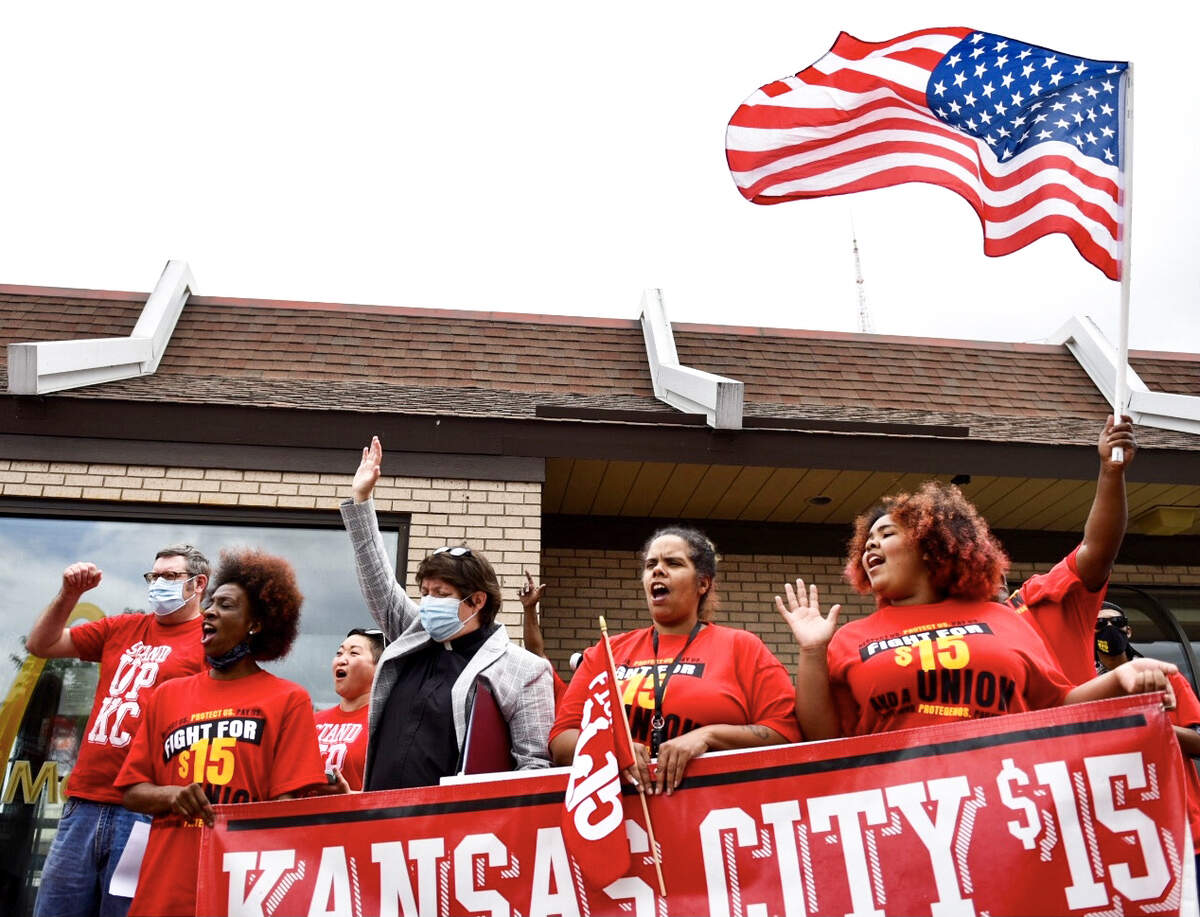
Didn’t Kansas City pass a $15 minimum wage years ago?
Yes. Kansas City’s voters passed a ballot initiative in 2017 that would have raised the city minimum wage to $15 by 2022. But Missouri instituted a law soon afterwards preventing cities from raising their own minimum wages above the statewide amount.
People who work for Kansas City’s government or a nonprofit that receives city funding are subject to a $15 minimum wage right now. There’s also a bill under review in the Missouri statehouse that would apply the same minimum to Missouri’s government workers.
But private employers, like fast food restaurant chains and other companies, are only subject to the current statewide $11.15 minimum. And those who live in Kansas face an even steeper challenge: the state’s minimum wage is the federal minimum of $7.25 per hour.
Is a higher minimum wage in Missouri’s future?
Not immediately, but organizers say they’re starting to see signs of change. Several McDonald’s locations near Thompson’s home, for instance, have started offering $14 an hour to attract new hires.
To encourage higher wages, Kansas City has a voluntary program that rewards employers who pay a “living wage” by listing them on a business registry and issuing them a special sticker to display in brick-and-mortar locations. However, this program hasn’t done much to change the wages offered by large companies.
Stand Up KC members don’t think significant change will come about voluntarily from large corporations, so they plan to keep organizing.
“We’re not vilifying the companies outright. We understand that we’re going to have to negotiate with them. But they have to hear our demands,” said Wise. “We get more done when we come together as the working class.”
Do you have more questions about working in Kansas City? Ask our service Journalism team at kcq@kcstar.com.
This story was originally published February 10, 2022 at 5:00 AM.
.jpg)