From the archives: Critical design change is linked to collapse of Hyatt’s sky walks
READ MORE
1981 Hyatt walkway collapse
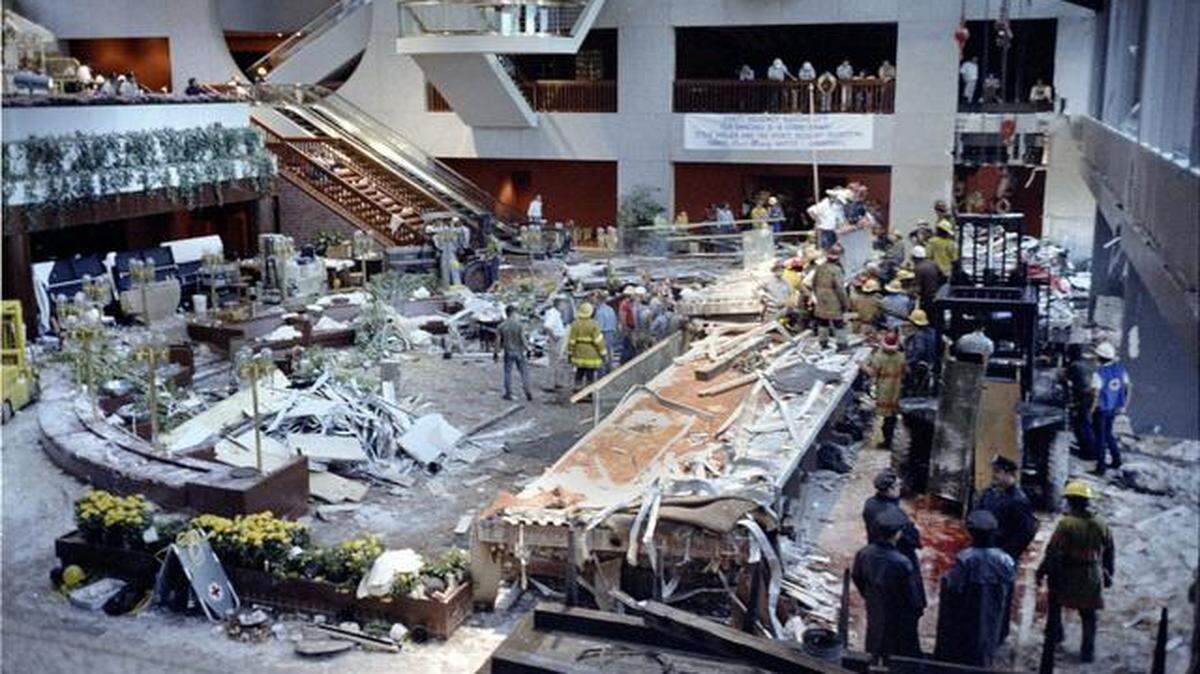
A look back at the Hyatt skywalk collapse that killed 114 people on July 17, 1981.
Expand All
This story was originally published July 21, 1981, in The Kansas City Star.
A critical change in the original design of the Hyatt Regency hotel’s sky walks doubled the stress on that part of the walks that later pulled apart during the collapse, The Star has found.
City records — in combination with visual examination by two experts and photographic evidence — reveal that, at some point, a change was made that doubled the stress on three steel “box beams” supporting the fourth-floor sky walk.
It was those beams that tore downward and away from their ceiling-anchored moorings, and both that walkway and a second-story walkway hanging below plummeted to the hotel lobby.
However, one of the experts — a structural engineer hired by The Star — cautioned that it is not yet possible to determine whether that tearing failure was the primary cause of the collapse, or merely one in a chain of structural failures. But it is clearly significant, he said.
The original design plans were revealed today when city officials made all Hyatt construction records available for inspection, including the specifications for the project and the construction plans.
Those records and the altered design, as constructed, were studied by Wayne Lischka, a structural engineer retained by the newspaper in the wake of Friday’s tragedy. The Star consulted another engineer who had viewed the wreckage after the accident and later was shown close-up photos of the damaged sky bridges.
The second engineer asked that his name not be used for fear that he would be ostracized by the local architectural community — that it would affect his business.
Once the design change was made, Lischka explained, the box beams beneath the top walkway were required not only to support its weight but also that of the second-floor sky bridge, 30 feet below. Each sky bridge has been calculated to weight about 65,000 pounds — or almost the weight of a loaded semitruck.
After examining the original design blueprints on file at city hall, and close-up photographs of the collapsed sky walk debris, Lischka determined that the box beams under the top sky bridge tore away from nuts that were on the lower ends of steel suspension rods that still remain anchored in the ceiling. …
The original hotel architects’ plans — approved by city officials in the fall of 1978 — called for six suspension rods, anchored in the ceiling, three to each side, to hold both sky walks aloft.
The base construction of the walkways looks something like a ladder with three rungs — with long steel I-beams making the sides of the ladder and shorter steel beams making the rungs. The shorter “rung” beams — which ran the width of the walkways — were attached to long steel rods which were in turn affixed to the ceiling of the lobby.
It was at the point where these long rods attached to the “rung” beams that the tearing took place. Under the original plans, the rods would have gone from the ceiling through the fourth-floor walkway and continued to the side beams at the bottom of the second-floor walkway.
That was changed sometime during construction so that no rod connected the top walkway to the ceiling, then another rod connected that walkway to the lower one. …
This story was originally published July 15, 2021 at 2:46 PM.