Arrested for trying to go bowling: At 98, Kansas City man lived and made Black history
Editor’s note: During the month of February, in honor of Black History Month and the vibrant Black community in Kansas City, The Star will feature profiles of Black Kansas Citians by telling their stories and highlighting their businesses, causes, and passions.
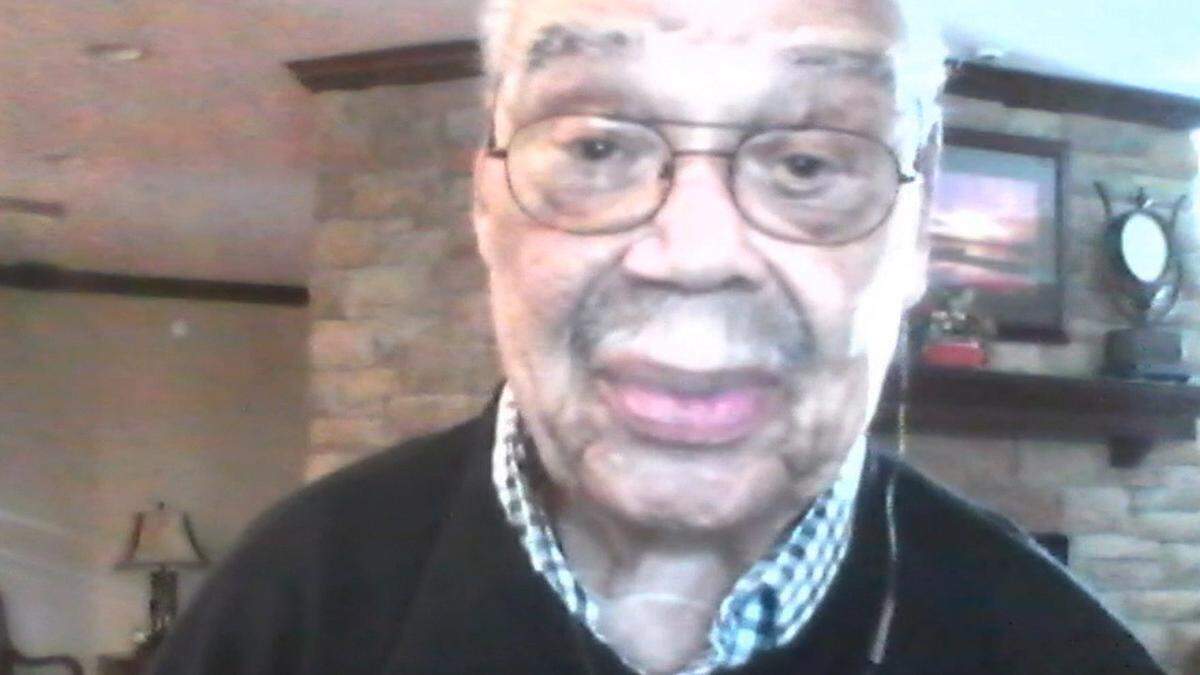
Earlier this month, self-described “race man” Howard Nelson Jr. of Kansas City turned 98 years old, an age that often dulls a few powers.
But not his mind.
And not his sharp memories of June 26, 1964, when Nelson — then a successful 41-year-old dentist, dedicated to the rising fight for civil rights — suddenly found himself being lifted and removed bodily from the Parkway Bowling club, now long gone from 49th Street and Prospect Avenue.
The club was refusing to allow Black people to bowl. Nelson, as interim leader of a local chapter of CORE, the Congress for Racial Equality, organized a peaceful protest. The Freedom Rides of 1961 had, in part, been organized by CORE.
That same June week in 1964, three CORE field workers — James Chaney of Mississippi and Andrew Goodman and Michael Schwerner from New York — would go missing and would be later found dead as part of what are now known as the “Mississippi burning” murders.
In Kansas City, Nelson and others were asking to bowl. A year prior, the City Council had passed a public accommodations ordinance outlawing racial discrimination in public places, but management of the alley, claiming it was a private “club,” refused to comply.
Police were called. The protesters sang as they were hauled away: “We Shall Overcome.”
The next morning, a photograph of Nelson’s lean, 6-foot-3 frame, slung like a hammock, in the arms of three white police officers, appeared on the front page of The Kansas City Times, the Star’s sister paper.
In his photo, Nelson exhibits a sly, satisfied smile. Earlier this month, he recalled precisely what he was thinking:
“I’ve done my job at last,” Nelson said. “The purpose was to get arrested.”
.jpg "HowardNelson (1).jpg")
The photo itself made history. A decade into the struggle for civil rights, Nelson’s image was among the first of any Black leaders of the movement to appear on the front page of either The Star or Times.
As The Star detailed in its recent series “The truth in Black and white,” the papers did not publish photos of Emmett Till upon his 1955 death or when his killers were acquitted, nor the Rev. Martin Luther King Jr. when he came to Kansas City in 1957, nor the Black Kansas Citians picketing outside segregated downtown department stores in 1958, nor the NAACP’s protests in 1960 over segregation at restaurants and movie theaters.
In August 1963, a Black preacher with the NAACP and a handful of CORE demonstrators did appear on The Times’ front page after a protest over segregation at Fairyland Park. They, like Nelson, were promptly arrested.
Gwen Grant, president and CEO of the Urban League of Greater Kansas City, remembers the impact of those protests and leaders like Nelson.
“I was a young girl growing up in the civil rights era,” she said. “People like him are role models for those who came after them — that they would get out there on the front line, fight for justice and equality, raise issues and stand up, and be willing to suffer the consequences or being arrested or dragged off.”
Racism in America
Nearly 60 years later, Nelson talks of being impressed with the organization and passion of both Black and white young people today, he said, who are raising awareness about systemic racism in the wake of the May 25 death of George Floyd beneath the knee of a white Minneapolis police officer.
“I’ve lived to be 98, and everything I did was to advance the Black race,” Nelson said from his apartment in a senior living community where, he said, he is now wading through the autobiographies of Barack Obama and Kamala Harris.
He finds hope in Harris’ recent ascendancy to the vice presidency, just as he did in 2008 with the election of President Barack Obama.
“Joy, total joy,” filled him when Obama was elected, Nelson said. “There was no limit to my feeling of joy at the step that had been made. I had never expected to see it.”
He feels similarly about Harris.
“Number one, she is a Howard University graduate, as am I,” said Nelson, who was 16 in 1939 when he first attended the historically Black university in Washington, D.C.
In 1943, he would graduate and leave as a member of the Reserve Officers’ Training Corps to enter World War II, where he would become an officer in the segregated 92nd Infantry, fighting as a “Buffalo Soldier” in Italy.
He continued about Harris: “I am tremendously impressed with her abilities and her preparation and what she has done. She is a very focused woman.”
Such focus, he said, is going to be necessary following the administration of Donald Trump, which he believes has been one of the most racially divisive in modern United States history. But he does credit Trump with one achievement: Laying bare America’s ugly underbelly.
“I’m thankful that he shook the flower and all the petals fell off,”Nelson said. “Because they were fake. He showed what America was, intrinsically: racist. Racism is the basis of everything about America.”
Indeed, Nelson believes, it is white people’s fear of race and loss of power — the U.S. Census projects that starting in 2045, white people will no longer be the majority demographic in the U.S. — that is fueling the division and anger evident among a broad swath of white America.
“I think that is a fundamental thought that has driven everything that Trump has done,” Nelson said. “If we’re not going to be the majority, let’s blow it all up along the way.”
More demonstrations
Racial animus has always existed.
“I knew about racism at least by the time I was 7 or 8,” he said. At age 16, he picketed a local drug store because they would not allow Black people to sit at the counter.
Born on Feb. 12, 1923, in Washington, D.C., Nelson was the youngest of four children. Their parents, Howard and Florence Nelson, came from a community outside Charlottesville, Virginia.
“Racial discrimination, segregation and lynching were popular,” he said of their Virginia town. “Not a decent place for Black people.”
In D.C., his father, standing 6-foot-5, of great humor, worked his way up from a dishwasher to a short-order cook to a waiter. His mother was a housewife until the Great Depression hit in 1929. His father was let go, losing his job to a white man. His mother found work at Central High School.
“She worked in the kitchen. She would bring home food for us to eat,” he recalled.
Most memorable was his parents’ mantra: education, education, education. “They dedicated their lives so that their children would be college bred.”
Ralph, the eldest by nine years, attended Howard until the need to work during the Depression forced him to leave. He later became an optometrist and went into real estate. His brother, Stanley, another Howard grad, became a dentist in New York. His nephew, who is also named Stanley Nelson, is the recipient of a MacArthur Fellowship “genius” grant, a Peabody Award and three Emmy Awards as a documentary filmmaker. Obama awarded him a National Medal in the Humanities.
Nelson’s niece, Jill Nelson, is a National Book Award winner, one of the first Black female reporters at The Washington Post, who last year, at age 67, was arrested in New York City for chalking “Trump=Plague” on an abandoned building.
Nelson’s sister, Florence, became a nurse. Nelson, himself, would marry and divorce and have two children. His son would also become a dentist, dying young, at age 47, from a drug addiction. His daughter, Karon Ramsey, is a Kansas City attorney.
After the war, Nelson entered Howard again for more college and then dental school. He eventually made his way to Kansas City, where his wife had family. He would head the all-Black Heart of America Dental Society. Later, in 1972, he would become the first Black member of the Board of Governors of the Missouri Dental Association. He would be named as the first Black member of the Missouri State Dental Board and, in 1991, become its first Black president.
He worked with his friend Samuel U. Rodgers, serving poor families, at the community health center that would later bear Rodgers’ name. Three years ago, in February, as part of Black History Month, Nelson was honored by a resolution at City Hall for “his contributions to the advancement of African Americans in Kansas City, Missouri.”
His life’s work has been dedicated to helping Black people move forward. In 1964, he did that by not budging.
Police carried him out. A photo was snapped. The idea was to get publicity.
“It was a magnificent affair,” Nelson said of the bowling alley sit-in. “I gave the command, sit, and we sat down and blocked the business. Chief (Clarence) Kelley arrived,” Nelson recalled. Kelley in 1973 would go on to become director of the Federal Bureau of Investigation. “They didn’t know what to do.”
The bowling alley proprietor was later fined $25 for breaking the new ordinance.
The following month, on July 2, CORE opened its national convention in Kansas City. Thousands of people were expected. Comedian and activist Dick Gregory was to be there.
On June 28, before the convention, Nelson would demonstrate again outside the U.S. Courthouse at 811 Grand Ave. to call attention to the disappearance of the CORE workers, Chaney, Goodman and Schwerner in Neshoba County, Mississippi. Chaney’s mother would attend the convention.
The day CORE’s convention opened, President Lyndon Johnson signed the Civil Rights Act of 1964 into law.
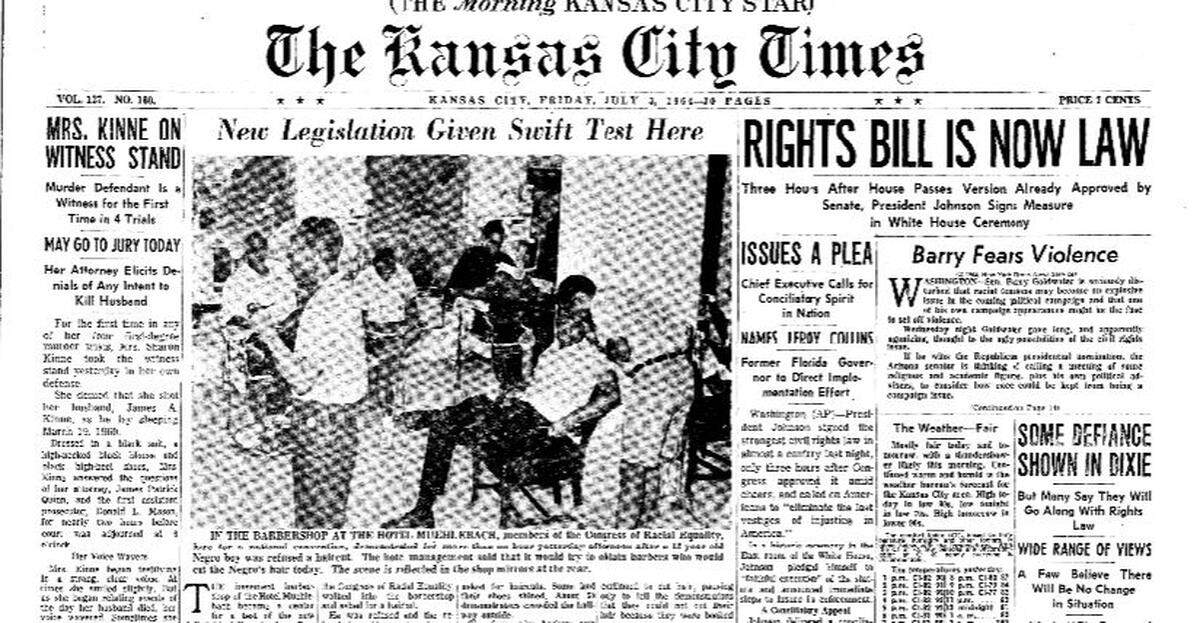
Moments later, a Black 13-year-old entered the barbershop at the Muehlebach Hotel to request a haircut and was refused, prompting an hour-long demonstration by CORE members at the convention, a moment captured in a front page photo in The Times the next morning.
“The hotel’s management said it would try to obtain barbers who would cut the Negro’s hair today,” the caption read.