Couple bought historic Kansas City mansion for $1.5M. Now they want to demolish it
Brian and Katherine Schell were anticipating a great life in the historic brick mansion they bought last year across from Kansas City’s Loose Park.
Now, only months after their September purchase, they are asking the city’s permission to demolish the 6,000-square-foot Georgian Revival home from 1918, that has been on the National Register of Historic Places since 1984. Purchase price: $1.5 million.
The home was once owned by John B. Wornall IV, a relative of the namesake of Wornall Road.
Outrage to the proposed teardown, which will soon go before the Kansas City Historic Preservation Commission, has been sweeping across social media in recent days.
“What a travesty!” wrote one resident on a neighborhood website, Nextdoor. “Some people have no respect for architectural treasures of the past.”
“Let’s face the music,” wrote another on the Facebook page for Historic Kansas City Foundation. “They wanted the lot. They knew from day 1 that their intention was to tear it down and build BIGGER. … build new. KCMO needs to send a message that in certain areas this is NOT ok!”
But before anyone breaks out the pitchforks and mob supplies, Brian Schell, the owner, wants to be clear. When he and his wife bought the home, their intention was not to tear it down, but to restore it to its historic glory.
$700,000 in repairs
Although they currently live in Chicago, where Brian Schell works as an executive in the financial industry, his wife was born and raised in Kansas City. They both lived in Kansas City for decades, in the same general area where they bought. They’d owned old KC homes before.
“We love this neighborhood,” Schell, 54, said by phone. “We love this house. We love this park. All four of our children were raised in this area. The historic nature of the home: That’s why we bought this house.”
Their plan was to use the home on return trips to KC and, eventually, to make it their permanent home by the time their daughter, currently in grade school, goes to high school, likely at nearby St. Teresa’s Academy.
“This was, potentially, our forever house,” said Schell, who said that his plan is to live and retire in Kansas City.
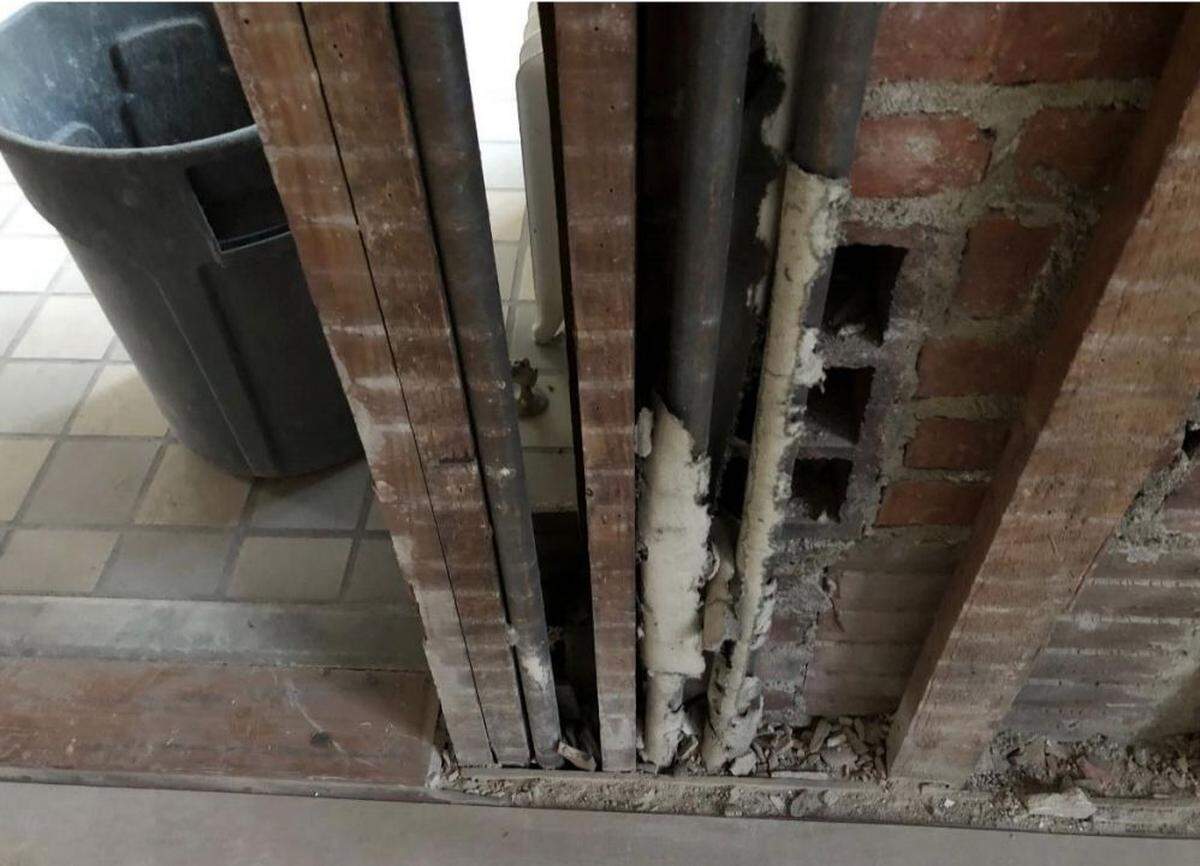
But then, as contractors began to assess the house for remodeling, they opened up the walls to find serious problems that were not apparent on the original inspection: Tons of friable asbestos. Lead paint everywhere. High levels of lead in the soil surrounding the home and inside its water pipes. Exterior box gutters leaking so badly and for so many years that contractors found much of the “envelope” or frame of the house was compromised. They also found black mold, Schell said.
“Right now, with the asbestos, we can’t go in the house,” Schell said. “It is sealed off.”
The initial contractors’ assessments cost nearly $100,000, he said. Before moving a single soffit in reconstruction, contractors handed the family sobering news: It would be less expensive to tear down the home and rebuild than to repair and remediate all that is wrong.
The Schells’ application for demolition now before the Historic Preservation Commission is 70 pages thick, with dozens of photos of asbestos-covered pipes and rotted wood.
Estimated cost of repairs: $700,000.
That “does NOT include any remodeling or enhancements,” the Schells’ application for demolition reads. In other words, the Schells would likely be looking at another $1 million minimum to remodel and make the home safe.
So they are asking the Historic Preservation Commission for permission to raze the structure.
“This is our last resort. This is not what we came in to do,” Schell said.
Despite residents’ concerns, he added, “We are not interested in a modern-looking home.”
Their plan is not to construct a Cubist home, or one made of shipping containers.
“We would look to rebuild a Georgian-type home or French provincial,” Schell said. The idea would be to keep the style of the neighborhood, build a new home that looks historic.
Commission’s decision
Bradley Wolf, an officer with the city planning department, said the commission’s first duty is to see if the home still fits the definition of a structure that is historic and of historic value. If the home, for example, had burned down and no longer bore the elements that make it worth preserving, then the commission would likely grant what is called a “certificate of appropriateness,” allowing for demolition.
Wolf said that his review of the Schells’ application shows that the structure is still of historic value. As such, it is unlikely that the Schells would be granted permission to demolish the home, which is on the Historic Register as part of Kansas City’s Simpson-Yeomans/Country Side Historic District.
The request was set to go before the commission on Friday, but the Schells could not attend and asked on Wednesday to postpone to the next meeting at the end of March.
The Country Side Homes Association on Monday sent out a notice of the Schells’ demolition proposal to the group’s 440 members.
“We wanted our homeowners to know we are aware of the situation,” said board president Jason Pryor. “We are going to let the process play out as it should, trusting the right thing will be done.”
Schell said that he expects his initial application to be denied. Wolf, with the city, said the Schells’ next step would be to ask for demolition based on “economic hardship,” meaning the cost of repairing and restoring the home to historic condition would go far beyond its market value.
That application would be taken up no sooner than the commission’s April meeting. If the commission still turns down the application, Schell said he is not sure what they will do.
“I don’t know,” he said.
The commission’s rulings last for three years. If turned down, the couple’s options would be to pay to restore the home, let it sit for three years and reapply for permission to demolish. Or they could try to sell it to someone who might be willing or able to restore it.
This story was originally published February 26, 2020 at 3:40 PM.