Amid $500,000 homes, KC neighbors wage decades-long fight against woman’s ‘rat house’
READ MORE
Kansas City ‘rat houses’
For years, neighbors fought the owner of a rat-infested house near the Country Club Plaza.
Expand All
Good fences make good neighbors, or so a character in Robert Frost’s poem asserts. But he wasn’t living in a $500,000 home next to the “rat house” of Westwood Park.
It is owned by Carol Dille. She is 67, an engaging sprite of a woman (even her enemies concede her intelligence and charms) with a mass of frizzy gray hair who describes herself as an unfairly maligned “plain clothes hippie,” a naturalistic gardener and lover of all things flora and fauna.
“I wouldn’t kill spiders,” no less rats, Dille said recently in her soft voice.
But near Westwood Road, southwest of Kansas City’s tony Country Club Plaza — in an area where 1920s middle-class homes are, with greater frequency, being bought up and torn down to erect modernist residences priced at $600,000, $700,000 and even one planned for $1.2 million — neighbors describe her in far less flattering terms:
They call her “cagey,” “crafty” and, echoing a recent federal indictment, assert she is a possible scheming “fraud” and “straight-up outlaw.”
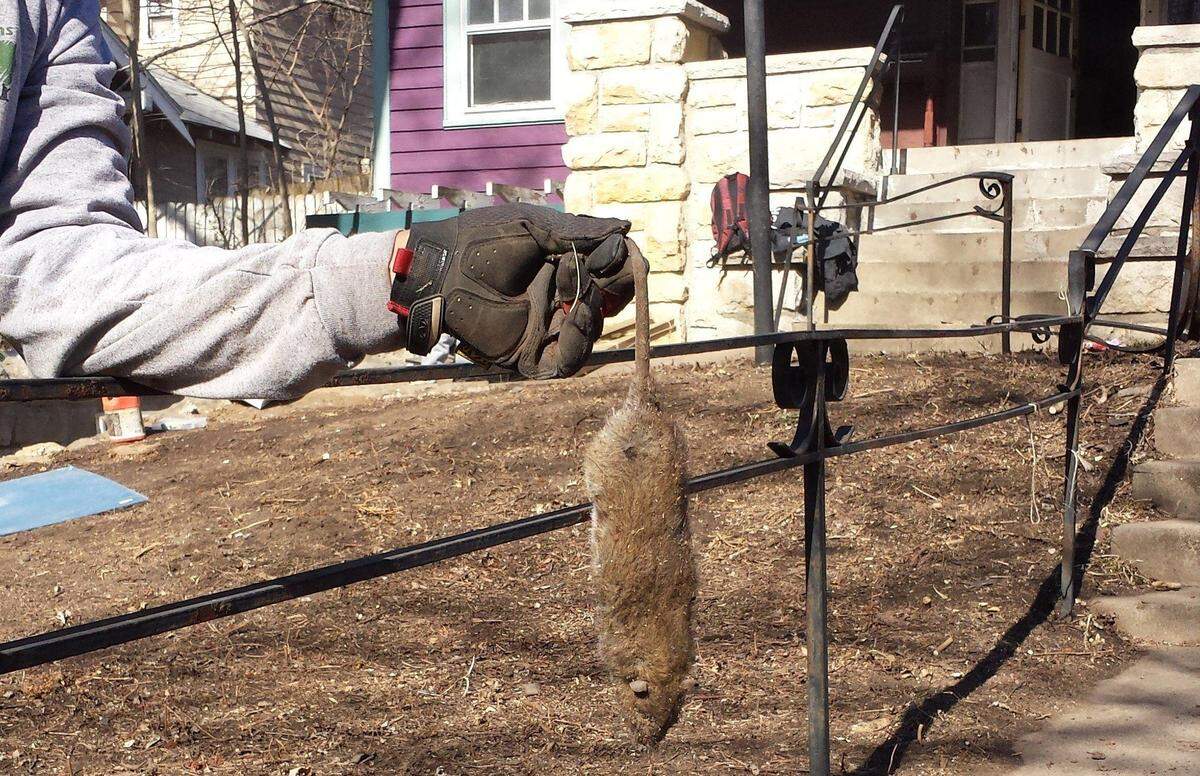
Dille doesn’t just tolerate rats, neighbors claim and have testified in previous court matters. They insist she nurtures rats, feeds them and has a documented history of creating a habitat for them not only in her jungle-like yard, but also inside her bungalow home at 4937 Westwood Road.
Cleaned several years ago by court order, the house revealed an interior horrorscape of branches, leaves, dead animals, live rats, feces and an overpowering smell of urine. Neighbors’ prime fear is that the rats not only have returned, but also are invading their yards.
“Have I seen rats in the last six months? Yes,” said Mike Posten, whose sculpted yard sits next to Dille’s home. “Have I seen rats in the last 90 days, the last 60 days? Yes.”
Dave Stewart, who lives behind Dille on Mercier Street, recently brushed leaves aside near his home to reveal rat holes. “Here’s one,” he said. “Here’s another one.” He uncovered four. Dille, neighbors said, has at least a dozen visible rat holes in her yard. They’ve seen sewer rats waddle along the fence line.
It’s not just in Westwood Park. Dille owns another house in Brookside at 206 E. 66th St. Neighbors there, too, said rats scurry from Dille’s thicket yard.
“My dog catches them on the daily,” said neighbor Katy Weber.
Stewart’s wife, Theresa Juarez, said of Dille: “She needs to be stopped.”
The neighbors’ fervent hope is that might happen in February, when evidence that Dille isn’t just the sweet, nature-loving woman she appears will finally come to light at trial in federal court. In March, a grand jury indicted her on seven criminal counts that include wire fraud, theft of government money including $76,000 of her estranged husband’s Social Security checks, identity theft and bankruptcy fraud related to her Westwood Park properties.
The neighbors’ rodent-related hope is that if Dille is found guilty and severely fined (she also faces up to 37 years in prison), she might finally have to sell the two weed-infested homes she owns side by side. She lives in the one they call the “rat house” at 4937 Westwood. The other at 4933 Westwood Road is unoccupied, except perhaps by animals that have been seen crawling down the chimney.
The belief is that a major federal court judgment might be the only way to end a rodent saga that has thwarted neighbors who have complained to the city about Dille for nearly 20 years.
“We don’t want to see her go to prison,” said resident Ann Nixon, a Realtor who, as vice president of the Westwood Park Homes Association, has long wrangled with Dille in municipal and state courts. “We just want her out of her houses.”
Complaints about rats in Dille’s yard go back to at least the year 2000. Police found multiple rats at the property in 2002, and city inspectors took photos of a large rat on her porch in 2003.
Dille, neighbors said, has consistently refused to acknowledge that rats are a problem, or at least one that she’s responsible for. This, despite the fact that since 2007, the city has ticketed her for rank weeds or come to her address on nuisance violations dozens of times, including several rat complaints.
Problem is, said officials with both the Kansas City Health Department and the Department of Neighborhoods and Housing Services, is that they’re stymied.
In some cases, city inspectors can enter a house if they have proof the house is a danger to the occupants. Otherwise, they can’t set foot on the property unless a resident allows it, which Dille does not. The city’s main recourse is to issue countless nuisance fines and place bait boxes in the neighbors’ yards to keep the rats from spreading.
“There’s no help from the city,” Nixon said. “They can’t get on her property.”
That is why the Westwood Homes Association finally ended up spending about $25,000 to sue Dille in state court. But not even that stopped her or the rats.
‘It’s a habitat’
Dille sees herself as a harassed victim.
After years of being singled out by her neighbors, she said she’s starting to see patterns and believes that she may be the focus of a “vendetta,” devised by her estranged husband and in league with her neighbors, to take control of her property, put her in prison and enrich themselves.
“I think they’re trying to take my house for their own personal gain,” Dille said.
Dille (pronounced “Dilly”) said she did not feel at liberty, prior to trial, to talk about the federal criminal indictments against her that allege theft of her former husband’s Social Security money, bankruptcy fraud and other charges.
But several times recently she met with The Star at the front edge of her property. She gently refused a request by a reporter and photographer to enter her home or backyard. She spoke calmly and graciously about the neighborhood conflict, her style of living, the rats and what she sees as the other unfounded rumors that have swirled around her.
One among them: That after her mother died in 2011, Dille kept her body somewhere on or in her Westwood Park property.
“This is the same thing they have been doing for years,” Dille said of her detractors, whom she believes amount to only a handful of neighbors nearby. “It’s the same mantra, ‘She’s crazy.’”
No, Dille claimed flat out, she isn’t nurturing, harboring or cultivating rats.
“I’m not,” she said.
But as an avowed environmentalist, she also is not alarmed if she sees them. Her choice would be to trap and release rather than ever poison an animal.
“I don’t kill insects,” Dille said. “I take them outside.”
Dille has owned the home at 4937 Westwood Road since 1978, purchasing the one next door in 2005.
A graduate of Westport High School, she studied history and biology at William Woods College before going to work for AT&T. She traveled the world for them, she said, and lived abroad for a time, doing client relations work for around 25 years until she left in about 2003.
Her complaining neighbors hardly doubt her intelligence, using words like “brilliant” and “genius,” but also, they insist, manipulative.
Long enamored of nature — “You know Greta?” Dille said recently of Greta Thunberg, the outraged teenage environmental activist from Sweden. “She’s my people!” — Dille’s travels to places like the Philippines, Indonesia, Hong Kong and China only intensified her passion for environmental sustainability.
Married for the first time soon after college, she would divorce and marry a second time in 1988 to Gerald Sanders, remaining together for 21 years before separating in 2009 and divorcing in late 2017. They wed in a park in Nairobi, Kenya.
“The monkeys were hanging out, and all the trees were full of flowers,” Dille said. “And then the next day we got on a plane and went to Rwanda and went gorilla trekking.”
Dille considers herself a naturalistic gardener, strongly inspired by the 2000 book “The Landscaping Revolution: Garden With Mother Nature, Not Against Her,” which promotes native plants in gardens and eschews pesticides and herbicides.
Neighbors and city inspectors may see them as overgrown “rank weeds,” Dille said.
“They think anything that’s native is a weed,” she said, explaining, “It’s a habitat. It’s habitat because in an urban environment we’ve taken away so much of that from things that were here long before us. I think we forget that we’re one of the newest species. … Nature was doing this long before us, and there was a balance.”
In her front yard, she spoke of the overall benefits to animals and the environment in general of having sedge grass instead of a lawn, and, instead of nursery-raised flowers, plants such as pokeberries, which are poisonous to people but loved by birds.
“I mean in this neighborhood, we have mink. We have muskrats. I mean we have deer. We have both species of fox — red and gray,” she said, listing other wildlife: hawks, raccoons, owls, opossums.
The battle she’s been fighting for nearly 20 years, she said, is against neighbors who simply don’t like uncultivated nature or the way she lives. Does she keep bags of leaves? Yes, she claims, because they make a nourishing mulch.
“I’m supporting what I believe in. They’re targeting something I believe in,” Dille said
As for rats: She concedes that they are not something she would ever kill.
“I have a tendency to think that all animals have an appropriate place in our environment,” she said, “and in our biological systems and on our planet. …
“I lived in Asia for 13 years. They love rats. Seriously, people born in the year of the rat consider themselves very lucky and blessed.”
Dille insisted that the last time she saw a rat around her home was five or six years ago when a red hawk flew overhead with a screeching rat in its talons.
She posited theories as to why neighbors see rats. Perhaps rodents migrated from nearby restaurants, or up along Brush Creek, a few hundred yards away across Ward Parkway.
If neighbors want to be rid of them, she said, they’re welcome to set traps or poisons on their own properties.
“They’re trying to make me do what they want, but I’m not trying to make them do what I want,” Dille said. “I’m not turning them in for having an exterminator.”
Another of her rat theories assumes something more diabolical. She asserts that one of her neighbors, who was then a top executive at Children’s Mercy Hospital, transported rats from a lab and let them loose in her yard to make her look bad.
“One of my next door neighbors actually released rats from a box into my yard because they couldn’t find any,” she said. “I took that box to court.”
True, neighbors clearly recall Dille bringing a box to Jackson County Circuit Court with the words “Lab Rats” written in felt marker.
“The judge was so stunned,” Nixon recalled. “I mean it was just wild. There was just silence.”
The judge didn’t give merit to Dille’s allegation. A Children’s Mercy spokeswoman told The Star that the hospital doesn’t keep lab rats on the premises. Nor would the former employee have had access. Lab rats, moreover, are almost always white.
In the end, Dille lost the civil case against her.
Rat nests and squirrel tails
Because the city and municipal courts seemed all but impotent to stop Dille, the Westwood Park Homes Association filed suit in late November 2013 to try to get the state court to remedy the problems.
The group sued under a Missouri law, statute 441.510, that says if a dwelling is considered a threat to health or public safety, the court could appoint an outside “receiver” to fix things.
Neighbors won. The victory, following four days of trial and testimony, left them ecstatic.
In her written judgment, signed on Halloween day 2014, Judge Sandra C. Midkiff declared that the grounds around Dille’s home at 4937 Westwood Road “is not a ‘naturalized yard.’”
“The house is not in livable condition” for multiple reasons, she wrote, including the “presence of dead tree logs, leaves and branches stored inside and outside the house conducive to rodent inhabitance … and rat infestation.”
She noted that Dille herself testified that the house had no gas or electric service for nearly five years, from 2009 to 2014, and no water for three.
Midkiff set forth a litany of decay, rot and “rat infestation … that existed and continued to exist up to and including the time of trial.”
The judge wrote:
▪ “There are holes in the soffit boards and eaves on the north side of the house, allowing animal access. … The interior of the defendant’s house is in filthy and unsanitary condition.”
▪ “Fecal matter was found at all levels of the house, from basement to attic, indicating the presence of rats and other rodents.”
▪ “An overwhelming smell of animal urine is present inside and outside the house.”
Noted, too: unsafe electrical wiring that was a fire hazard; nonfunctional boiler; no working hot water heater; unsafe chimney; faulty pipes, faucet and fixtures; leaks in the roof; water damage throughout the house.
“Defendant Carol Dille has deliberately allowed the property to continue to deteriorate and exist in a state of nuisance and long-term blight over a period of several years,” Midkiff wrote. “The property at issue poses a threat to the health and safety of others.”
Although Dille still owned the house, the court appointed a receiver — a Westwood Park neighbor with construction experience. His job would be to get rid of the nuisances. He would renovate the home and have the authority to rent it out.
Dille, meantime, would have up to two years — if she so chose — to pay for the cost of the fixes (the rent money, held in trust, would go to her). That way she could get the property back. Or else the property would be sold.
The receiver entered Dille’s house in February 2015. The stench and sight instantly overwhelmed him.
“I mean, I have been in some of the worst houses in the city,” said Matt Tomasic, who at the time he became receiver was also a Kansas City police officer. He’d retire in 2017 after 23 years. “She lived with the rats. … Just the photos of that bed are enough to make you sick.”
Tomasic sat down recently at his computer inside his Westwood Park home and clicked through hundreds of images. Photos of the one accessible bed in the house showed a box spring that had been gnawed through by rodents.
Workers flipped it over to reveal an entire rat habitat. Rat fecal droppings that numbered in the thousands poured onto the ground.
Traps and poison killed at least 15 rats, not counting those that ran off or died elsewhere, Tomasic said.
In another room, a virtual wall of cardboard boxes sat stacked from floor to ceiling, each filled with grass clippings and pine cones.
Rats skittered around the basement through heaps of Dille’s amassed belongings, from window frames to wood pallets to massive branches, wood stumps and scores of bags of leaves that had been dragged in from outside to fill the room.
“As we’re cleaning,” said Tomasic of the basement, “I’m like, ‘Oh, my God. There’s a deep freezer in the corner.’ I’m thinking, ‘I don’t want to open this.’”
The door swung open. Inside were the whole frozen bodies of numerous woodland animals in their feathers or fur: an entire red hawk, an entire opossum, its mouth agape, an owl, rabbits, squirrels. In another drawer, they found various squirrel limbs and tails.
Dille, who speaks highly of environmental organizations such as Powell Gardens, Monarch Watch and Bridging the Gap, said she found the animals at the side of roads. She said she brought them to Lakeside Nature Center for possible taxidermy.
“They stuff them,” Dille said. She claimed that because Lakeside’s freezers were full, the organization gave her a special permit to store them at home.
But Lakeside does not do taxidermy, said center director Kimberly Hess, who said she knows Dille and appreciates “her passion for animals,” but added: “No, we don’t authorize people to collect animals for us.”
It took Tomasic about six months and $145,000 to renovate the home, inside and out, with a new kitchen, bathrooms, air conditioning, electricity, heating, air conditioning, roof, exterior wood, sanded and stained hardwood floors. Dille’s eggplant-colored bungalow was painted tan. The yard was uprooted and sodded.
“It was darling,” Nixon said of the house. “We rented that for like $2,100 a month. I mean it was precious.”
Dille didn’t surrender easily to having her house taken.
Twice she filed for personal bankruptcy, a tactic that would essentially stop legal actions against her. Twice, the federal courts dismissed the cases, court records show.
Dille also filed an action against the homes association through the U.S. Department of Housing and Urban Development, claiming she was being discriminated against as a woman. That case also went nowhere.
For more than two years, from early 2015 through June 2017, neighbors said they were rat-free.
They reasoned if Dille was close to actual bankruptcy, there would be no way she could gather the $144,000 or more that court records show was needed to pay to reoccupy her house.
Until, at the last minute and to the surprise of all, she did exactly that.
To gather the money, Dille said she ended up selling yet another one of her homes, this one located in Redondo Beach, California, and owned by her and her then-estranged husband.
Dille was back in the house.
“That didn’t end up the way we prayed it would,” said Aryn Roth, the homes association’s current president.
Slowly, the rats came back.
Fraud, fines and divine love?
Stewart, Dille’s back-fence neighbor, points out two rat bait boxes along the foundation of his home.
“I mean, we’re always, you know, conscience of, ‘Oh, we’ve got to keep this door shut so a rat doesn’t run in while we’re out raking leaves,’” Stewart said. “It’s bothersome, to say the least.”
For many years, he and his wife were friendly with Dille. Until 2014, they had tolerated the way her backyard behind the fence had become a tangle of weeds and brush.
Then a rat scurried near Jaurez’s legs. Frustrated, driven to distraction, neighbors found themselves behaving in ways they never imagined to document the problem.
In her living room, Jaurez flipped open a thick binder — one of two files with five years’ worth of photos taken surreptitiously: Rats on their hind legs, clambering against the glass and beneath the blinds inside Dille’s house. Another of Dille dragging bags of leaves into her home, where neighbors suspect she is creating a rat habitat. Others show rat heads poking out of holes or multiple rats feasting at a bird feeder placed close to the ground.
What seemed past has come around again.
“This is the present,” Jaurez said. “I see her almost every morning go outside — and that’s her right there — and she has a tray. That tray is full of food to feed the rats.”
Neighbors’ hopes now rest on the trial scheduled for February based on what was alleged in March by the U.S. Attorney’s Office in the Western District of Missouri.
While residents in Westwood Park were preoccupied with rats, a federal grand jury was hearing evidence alleging that from 2013 through 2016 Dille had been “engaged in a scheme to defraud” the U.S. government by stealing and concealing her ex-husband’s Social Security checks for a total of $76,601.
Documents show that Dille had applied for Gerald Sanders’ Social Security retirement benefit in September 2013 and soon after began collecting about $1,500 a month.
Sanders, living away in Indonesia and then Guam, did not turn 65 until 2016.
When he went looking for his checks, he was informed that he had been receiving them for three years. Moreover, they were being deposited into an account held in the name of the Alliance of Divine Love Chapel 1202.
The chapel address: Dille’s overgrown property at 4933 Westwood Road.
In 2004, Dille — registered as an interfaith pastor, the Rev. Carol L. Dille — had once before incorporated the 4937 Westwood Road house as the Alliance of Divine Love Chapel 1202. But the Missouri Secretary of State’s Office dissolved the incorporation when Dille failed to file correct annual reports.
In February 2012, she incorporated again, but this time registering the unoccupied house at 4933.
Among the grand jury’s indictment are three counts of bankruptcy fraud. The alleged fraud would have occurred during the rat controversy. When Dille filed twice for bankruptcy in an attempt to prevent the receiver from taking her house, she apparently failed to include her husband’s Social Security money, deposited in the chapel bank account, as an asset.
Recent documents reveal significant assets, which could complicate any hopes neighbors have that Dille, let alone rats, will go away soon.
Dille has, for a third and fourth time, filed for bankruptcy. Once was in 2016, which was dismissed, and again in 2018, which is still before the court.
Her 2018 bankruptcy filing indicates her assets total $940,000.
She receives a $1,300-per-month pension and nearly $1,500 a month in her own Social Security. But the bulk of her assets are in five homes that include the two in Westwood Park, the one in Brookside, a half share of a home she owns with her brother at 4605 Liberty St. and another home, claimed to be valued at $260,000, in Bates City in Johnson County, Missouri, along Northwest 1621st Street.
If Dille is found guilty on all seven counts against her, she could face a maximum of 37 years in prison. Her fines, if accumulated, could total $850,000.
But attorneys insist that fines that high, let alone prison time, would be highly unusual for a defendant like Dille, who has no prior felony record.
She is currently being represented by a public defender who could plea bargain for a lesser punishment. Attorneys insist that a more likely outcome would require Dille to pay back the $76,000 in Social Security benefits together with a fine.
With property to sell, that might be something Dille could swing.
Neighbors, meantime, insist they are just tired. Tired of fighting. Tired of the court cases. Tired of dealing with rats that Dille insists are not her fault.
“You know, I really don’t care what happens to her personally,” Roth, the president of the homes association, said. “All I want is for her to move out to the country, far away from this neighborhood. I really do hope she goes to her country estate with her dead animals around her and lives happily ever after … and leaves us alone.”
Dille has other plans.
“I’ve had this house since 1978,” she said. “I intend to have it for the rest of my life, however long it is.”
Includes reporting by The Star’s Steve Vockrodt.
BEHIND THE STORY
MOREHow did the reporter learn of this story?
A resident of Westwood Park, reporter Eric Adler had long been hearing about what residents call the “rat house” a few blocks from his home. He does not participate in Westwood Homes Association affairs, so he had no first-hand knowledge of the house or the conflict with its owner, Carol Dille, other than general neighborhood talk and what appeared in a 2005 story, “Owner, ‘system’ faulted for ‘rat house’” written by former Star reporter Lynn Horsley. Adler thought, however, that whatever conflict existed had ended in 2015 after the house went into receivership. He was surprised recently to learn that the conflict was still boiling after nearly 20 years. (Click at top right for more.)
Why do the story now?
In searching court documents, Adler was further surprised to see that Dille was charged with seven criminal counts in federal court, including for bankruptcy related to matters involving her controversial home. The case goes to trial in early 2020. That development prompted him to look at the story afresh.
Did the reporter previously know the people he quoted?
Until he reported this piece, Adler had never met Dille. Nor did he know her closest neighbors. He was familiar with two sources quoted in this story, Westwood Park Homes Association Vice President Ann Nixon and the receiver, Matt Tomasic, both of whom are nearby neighbors.
Was he the only reporter on the story?
Reporter Steve Vockrodt helped Adler analyze stacks of documents from years of Dille’s litigation in municipal, state and federal courts.
This story was originally published December 1, 2019 at 5:00 AM.