‘I’ve had enough’: After beloved cyclist dies, Kansas City advocates call for action
The death of a beloved Kansas City cyclist has renewed calls for City Hall to take action on a long-stalled plan for bike lanes and other safety upgrades across the city.
Pablo Sanders Jr., 31, was hit by a car on Christmas Eve while riding through what cycling advocates claim is an especially dangerous intersection. He died Monday.
Now cycling advocates — and some city officials — are calling for better bicycle safety and passage of the Bike KC Master Plan, which has languished in a City Council committee since April. They argue the city needs improvements to save other lives.
But other city officials say the city has more important things to spend its money on.
The cycling advocacy group BikeWalkKC says at least 14 cyclists and pedestrians were killed in collisions last year in the city, though the group said that is likely not a comprehensive number.
Councilman Eric Bunch, who used to work at BikeWalkKC, said he’ll champion the long-awaited bike plan. He also announced in a series of emotional tweets highlighting other cyclists who have died that he will introduce “Vision Zero” legislation to endeavor to end traffic deaths.
“I’ve had enough,” Bunch told The Star. “There’s no excuse for this, and we’ve got to do better.”
He said it’s “scary that we value the movement of vehicles through neighborhoods more than human lives, it seems.”
“That’s how I feel and why I’m frustrated and angry.”
The Bike KC Master Plan has been shelved at City Hall since an April committee meeting, when council members lost the quorum they needed to vote on it. A disputed estimate that the plan could cost as much as $400 million flustered council and community members early on. During his campaign, Mayor Quinton Lucas argued that the plan’s price tag would divert much-needed resources away from other priorities like crime and education.
Discussion over the bike plan has remained relatively quiet for months. But after Sanders’ death, officials and advocates are speaking out.
“We have to complete our unfinished work and seek new ways to protect all, not just some, commuters,” Lucas said Tuesday on Twitter, adding that too many cyclists and pedestrians have died in Kansas City in recent years.
In an interview, Lucas’ policy director, A.J. Herrmann, said that in the wake of Sanders’ death, the mayor’s office was looking at safety measures, including identifying dangerous routes and intersections and slowing traffic in some areas, but not necessarily adopting all of the bike plan.
“I wouldn’t say as of now that implementing the full bike plan is one of our biggest priorities with other things we’re working on,” Herrmann said.
Councilwoman Teresa Loar, who represents parts of the Northland, said there are more important issues at hand.
“To be truthful with you, it’s not a priority,” she said. “We’ve got huge issues in front of us, and I’m very, very sorry and very troubled by the death of the gentleman on the bicycle and certainly don’t want to see that repeated, but unfortunately people die in this city every day and we just have to make sure that we’re keeping everything in perspective.”
Improving street safety
Loar is chairwoman of the council’s Transportation, Infrastructure and Operations Committee, where the master bike plan would likely be considered. She said Kansas City streets have never been safe for bicyclists. But they’re also dangerous for pedestrians, people in wheelchairs and motorists.
She said adding protections like bike lanes would be “astronomically expensive,” given the sprawl of city streets. Loar said education about sharing the roads would be more beneficial.
“The streets were made for cars, and we’re going to have to take a different mindset on how we are going to tolerate other forms of transportation on these roads that are originally made for cars,” she said. “Until that happens, I don’t think we’re going to see much change.”
But Bunch said the city is missing opportunities to improve safety.
While the master bike plan’s enormous price tag was hotly debated, cycling advocates noted many improvements could be made over time as the city repaved streets.
For example, Bunch, whose 4th District includes Midtown, said the city recommended a lane reduction along 39th Street, which he crosses to take his daughters to day care daily, but just a few months ago, the city repaved the street with the same four-lane configuration.
“You can’t get a bigger softball teed up than something like this, and for whatever reason, we just took a big swing and a miss,” he said. “I mean — didn’t even step up to the plate.”
Maggie Green, spokeswoman for the city’s Public Works Department, said in an email that reducing lanes — known as a “road diet” — involves considerable study and that the department didn’t have time to do that for 39th Street before the end of the repaving season.
A plan on a shelf
After the long, winding April discussion over the bike plan — and with pushback from some neighborhoods — the new City Council, elected in June, hasn’t touched the issue, much to the frustration of some bicycling advocates.
The plan calls for narrowing some roads to slow traffic and adding bike lanes to connect Kansas City’s patchwork of bike routes. Proponents say those changes would make the city safer for cyclists and encourage more people to bike.
Asked why the bike plan hadn’t moved, Bunch said no council member — including himself — has championed the issue. Bunch said he had been getting his bearings as a new councilman.
“I think that everyone looks to me as the bike guy, and so I think people were probably just waiting for me to bring it back,” Bunch said, “and I don’t know if it’s going to get the same kind of opposition that it had before on the old council, but we’ll see.”
Loar said she had no plans to bring up the bike plan, but said if Bunch championed it, she would let her committee hear it.
Bunch also announced earlier this week that he will introduce a “Vision Zero” resolution, a set of policies intended to end traffic deaths in Kansas City by 2030. He said the resolution will call on the city manager to put together a task force and use data to identify areas with the most traffic deaths and injuries and find ways to improve safety.
The Missouri Highway Patrol counted nearly 700 collisions involving bicycles in the Kansas City limits between the beginning of 2009 and Nov. 15, 2019. Those crashes resulted in 577 injuries and at least nine deaths.
Mapping those incidents makes clear that no part of the city is immune, though collisions appear to cluster on Kansas City’s East Side and around downtown, Midtown and the Country Club Plaza.
A dangerous intersection?
Kansas City Police said Sanders was crossing Southwest Trafficway, moving west on Valentine Road on his 10-speed bicycle shortly before midnight on Christmas Eve.
Police said the driver of a silver Buick on Southwest Trafficway tried to avoid him but struck the bicycle. KCPD noted that Sanders was wearing dark clothing and that his bike helmet was not properly secured.
Shortly afterward, BikeWalkKC officials said the police description was “verging on victim-blaming.”
Eric Rogers, executive director of the organization, said any pedestrian or cyclist fatality is a tragedy. But he said Sanders was such a well-known figure around town that his death has led to an outpouring of support and calls for action. Plus, many cyclists have previously identified the location of the collision as a dangerous intersection.
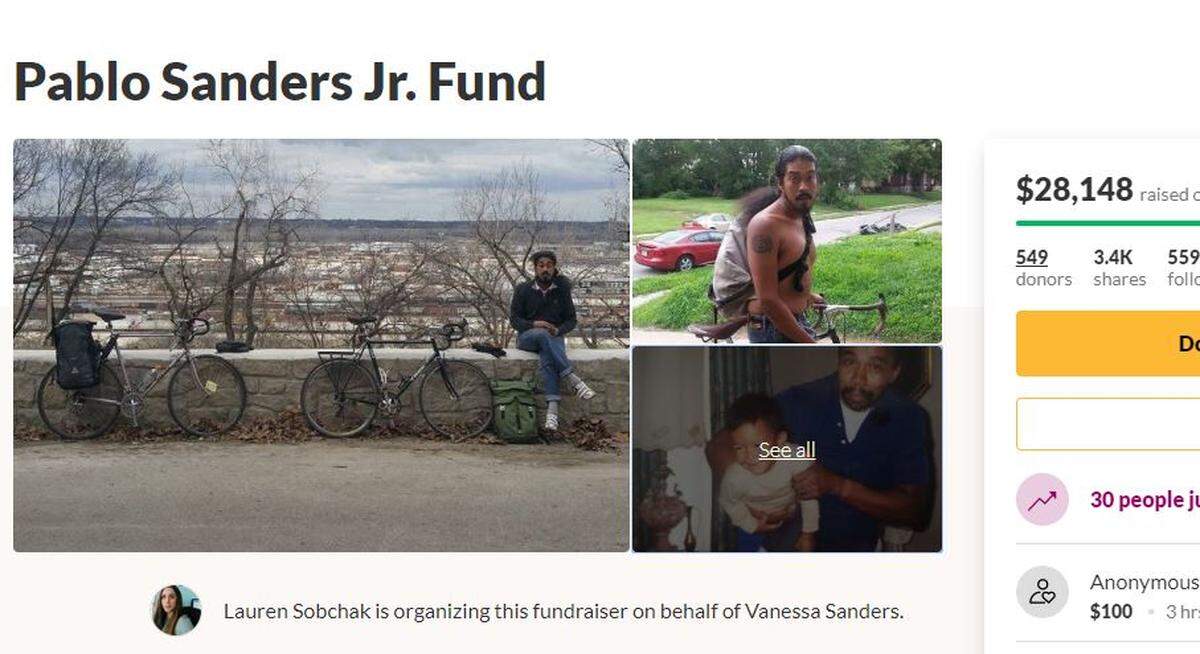
Sanders was a recognizable figure to many after having “worked in the service industry at more places than one could add to a resume,” according to a biography on a GoFundMe page that has raised more than $28,000 for his family.
“Over the last decade Pablo discovered cycling, married his bikes, and has been keeping the rubber side down every day,” the site says.
Rogers said cyclists and city staffers have long known of the danger that abounds on Southwest Trafficway. The light doesn’t always detect a bicycle sitting at the intersection, meaning cyclists sometimes must wait for a car to approach. When the light does turn green, it doesn’t always stay green long enough for a bike to cross all six lanes.
“We understand where the problems are. We understand what the solutions are,” Rogers said. “In a lot of cases, we have plans to make improvements. What we need now is the leadership at City Hall to actually start making changes.”
A Star reporter who visited the intersection found that at one point, the green light for traffic headed west on Valentine, as Sanders was, lasted only 10 seconds, giving just enough time for two cars to pass through the intersection.
When the light is green for vehicles on Southwest Trafficway, they move quickly and within steps of pedestrians. The sidewalks are right next to the road, without any green space separating them.
Public works staffers say they are examining short-term improvements they can bring to the intersection with existing funding. That might include ensuring signal detectors are picking up cyclists, reviewing signal timing and checking that street lighting is adequate.
But Rogers said that intersection isn’t an outlier. And Sanders’ death was “not unique.”
He wants to see the city pass the bicycle master plan, make cyclists and pedestrians safer across the city and treat traffic collisions as a public health problem. Rogers noted that people of color and those in poorer neighborhoods are disproportionately affected by collisions.
“I think it should have already been front and center after all the fatalities we had this year,” he said. “I also hope no one else has to die to make this more urgent.”
The Star’s Robert A. Cronkleton contributed to this story.