What southwest Missouri residents told CDC-aided researchers about vaccine hesitancy
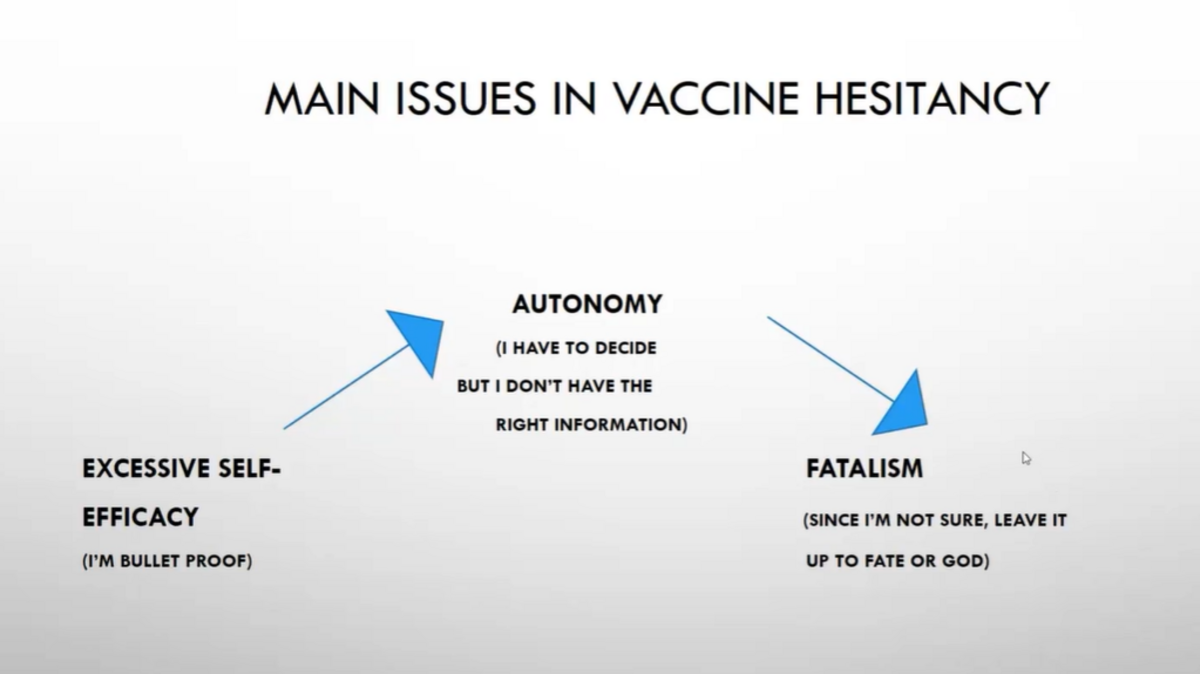
As COVID-19 strains hospitals in southwest Missouri, a sense of fatalism is among the drivers of vaccine hesitancy in the area, according to interviews conducted by public health students as part of the Centers for Disease Control and Prevention’s effort to raise vaccination rates.
A “bulletproof” feeling and a need for autonomy were also primary reasons offered when asked why they or their neighbors would not be getting vaccinated. Their comments offer insight into attitudes in a region where many counties have fully vaccinated fewer than half their residents.
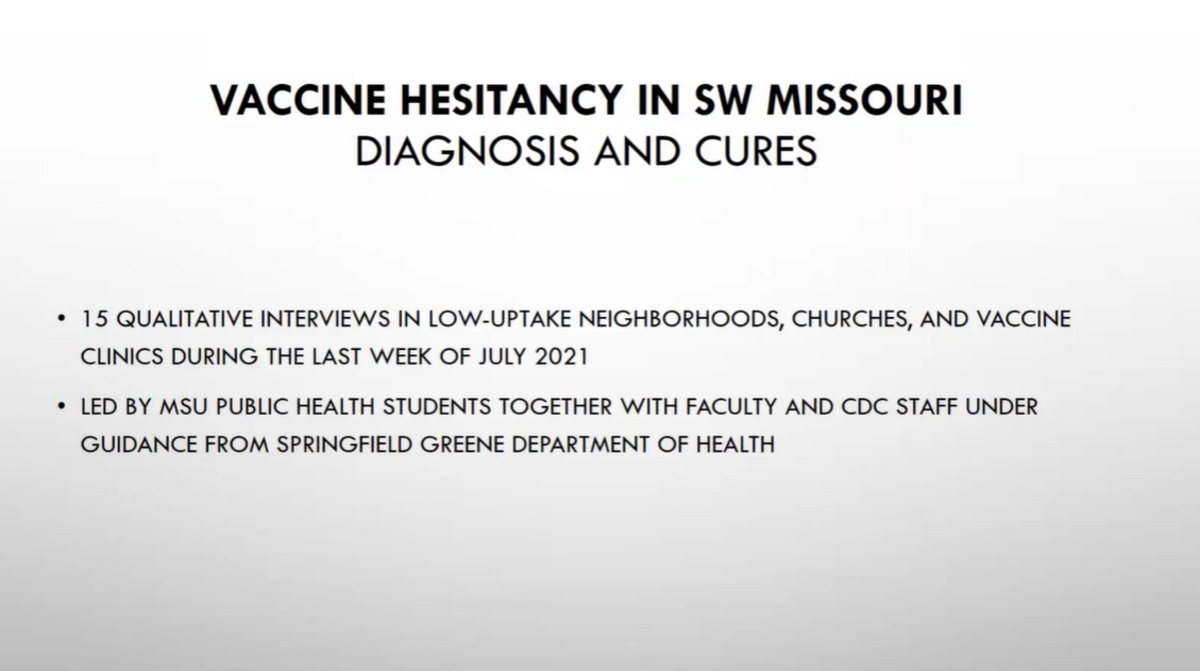
Missouri State University master’s of public health students, with assistance from the CDC and university faculty, performed more than a dozen interviews during the last week of July under the guidance of the Springfield-Greene County Health Department, according to a virtual briefing on the findings held for public health leaders on Aug. 5 by the Missouri Department of Health and Senior Services.
The Star reviewed a video of the briefing, which describes concerns raised in the interviews and how local health officials should address them. An unidentified presenter repeatedly emphasizes the importance of adapting approaches to individual communities, such as using video testimonials by local figures.
The interviews came after the arrival of the CDC “surge response team” that deployed to Missouri in July as cases rose across the state. A CDC employee who was part of the response assisted the students, the health department and a university professor said. Officials have previously confirmed the CDC sent a remote risk communication specialist to assist the state’s Bureau of Immunizations in combating vaccine hesitancy and low vaccination rates.
Dalen Duitsman, an MSU public health professor and director of the Ozarks Public Health Institute, said the interviews were conducted over five days across targeted areas selected by the Springfield-Greene County Health Department. They were designed to take a conversational approach, rather than follow a strict question-and-answer format, said Emily Fessler, a graduate assistant at the institute who helped lead the effort.
Aaron Schekorra, a spokesman for the health department, said in an email that the CDC is now working with communications students at the university to develop messaging to use locally.
“The CDC’s primary role was to partner with and oversee MSU students to equip them to go out into the community to initiate conversation with individuals,” Schekorra said. “CDC worked with MSU students to develop an outline for questions and topics that would help to start conversations and make conclusions about an individual’s thoughts and feelings about the COVD-19 vaccine.”
The briefing for public health officials said 15 interviews were conducted, but Fessler placed the number at 19. She said the interviews were focused on northwest Springfield.
The CDC didn’t respond to questions on Wednesday. DHSS indicated the CDC’s surge response team left the state on Aug. 6, but five employees continue to work remotely on Missouri-related projects.
In Missouri, 49.6% of residents age 12 and older — those eligible for shots — are fully vaccinated, according to the CDC. The United States as a whole has fully vaccinated 58.8% of that same group.
A Saint Louis University-YouGov poll of 950 Missourians in July found that 24% of likely Missouri voters reported that they won’t get vaccinated. The poll, with a margin of error of plus or minus 4.1%, was released earlier this week.
Vaccine resistance is intense among some residents. In Springfield Monday, the city council passed a resolution encouraging vaccination, but not before council members were met with jeers and laughter by a crowd that showed up to speak against the symbolic measure, the Springfield News-Leader reported. According to the newspaper, about 15 people at the meeting wore yellow stars in an allusion to the Holocaust.
A slide shown during the briefing lists “excessive self-efficacy,” “autonomy” and “fatalism” as main issues underlying vaccine hesitancy in southwest Missouri. The CDC-MSU interviews were conducted at specific locations in neighborhoods with low vaccine uptake, such as churches and vaccine clinics, according to a slide.
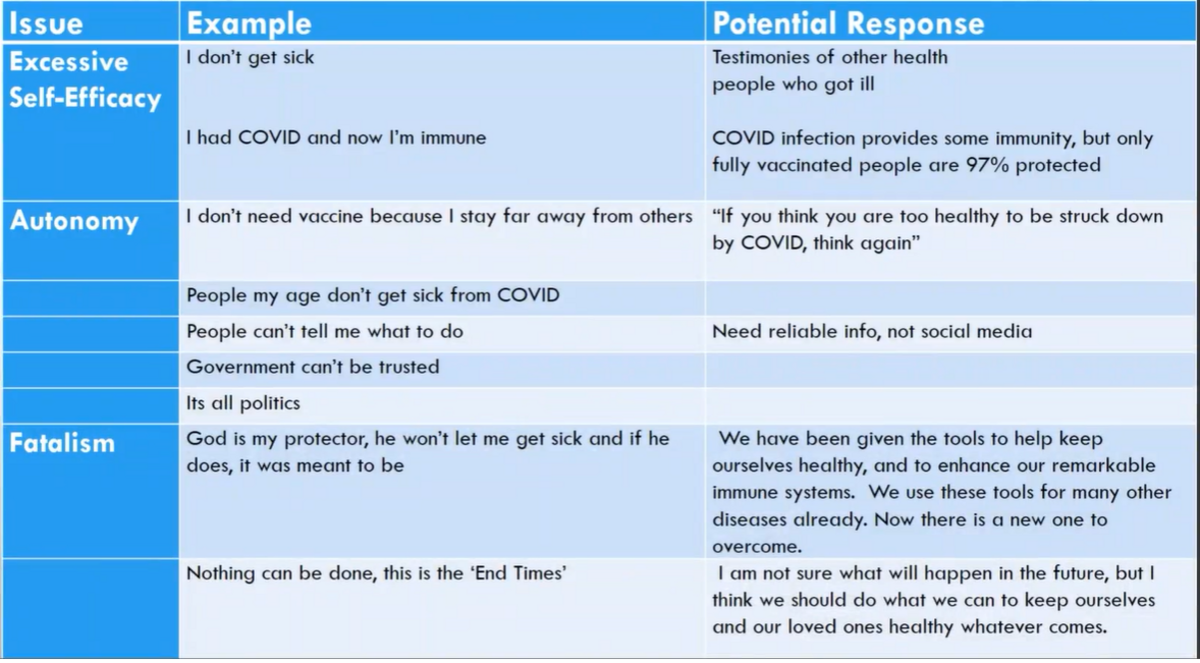
One example of fatalism: “God is my protector, he won’t let me get sick and if he does, it was meant to be.” Another: nothing can be done and this is the “End Times.” It’s not clear whether the examples represent composite answers or exact quotes from interviews; Duitsman said the interviews were transcribed but a formal report hasn’t been produced and the information is still being compiled.
An instance of excessive self-efficacy offered was that “I had COVID and now I’m immune.” Illustrations of autonomy included a belief that “people my age” don’t get the virus and a mistrust of government or sense that “it’s all politics.”
“We see that, and it is playing out in politics, which is sad to say because it’s not political, it’s health-related,” the presenter says.
After each example, the presenter and on-screen slides provided a counter-message. For fatalism, a suggested response was that people have been given tools to stay healthy and to enhance our immune systems and that these tools are used for many diseases already.
“You can say, ‘I’m not sure what will happen in the future, but I think we should do what we can to keep ourselves and our loved ones healthy with whatever comes,’” the presenter suggested as a response to “End Times” reasoning.
A potential response to autonomy concerns was that if you think you’re too healthy to be struck down by the virus, “think again.”
The briefing also delivered practical advice for holding vaccination clinics to maximize interest, such as advertising at least a week in advance and emphasizing that the vaccines are free. Local health leaders were also encouraged to consider holding their own clinics because of concerns among the unvaccinated that Walmart or a pharmacy would charge for a shot.
“People no longer come to where we are, they really want us to move to where the people are,” the presenter said.
‘Localized approach’
Fessler said the interviewing was split between vaccine clinics and other locations in neighborhoods with low vaccination rates. Interview subjects could speak to either their personal views or the views of those in their area.
“We kind of left it open to them, whether they wanted to talk about themselves and their personal viewpoints or maybe some of their peers or the neighborhood,” Fessler said.
For individuals at vaccine clinics, interviewers asked what brought them out, why now and what would make vaccination easier. “Just trying to get a feel for why did they come today and what barriers or ways could we make vaccine clinics more accessible to people,” Fessler said.
At other sites, people were asked what they think has kept neighbors from getting vaccinated, and what kind of information they’ve received — and from where — that has caused the most concern. They weren’t explicitly asked about their vaccination status, but people could volunteer the information.
Brett Bricker, a specialist in communications studies at the University of Kansas who has researched vaccine hesitancy, praised several aspects of the briefing after watching it at The Star’s request.
“In general, this is exactly what needs to be happening: a really localized approach that tries to figure out what the actual concerns of the community are and start to strategize with those concerns in mind,” Bricker said.
Bricker said the list of concerns that was provided is important to communicate to health workers, adding that he has also heard similar objections, such as the idea people can be too young to get COVID or won’t get very sick if they do.
But Bricker noted that at one point in the briefing, a moderator tried to prompt a broader discussion among public health officials about efforts to work with Black populations. Several seconds of silence follow before the moderator talked about outreach efforts in Clay County.
“There were crickets after that, and none of the messaging appeals to what I view as the largest hindrance to the Black community, which is distrust of the medical institution,” Bricker said.
About 27% of Black Missouri residents are fully vaccinated, compared to 35% of white residents and 48.5% of Asian residents, according to DHSS. Roughly 41% of Hispanic or Latino residents are fully vaccinated.
Bricker also questioned the interview methodology, noting that — at least in the briefing — the racial makeup of those interviewed wasn’t disclosed and that at least some of those interviewed were at vaccine clinics. Bricker said he imagines the concerns found at a vaccination site are “far different” from those found elsewhere because people at the site are likely there getting the vaccine.
Duitsman said the interviews were intended to be representative of the areas targeted. He made clear the messages drawn from the interviews aren’t designed to create a blueprint for the entire state.
“Are they representative of Springfield as a whole or Missouri as a whole? I would say that you couldn’t make that generalization,” Duitsman said. “We’re really trying to focus on the area that we were given.”
Raising interest
Missouri has tried desperately to drum up interest in vaccination recently in response to a wave of cases and hospitalizations fueled by the delta variant. Gov. Mike Parson announced a series of drawings for $10,000 cash or scholarship prizes. The first one will be held Friday.
Missouri has also asked the CDC to approve $100 prizes for those getting a shot — an idea that’s run into resistance from some local health departments.
For whatever reason, more residents have gotten vaccinated in the past few weeks. The daily average of first doses administered has climbed from a low of 3,520 in mid-June to 9,693 at the end of July, according to CDC data.
But the bump may already be waning. The average dropped last week, though the CDC cautions the data may change because of reporting delays.
This story was originally published August 12, 2021 at 5:00 AM.