Major Kansas City employers not mandating COVID-19 vaccines, but pressure growing to act

Face masks are again mandatory at Cerner. Black & Veatch employees must put theirs back on. And Ford is requiring face coverings for workers and visitors to its Missouri plants.
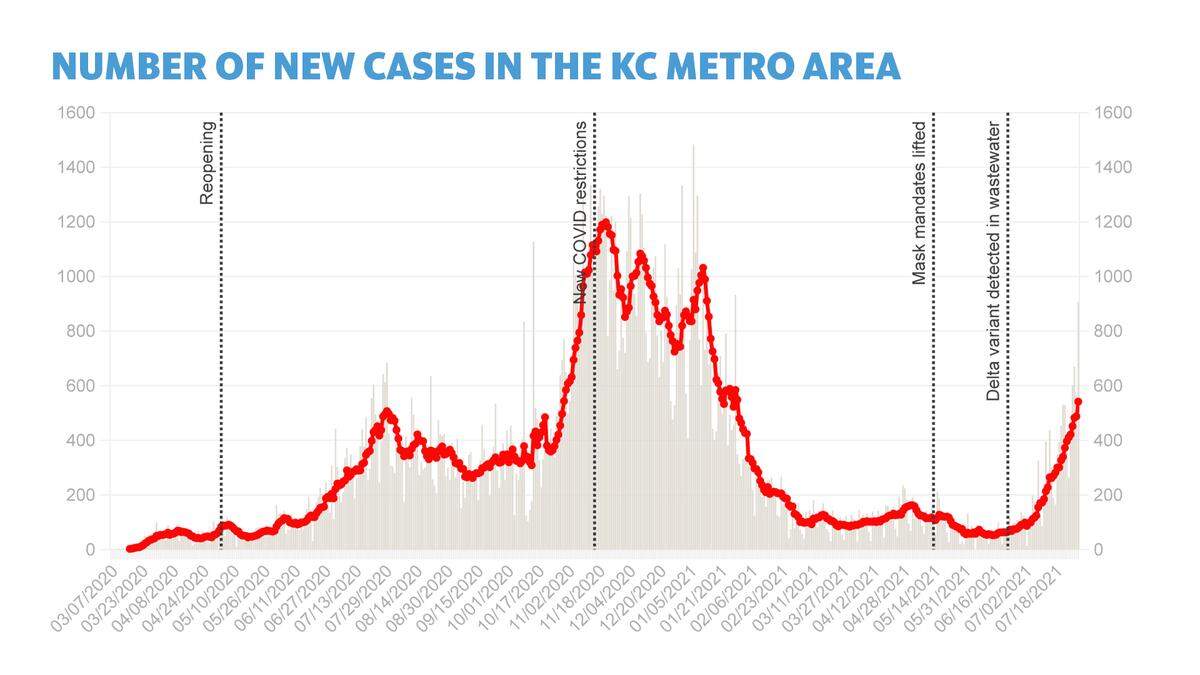
As the delta variant drives up cases and hospitalizations in Kansas and Missouri, businesses in the Kansas City metro are reimposing safety precautions before the new citywide mask mandate takes effect Monday. The measures mark a retrenchment after a hopeful period in which the pandemic seemed to be ebbing. Instead, area hospitals are under pressure as the highly-contagious virus freely spreads.
But many of the metro’s most prominent employers have no plans as yet to compel their tens of thousands of workers to get the vaccine, even as calls grow for mandatory shots. Employer-required vaccinations represent one of the last and most powerful tools available to drive up vaccination rates in a region where too few people have gotten shots to control the latest wave of infections.
“Individuals make decisions about their health for different reasons,” Eva Karp, Cerner Corp.’s senior vice president and chief clinical and patient safety officer, said of mandating shots for workers. “It is not an area we want to direct or require.”
Cerner, Kansas City’s largest private employer, will mandate vaccinations for workers whose roles require it. Those in the company’s consulting division, for example, spend much of their time posted at health care facilities around the country, working to sell or support Cerner software. Karp said the company would follow any mandates made by individual hospitals and clinics.
They expect to do the same for the thousands of Cerner employees who work under contract with the U.S. Veterans Administration and the Department of Defense, if the federal government requires it.
“We will make vaccines required if their role requires it,” she said. “If the role does not require it, we will not require it.”
Cerner’s position — encouraging but not insisting on vaccinations except in certain situations — matches the tone set by other major employers. Burns & McDonnell, the Federal Reserve Bank of Kansas City, and Commerce Bank all told The Star they aren’t currently making shots mandatory, even as they take other steps, such as hosting vaccine clinics, to get shots into worker arms.
“We are not requiring or mandating the COVID-19 vaccination for our employees,” Renita Mollman, chief administrative officer of Burns & McDonnell, said in a statement. “However, we are committed to providing educational resources about the vaccine to our employees and have offered vaccination clinics at our Kansas City offices to help employees obtain vaccines.”
While shots remain largely optional, public health experts, employment lawyers and worker advocates all expect more businesses and organizations to begin requiring vaccination. They anticipate the shift in the weeks and months ahead as executives desperately try to stop delta from disrupting in-person work and back-to-the-office plans this fall.
Pressure is building on employers to get tougher on vaccine holdouts. President Joe Biden announced Thursday that he will require on-site federal contractors to be vaccinated or comply with stringent masking and testing rules. The White House is looking for ways to expand vaccination requirements to all federal contractors.
Hospitals and other health care facilities are also imposing vaccine rules, giving non-health care sectors real-world examples to watch. Truman Medical Centers announced this week it will require workers to get shots. Mercy, with 40 hospitals in Missouri, Kansas and neighboring states, has also implemented a mandate.
“I think a lot of employers are giving it renewed thought in light of the uptick in the COVID infections and the delta variant, and the fear we go into not just more mask mandates but potentially back into some type of lockdown situation by fall if the trajectory doesn’t change,” said Michael Jones, a labor and employment attorney at Eckert Seamans in Philadelphia.

Feds mandating contractors
Just over 53% of people 12 and older — the age group currently eligible for shots — are fully vaccinated in the Kansas City region, according to data compiled by the Mid-America Regional Council.
After climbing sharply this spring, the vaccination rate has largely leveled off. From June 1 to July 28, the percentage of the eligible population vaccinated grew by just over 8%.
“People aren’t voluntarily stepping up to the extent that we need,” said Lynelle Phillips, vice president of the Missouri Public Health Association and president of the board of the Missouri Immunization Coalition.
Experts initially predicted roughly 70% of the population would need to get vaccinated to achieve herd immunity, when the virus stops circulating because it has trouble finding additional hosts to infect. But the delta variant, which spreads much more easily than previous versions of COVID-19, is upending those expectations. Some scientists now believe a rate of 90% or more may be needed.
Additionally, evidence suggests vaccinated individuals with rare breakthrough infections may still be able to spread the virus, even if they don’t have symptoms. The Centers for Disease Control and Prevention updated its guidance this week to recommend vaccinated people again wear masks indoors in areas with lots of virus circulating. It pointed to data indicating vaccinated people infected with delta risk spreading it to others.
The new revelations about transmission, combined with severe delta-driven outbreaks, are prompting public health experts and political leaders to mount a new vaccination push that includes calls to action for businesses.
“Absolutely,” said Rex Archer, the retiring director of the Kansas City Health Department, when asked whether employers should be considering either mandating or incentivizing vaccinations for workers.
“There are a number that are doing that. You know the private universities around Kansas City, William Jewell, Rockhurst, Kansas City University, they’re all doing that for their students,” said Archer, who just finished his last week on the job. “There have already been a number of businesses that have already said we’re not going to let you do out-of-state travel if you’re not vaccinated.”
William Jewell and Rockhurst have made shots obligatory for students and staff, and Kansas City University is requiring vaccinations for students. But larger universities in the region, such as the University of Kansas and the University of Missouri, haven’t taken that step.
Biden this week embraced employer mandates. In addition to directing that vaccinations be required for on-site federal contractors and taking steps to apply the rules to all federal contractors, he is offering small-to-medium sized businesses reimbursements for giving paid leave to allow employees to get their children and family members vaccinated.
“Every day, more businesses are implementing their own vaccine mandates. And the Justice Department has made it clear that it is legal to require COVID-19 vaccines,” Biden said at the White House on Thursday.
Political leaders closer to Kansas City have taken a less assertive stance. Kansas Gov. Laura Kelly has repeatedly stressed the importance of vaccinations, though she stopped short this week of saying businesses should require workers to get shots.
“I think private companies are very good at doing what’s best for the business and if they think that’s what’s best for their business then they would have my support,” Kelly said in response to a question at a news conference.
Missouri Gov. Mike Parson has consistently spoken against any kind of government vaccination mandate. His encouragement to residents to get vaccinated has slowly become more urgent in the past few days as cases rise across the state.
But as recently as Thursday, Parson criticized Biden’s vaccine mandate for federal contractors. Speaking on Fox News, he portrayed the CDC’s decision to change its guidance as unhelpful.
“Then the president several hours later saying, ‘I’m going to mandate all federal employees’ and more important, all contractors to have vaccine, whatever all contractors is — that’s problematic,” Parson said. “We’re actually taking a step backwards trying to fight a virus that we are trying to win a battle with.”
The governor’s comments came after Kansas City Mayor Quinton Lucas said he may mandate shots for the municipal workforce. “In terms of compulsion, we are giving more consideration to requiring all of our 5,000 city employees to get vaccinated,” Lucas said on CBS Face the Nation.
Mandates legally solid
If more businesses and organizations decide to impose vaccine mandates, they will be on solid legal footing.
Employers must make reasonable accommodations for individuals unable to take the vaccine because of a medical condition or religious beliefs. Still, the power to compel workers to get vaccinated is fairly broad. Hospitals and colleges have long required vaccinations for numerous conditions
“Employers have a general right to require their employees to take a COVID-19 vaccination as a condition of employment,” said Joseph Mastrosimone, a professor of employment and labor law at Washburn University School of Law.
Whether employers can mandate shots without damaging their relationship with workers is another matter. Even in health care, the sector that has been most aggressive with mandates, such requirements can lead to blowback.
Heidi Lucas, director of the Missouri Nurses Association, said membership views on mandates are all over the place. The American Nurses Association, of which her group is an affiliate, signed on to a statement released Monday urging health care employers to require vaccination.
The statement, also signed by the American Medical Association and dozens of other health groups, expressed hope that with health care leading the way, all other employers will implement policies to encourage or compel vaccination.
The reality on the ground is complicated, however.
“I think overall the folks who haven’t been vaccinated, at least the majority of the folks who haven’t been vaccinated, are pretty dug in in the fact that they are not going to get vaccinated,” Lucas said. “So what does that mean when hospitals start requiring it when some of the larger facilities have?”
Lucas wondered how many nurses and other personnel would quit in facilities that mandate vaccination. A nursing shortage already exists and some facilities, especially in rural areas, may weigh their expected losses before making a decision.
“I personally think that if it is mandated, people will err on the side of keeping their jobs and going ahead and getting it, but there will be some who won’t,” she said.
Employers who require shots may also have to contend with political backlash. Lawmakers in numerous states have proposed, and in some cases enacted, limits on the power of businesses to require vaccinations for employees and customers, measures which are sometimes framed as bans on vaccine passports.
Kansas and Missouri lawmakers didn’t limit the power of businesses to mandate vaccination, though the Missouri House in April voted 102-48 in favor of prohibiting businesses from requiring employees and customers to verify their vaccination status. The bill died in the Senate.
The proposed restrictions place conservatives in the Republican-controlled legislatures in an awkward position, wedged between the rights of businesses and individual liberties.
“If it’s a private entity and they’re the ones paying the salary I think they have every right to ask the person who they employ to do things, including be vaccinated, and the private individual has every right to walk away from that job,” Sen. Eric Burlison, a Battlefield Republican, said. “In the public sector I think it’s horrific to think of government mandating vaccines.”
Some organizations that have already imposed a mandate are confident they made the right choice. Good Samaritan nursing homes in Olathe decided to move forward with a mandate for staff last week. Its president, Joanna Randall, said the call was based on overwhelming feedback from residents and health care providers.
Good Samaritan gave employees a Nov. 1 deadline. Between 60-70% of its workers have already gotten shots, Randall estimated.
“I take it that some of the employees were a little bit surprised,” Randall said. “But I think overall most of them feel and agree that it is the right thing to do for our residents.”
‘Everybody got over themselves’
Some businesses may be waiting for the Food and Drug Administration to give at least one of the vaccines full authorization before moving forward with a mandate. The Pfizer, Moderna and Johnson & Johnson shots are all being given under an emergency use authorization currently, but full approval is likely in the next few months.
“It may make them feel a little bit more comfortable if they decide to impose their own mandate for their employees,” said Jones, the labor and employment attorney.
Some Kansas City employers left open the door to changing their policies, saying only that they aren’t currently requiring shots. The Kansas City Federal Reserve, with some 2,200 workers, said it would continue to evaluate its practices.
“We are not requiring employees to be vaccinated at this time, however, we continue to strongly encourage all staff to be fully vaccinated as it offers significant protection against the COVID-19 virus,” it said in a statement.
Many businesses will probably never end up issuing mandates. In the restaurant industry, employers are more likely to strongly encourage workers, said Bill Teel, executive director of the Greater Kansas City Restaurant Association.
“I don’t think we’ll see that for the most part in restaurants,” Teel said of mandates.
There are always exceptions, of course. Bengelina Hospitality Group, which operates Nixta, Elaia and other restaurants in the St. Louis region, said this week it will require vaccinations for workers and won’t accept indoor reservations from unvaccinated customers.
Phillips, president of the board of the Missouri Immunization Coalition, said past vaccine mandates have often proved controversial. She recalled an early uproar at the University of Missouri when the measles vaccine was first required.
“And then the policy became routine, the vaccine became routine, and everybody got over themselves,” she said.
The Star’s Jeanne Kuang and the McClatchy Washington Bureau’s Bryan Lowry contributed reporting