
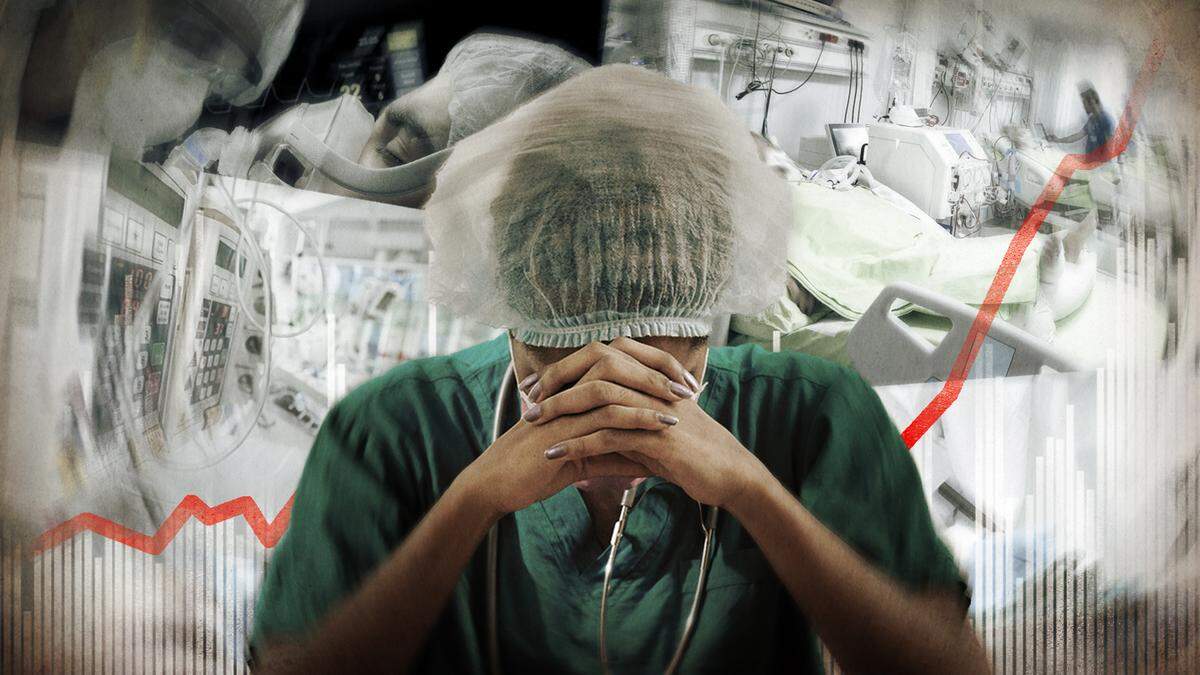
KC nurse: ‘My world is crumbling.’ Health care workers’ COVID burnout raises alarms
As the pandemic rages, psychologists at AdventHealth Shawnee Mission have been hosting confidential phone calls for health workers who just need to talk. Some happen in the evening, some over the lunch hour.
One day last week, a nurse called to say: “My world is crumbling around my ankles.”
“So we handled it,” said Rennie Shuler-McKinney, clinical director of behavioral health services at the hospital. “But she just could not go on another hour without talking to somebody.”
What Shuler-McKinney and her colleagues see happening is unlike anything they’ve seen in their medical careers. But it’s happening across the country, too.
They see what the public might not: The pandemic is taking a toll on health care workers.
The jobs were inherently stressful already.
“Then you couple that with COVID and bring in a factor that I haven’t seen throughout the years: the fear factor,” Shuler-McKinney said. “The fear am I going to get COVID, and if I get COVID am I going to be OK, or will I be like many of the individuals across our nation that have lost their lives? And too, am I taking COVID home to my family?”
Burnout is spawning efforts by hospitals, professional organizations and medical researchers to heal the healers during a historically traumatic moment in medicine, whose effects might not be known for years.
Health care workers have faced shortages of staff and personal protective equipment — some still are — and are dealing with larger case loads and serving as surrogate family for patients when COVID-19 restrictions keep loved ones away.
Putting a COVID-19 patient on a ventilator can be soul-crushing. So, too, is watching people refuse to wear masks or social distance.
And if the care providers are suffering, patient care can suffer too.
“Front-line health care workers, in the setting of the pandemic, have been doing so much for so many for so long,” said Dr. Becky Lowry, who spearheads wellness programs for the medical staff at the University of Kansas Health System. “That equates to the feeling of exhaustion and what some people would describe as burnout.
“We know it’s a privilege to work in medicine. We know it’s a high stakes and demand field. But for all of us, we’re human. We’re people first and this is an incredibly stressful time in medicine.”
Many health care workers are wary of speaking publicly about their jobs; workers protected by labor unions tend to be the most vocal with their concerns. Some don’t even trust anonymous surveys.
“From the very beginning nurses and health care workers were afraid of repercussions,” said Dr. Jessi Gold, assistant professor and director of wellness engagement and outreach at Washington University School of Medicine in St. Louis. “And places where health care workers talked about not having PPE (personal protective equipment), there actually were repercussions.”
But family members are speaking out on social media on behalf of their stressed-out loved ones in the field. And some health care workers are talking among themselves in private Facebook groups.
“Nurses seem to be reaching their boiling point,” said the organizer of one such group for Kansas City nurses.
“I have heard from many nurses in KC who are working extra hours and are exhausted,” said Kelly Sommers, director of the Kansas State Nurses Association.
Sommers and Heidi Lucas, director of the Missouri Nurses Association, are talking with state health and hospital officials about how to handle burnout in both states.
“Nurses are not getting rich off this, and they are facing the most difficult time ever in their lives,” said Sommers. “They will be dealing with a lot over time, and this isn’t going to end for them any time soon.”
On Friday, public health directors across the Kansas City area warned about the “uncontrolled spread” of COVID-19, urging elected officials to close restaurants early and limit group gatherings. They warned that hospitals might have to “ration” care soon.
The alarm could not be any louder. What happens if the public ignores the medical advice and hundreds get infected at holiday gatherings? Will that push hospitals, and their employees, over the edge?
“Our hospitals can’t handle much more. Reminder: If your family member becomes a COVID statistic due to Thanksgiving gathering, you won’t be able to visit them in the hospital over Christmas,” Dr. Jake Riggle at the University of Kansas Medical Center, tweeted a few days ago from his private Twitter account.
“I think the biggest change people can make is take this seriously for the holiday season,” said Riggle. “Don’t get together with your whole family. I think that’s going to be one of the scary things going forward.”
Before COVID-19, burnout had become normalized in health care, say two researchers at the University of Arizona who are tracking the pandemic’s impact on the nursing profession. “The pandemic has only intensified a problem that many people outside the healthcare industry aren’t even aware of: nurse burnout,” they write.
Researchers Jessica Rainbow and Chloe Littzen are collecting stories from front-line nurses across the country about what their jobs were like pre-pandemic, and what they are now.
The stories are full of hopelessness, and they warn that the pandemic “is on the verge of breaking the nursing workforce, and to a larger extent, healthcare at large.”
“Nurses want the public to understand that they are doing everything they can to help their patients and families,” the researchers write. “But they are tired, and their bandwidth is maxed out.”
‘Emotionally complex situation’
“Nurses have the longest exposure to a patient than anyone else, but yet they’re having to be everything right now. And it’s a lot of pressure on somebody,” said Sommers.
“But they still go to work. And I think that’s the part I wish people understood more. Nursing is a profession … and we try really, really hard to stick it out and work through those things.”
Researchers have compared front-line workers to soldiers in combat. The Department of Defense, in fact, shared its combat stress management strategies with hard-hit hospitals in New York City early on in the pandemic.
Gold, who is a psychiatrist, said venting emotions has not traditionally been part of the medical culture.
“I think we are in a profession where we focus a lot on helping other people, and focusing a lot on actually admitting that we have emotions is seen as a weakness,” said Gold. “We just say I’m going to do my job, I’m going to do my job. I’m going to do my job, until we can’t.”
Like soldiers, health care workers are trained to deal with the intensity of the job, but the pandemic has created unrelenting stress.
“We do expect that most of the time there’s an ebb and flow to that stress, that we know there will be times of higher stress, but typically times of recovery,” said Lowry. “And with this, there has not been.”
Burnout pushes nurses out of the profession. After years of steadily climbing, the national turnover rate for nurses seems to have leveled somewhere between 8.8% and 37%, depending on location and nursing specialty.
Nurses have left the job since the pandemic began, some to stay with children now taking classes at home.
Littzen, a doctoral candidate in the University of Arizona’s College of Nursing, said she has found, particularly among young nurses under 30, that their well-being “is very volatile.”
“There are days when they are fearful of going into work. They have all these new stress-induced symptoms, such as gastritis, ulcers. They don’t feel they have support from the system itself. Half of them have expressed the desire to leave (patients’) bedside, or leave nursing,” said Littzen.
There’s worry about whether the pandemic will cause physicians to leave, too.
Doctors have been “leaving medicine at concerning rates over the last decade, feeling some symptoms of burnout or emotional dissatisfaction,” said Lowry of KU, noting that physicians have a higher suicide rate than most professions and doctors are reporting increased stress now.
“This is an emotionally complex situation,” said Lowry. “I don’t know that most practicing health care workers right now have been in any situation like this.”
Psychologist Ravi Sabapathy, the well-being director for the medical staff at AdventHealth Shawnee Mission, said the last eight months have shown how resilient health care workers can be — to a point. At AdventHealth, which now has a licensed therapist available to employees for free therapy, the new motto is “fine” is not always fine.
“You know how people ask how your day is going, and it’s so almost automatic, almost instinctual to say, ‘I’m fine.’ That happens a lot,” said Sabapathy. “But fine isn’t always fine.
“I think that an industry like this, there is a concept that we can handle whatever is thrown at us, whatever we see, hear, touch, smell, whatever experience we go through. And I think what we’re really trying to do … is shift the culture away from the silent pride. This sense of silent pride that ‘I’m OK.’”
‘A lot of PTSD after this’
In September, Rainbow, an assistant professor at the University of Arizona College of Nursing, set up a voicemail box to collect recordings of health care workers during the pandemic. (The number is 833-624-0707.) She’s memorializing a historic moment, but also looking for fixes.
It’s going to take a lot more than aromatherapy in the break room when no one has time for breaks.
“The reason I’m collecting the phone line data is I think there’s going to be a lot of PTSD after this,” said Rainbow. “There are stories of nurses taking care of their co-workers in their ICU. … I think there definitely is a lot of trauma that is going to be associated with this beyond the burnout that we knew about before.”
The Arizona researchers found that nurses across the country are engaging in creative self-care, trying meditation, yoga, journaling, hobbies, napping, hiking and spending time outdoors to combat their burnout. The Calm app for sleep and meditation has become a go-to.
The KU health system encourages employees to exercise, eat well, get plenty of sleep and find ways to disconnect from work. The advice about balancing work and home life? Lowry knows that’s easier said than done.
But health care workers want help from the public as well. They want people to stop believing everything they read on social media, especially anything that discourages masks.
One nurse who left a voicemail for Rainbow’s research said: “We’re tired. Frustrated and over begging people to do the right thing. We’re doing the best we can, one second we’re heroes, the next villains for asking people to wear a mask. But we continue to fight. Because mask or no mask we will care for those in their sickest hour.”
Riggle said it’s frustrating “seeing so much mistrust of the science and the facts, seeing what we’re seeing here in the hospital but seeing so many people trying to deny it.”
Along with pictures of his family on his Twitter account, he’s posted charts showing rising infection rates and other data from scientific sources to combat what he and other health professionals consider misinformation.
“Social media is a dangerous place to get your information,” said Riggle.
Gold, too, has been using social media to post data, some on behalf of colleagues who don’t feel comfortable doing it themselves.
Some of their stress, Gold said, comes from the public backlash, such as the accusation that doctors get paid more money for every COVID-19 patient who dies.
Gold said some health care workers feel the public has moved from applauding them to criticizing them for promoting COVID-19 safety precautions. “I think it is a harder environment to be a truth-teller right now,” she said. “There are so many polarizing views on all sides.
“I think the best thing the public can do right now is listen to the experts. Clapping for us right now would be wearing masks and socially distancing, trying to follow protocols and realize that we know you’re tired and frustrated and want to go back to normal, because we do, too.
“We want to go back to normal too, but for us that means going back to work and not seeing people die all the time, or going home and sleeping through the night.”
This story was originally published November 16, 2020 at 5:00 AM.
.jpg)