
Wanted: 1,250 volunteers for KC COVID vaccine test. Will the right people sign up?
A search for a COVID-19 vaccine widens in Kansas City this week with an urgent appeal for 1,250 volunteers. And they can’t all be young and white.
Researchers at the University of Kansas Medical Center and Children’s Mercy are using a unique outreach to take a vaccine from drug maker AstraZeneca directly to groups known to be historically underrepresented in clinical trials but at highest risk of COVID-19.
It can be hard enough to get many volunteers because the push to find a vaccine quickly has made people worry about whether it’s safe, let alone effective, nationwide polls show, creating a “you first” attitude.
But researchers leading the local trial recognize that long-standing issues — trust in the medical community is a big one — will make Black and Hispanic residents even more leery.
Meanwhile, COVID-19 has killed more than 237,000 Americans and continues to spread in record numbers locally and nationally.
The news Monday that a vaccine from Pfizer has shown, early on, to be effective at preventing the virus sparked widespread optimism. But vaccines cannot be offered to the general public without first being tested on people willing to take them in their experimental form, before they’re officially pronounced safe and effective.
Now a mobile medical unit is hitting the road to register Black, Hispanic and elderly residents in the Kansas City area and Wichita, to make sure local vaccine trials reflect the broader community.
The first stop for the clinic-on-wheels: The long-term care facility at Truman Medical Centers/University Health Lakewood in Lee’s Summit, then on to a community health clinic in Olathe before heading to locations in Wichita.
The study is enrolling adults 18 and older who are at increased risk of getting COVID-19. Participants will be paid about $1,200, possibly more for a commitment that will last two years.
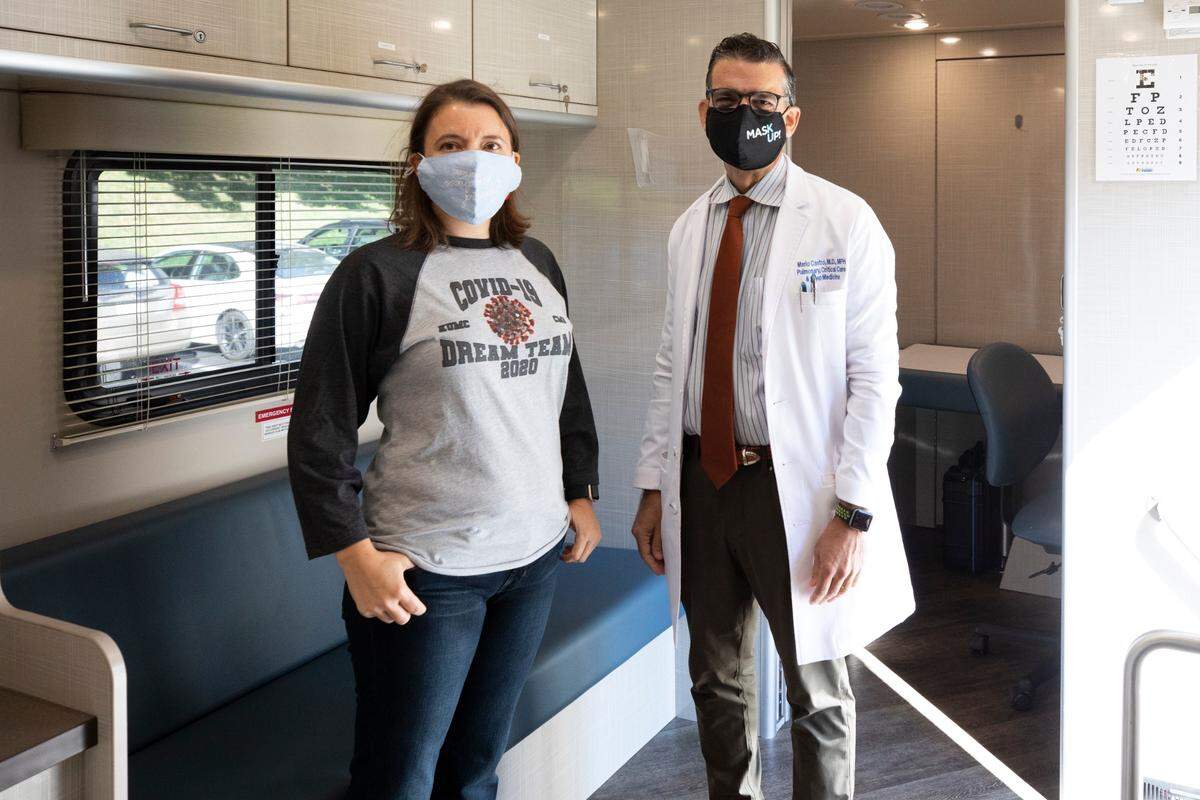
“Who don’t we want? That would be somebody who is basically quarantining themselves in their house, they’re not coming out, they’re not being exposed. … We don’t want that participant,” said pulmonologist Mario Castro, vice chair for clinical and translational research at KU Med.
“We want somebody who is working in the community, being exposed to this virus because we need to know if this vaccine is going to protect you in that kind of normal lifestyle.”
KU and Children’s Mercy are running one of 62 AstraZeneca trial sites across the study. Plans were well underway and recruitment set to begin when the U.S. Food and Drug Administration halted the study in early September after a study volunteer in Britain developed a neurological condition. The FDA authorized the trial to restart on Oct. 23 after reviewing safety data.
AstraZeneca, working with the University of Oxford, is one of four drug companies that have started late-stage, Phase 3 trials in the United States — the phase involving thousands of participants before the FDA will approve anything. With 23,000 participants enrolled in trials around the world, the company said last week it expects results later this year.
In July, the company announced that interim results showed that all participants who took the vaccine had a strong antibody response.
But, will it work on those hardest hit?
“The concern we have with this virus is it’s disproportionately hitting African American, Latino populations, and those are not the populations that normally line up to come enroll in clinical trials,” said Dr. Barbara Pahud, a pediatric infectious diseases physician at Children’s Mercy.
Some Latinos are afraid to even step foot inside a hospital for fear they might be met by U.S. immigration authorities and worse, be deported. “Those fears are real,” said Pahud.
And, the Tuskegee Institute syphilis experiments from almost a century ago remain a pall over modern-day research efforts. In the 1930s, the government researched the effects of syphilis on hundreds of Black men without them knowing the study’s purpose or being treated for the disease — seeding generations of suspicion.
“So there’s mistrust for the medical community and research in general from these populations that are currently being impacted by COVID,” said Pahud. “So the goal was, how do we get to them since we know they are not going to come to us.
“The mobile units was one of the ways that we felt we could do it because we did a lot of outreach with our community partners and they told us our participants who are African American and Latino are not going to come to KU. They’re not going to go there.
“It’s too far, it’s too expensive, it’s scary for them. They don’t know how to navigate the system there and it’s just intimidating.
“If we want them to participate in our studies, we need to go to them.”
We’re not guinea pigs
The clinical trial will begin signing up participants on Nov. 16 at Swope Health locations, federally funded community health centers that serve a large Black population.
During a COVID-safe, drive-thru Halloween event at Swope’s main clinic on Blue Parkway last month, health officials tucked informational pamphlets about the trial into hundreds of trick-or-treat goody bags. Whether that outreach has borne fruit isn’t known yet.
Health officials are having one-on-one conversations with patients about the vaccine study, relying on the trust they hope the name “Swope” stands for and emphasizing that this study is not run by the U.S. government.
“We really are trying to go for grassroots discussions,” said Tricia Snow, who works with a KU team of researchers at Swope working on smoking cessation research among Black patients.
“Swope has a great name in the community, and feels very trusted and respected. I think that helps. That gets people to open their ears and kind of pause and listen for just a minute. That’s one aspect that we’re really using. We want people to be ready to listen.”
She’s heard a “wide range of reactions” so far to the vaccine trial.
Some people are like absolutely not,” said Snow. “And when we ask them why, because we want to know why, we want to know if that’s something we can educate ourselves on or educate them on — they range greatly from ‘I’ve never had a vaccine in my life’ to ‘I’m not gonna start now, I don’t trust this, I don’t want to be used as a guinea pig.
“And that really goes across all diverse lines — ‘I don’t want to be a guinea pig.’ Which is kind of a Catch-22, because we can’t say we know everything about the vaccine because it is a study and we have to learn, but the only way to learn is if we have enough folks to take the vaccine so that we can learn. So it’s tricky.”
Swope is relying on the community to promote the trial.
“One of the best ways to reach probably every community, but specifically the African American community, is through word-of-mouth,” said Snow. “So that is what we’ve been doing for the past few months, and developing kind of that word-of-mouth tree so that the community is aware and they can ask questions and they can talk amongst themselves and they can call us.”
Some of the doctors who work in the clinics have signed up for the trial, which might make their patients feel confident in doing it too, said Snow. “You feel a lot better if your doctor says, ‘I believe in this, I believe in it enough that I did it it myself,’” she said.
Those same conversations are happening at Health Partnership Clinic in Olathe, another federally funded community health center where about half the clientele is Hispanic. The mobile unit is scheduled to pull into the parking lot of the clinic on Clairborne Road over the next few days.
The clinic is using Facebook and its email and text system to let patients know about the trial, sending messages in both English and Spanish.
“The other thing is, community health centers exist through partnerships. That’s one of our main pushes,” said Catherine Rice, vice president of marketing and outreach.
“We could not serve all the people we do without all the partnerships we have in the community, so we’ve also sent emails to all our partners, area churches, El Centro, Center of Grace ministries, area schools, as well as our staff and board members, too.”
Ultimately, Rice said, whether to participate “will be an individual decision that the person has to make. And it’s a big commitment. There is payment for participating, but still it is a huge commitment on that person in so many ways. And there’s an unknown, too. But, I think we’re doing as much as we can to push the information out and then the patient has to decide if this is right for them.”
“We’re optimistic that the word will get out and there will be enough participants that will be willing to be part of this kind of groundbreaking opportunity for our community to be here in Kansas City having this vaccine study opportunity.”
But will ICE be there?
Pahud and Castro, both of whom speak Spanish, have been talking up the trial on Spanish-language radio stations in Kansas City. They’re also using grassroots health organizations and local churches to find participants.
Pahud is aware that the message falls differently, depending on who hears it and a patient’s citizenship status, the doctor said.
“For example, a Latin illegal person may want to participate. I know them. I’m Mexican. They are my peeps. They want to do it. They want to roll up their sleeves and help,” said Pahud. “But they are concerned about being deported. So the message for them is we have created a system for us to be able to reimburse you for your participation.
“So, for me, when I get into those radio stations, that’s my main message. You’re not at risk. We’re here to protect you. We’re doctors. The same way you can come see us in the emergency room or bring your kids to Children’s Mercy, and you’re safe.
“It’s the same in a clinical trial. My priority is you. We don’t work with government that way and you are protected. This is independent of other things. You can still help science by living in this country and you’re safe. So that’s the first message.”
Other people don’t trust the vaccine itself, said Pahud.
“They’re worried about the side effects. They’re worried that it may not work. So then what you need to do is try to provide as much information and be as transparent as you can. Honesty above all. And explain that this is a study, that is voluntary, that they can pull themselves out if they don’t want to participate,” she said. “But the main message that I give them at that point is, if you really want to help our people, we’re not going to know this vaccine works in our people unless we volunteer to participate.
“So if you want to help your Grandma and your kids, and you’re the only one that’s eligible to volunteer, volunteer so you can help others. Because we need data in different populations, ethnicities, ages, and the only way that we’re going to know if this works among Latino and African Americans is if they volunteer.
“If we only have white old men, we’re only going to know if it works on white, old men. And a lot of you have complained that we don’t have enough data on how it works on your population, and that’s because you guys are not stepping up to volunteer. So this is your chance.”
Castro and Pahud aren’t sure how many people they’ll get to sign up. Castro said about three dozen people have already enrolled. They especially need participants who are over 70.
“As you can imagine, doing a clinical trial, normally, pre-COVID times, means you open up the doors to your nice ivory tower, the academic medical center, and the usual suspects come in to participate, which tends to be your peers, the kids of your peers, your peers’ parents,” said Pahud.
“So you know, it tends to be a very non-diverse group of people that participate in research, let’s just be honest. I’m talking about the big ones, so the big ones tend to be really only in the big places.”
They’re collaborating with the CoVPN, Covid-19 Prevention Network, a global effort by the U.S. National Institutes of Health to find a vaccine.
The Matrix Medical Network, an Arizona company that provides mobile clinics to community-based health providers, will have an exam room and areas to prepare the vaccine and do lab work, with emphasis on comfort for the patients, Pahud said, so it doesn’t feel too clinical. Matrix supplies the staff who will work onboard.
The trial involves a series of seven visits over two years time. Participants will receive two injections, with follow-up visits needed for blood work. For every three participants, two will get the active vaccine and one will get a placebo. Screening and the first injection will happen on the same day.
Making sure that people understand they might only get a placebo, Castro said, will hopefully go a long way toward building trust where there might be very little.
“I think is very important to establish the trust and understanding that they as a community — and I say ‘we’ as a community because I’m Hispanic as well — we have to participate, we have to be able to do this for our community,” said Castro.
“If we don’t, then we are going to continue in the same rut, being disproportionately affected by this. But if we establish that this is safe in our communities and effective, then this is the way to move forward because it is the only preventative route we have right now to help us move back to normalcy.”
To sign up
▪ Register at the Coronavirus Prevention Network website — coronaviruspreventionnetwork.org — and choose the “KUMC” site, or
▪ Call 913-574-3006 in Kansas City, or 316-293-1833 in Wichita.
This story was originally published November 10, 2020 at 5:00 AM.
.jpg)