Coronavirus still creeping into your nightmares? You’re not alone, studies say
As the coronavirus rages on, so too do the nightmares about accidentally shaking someone’s hand and running into a store without a face mask on. It’s a phenomena that has been observed during wars, terrorist attacks and past pandemics.
Now, new research from Finland adds to the growing evidence that unprecedented stress is allowing the coronavirus to infect more than just our immune systems.
In a survey of nearly 1,000 people, more than half of the respondents reported having nightmares about COVID-19 and increased stress levels that have contributed to more disrupted, bad-dream filled sleep, according to a study published Thursday in the journal Frontiers in Psychology.
The researchers say dreams could “provide valuable insight” for health care professionals monitoring the pandemic’s impacts on mental health.
“The results allowed us to speculate that dreaming in extreme circumstances reveal shared visual imagery and memory traces, and in this way, dreams can indicate some form of shared mindscape across individuals,” study lead author Dr. Anu-Katriina Pesonen, head of the Sleep & Mind Research Group at the University of Helsinki in Finland, said in a news release.
“Repeated, intense nightmares may refer to post-traumatic stress. The content of dreams is not entirely random, but can be an important key to understanding what is the essence in the experience of stress, trauma and anxiety,” Pesonen added.
Intense emotions such as fear and threat are processed during REM sleep cycles when dreams occur. This cycle happens on average five to six times a night and is associated with rapid heart rate and irregular or shallow breathing.
Neurologist Dr. Patrick McNamara said people can better handle these emotions when they are transformed into visuals in dreams, where they are transferred into a long-term memory bank, he told Futurity. And the more “unusual” the threat, the longer it takes to complete this process, meaning more scary dreams, said McNamara, an associate professor of neurology at the Boston University School of Medicine.
In the new study, researchers used artificial intelligence to scan descriptions of dreams from about 800 respondents for word associations that appeared frequently. The computer organized the information into “dream clusters” with word pairs such as “mistake-hug,” “crowd-restriction” and “handshake-distancing,” according to the study.
They found 33 dream clusters, with 20 classified as “bad dreams.” About 55% of those bad dreams were about the pandemic with themes involving social distancing, personal protective equipment, dystopia, an apocalypse and coronavirus infection.
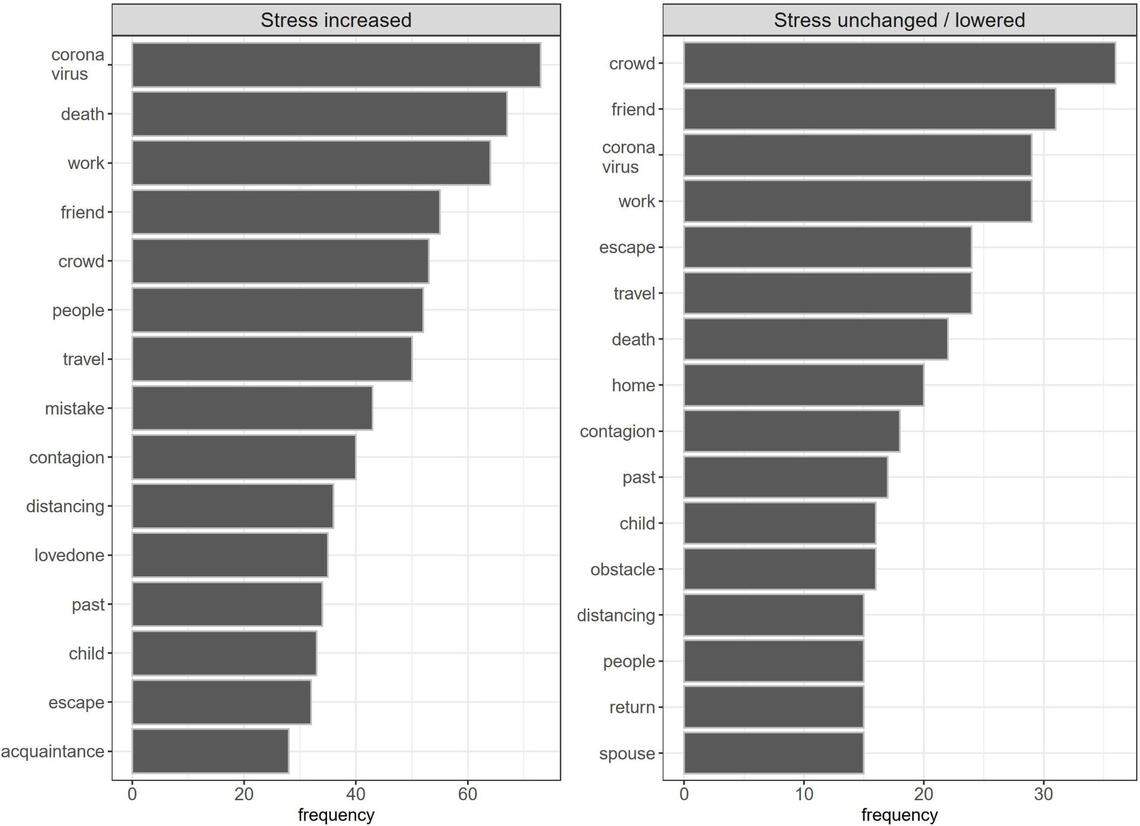
The most frequent words in the dream reports were “coronavirus, death, work, friend and crowd,” among others. Overall, respondents reported increases in waking up in the middle of the night (29%), time spent sleeping (54%) and nightmares since the pandemic started (26%), the study says.
More than half of the study participants said they were more stressed than usual, with females more affected than males. Harvard Medical School psychology professor Deirde Barrett said the gender divide reflects the different ways the pandemic has impacted men and women, according to LiveScience.
In her own study on coronavirus and dreams, Barrett found that women reported feeling more anger and sadness than men, and were more likely to have dreams about taking care of sick people and homeschool issues. This, she says, makes sense because women more often take up caretaker roles and responsibilities for children’s schooling.
Barrett’s study analyzed 2,888 survey responses between March 23 and July 15 and also discovered that Americans were having more, intense dreams during the pandemic.
“[Dreams] make up a little highly visual drama, with a narrative and vivid images,” Barrett told LiveScience. “They often tell us something that may not have otherwise been center stage in our attention.”
A common theme among the reported dreams in the Harvard study was bugs, which people often use — unconsciously — to symbolize a virus, according to Dr. Susan Rubman, a Yale Medicine psychologist and sleep specialist.
Although dreams are a sneak peek into the stresses going on in a person’s life, doctors still aren’t sure if they carry much meaning beyond that.
“I wish it were the case that we could draw a point-to-point correlation between what happens in our dreams and some meaningful information during the day, but we can’t always do that,” Rubman said in a university article. “We can’t say I dreamt about ‘X’ so it must be that ‘Y’ is bothering me.”
“However, if we are anxious or distressed or feeling a lack of control during the day, it can certainly show up in some way in our dreams. Often the format is not obvious,” Rubman added.
This story was originally published October 2, 2020 at 12:28 PM with the headline "Coronavirus still creeping into your nightmares? You’re not alone, studies say."