
‘Never seen anything like it.’ Former nurse treated in coronavirus wing describes stay
The symptoms manifested in full force last Friday — fever, chills, vomiting and stomach pains bad enough to warrant a trip to the emergency room.
When Anna Marie Brown, 63, arrived at Lee’s Summit Medical Center, they stopped her husband at the front door. She would need to walk in alone.
After going through ER protocol, a nurse escorted her to a secluded wing of the hospital, reserved for potential coronavirus patients. She could hear some. All were out of sight.
As she walked down the hallway, she passed nurses along the way, their faces visibly bruised from masks they’d been wearing for hours. Bloodshot eyes illustrated their fatigue, Brown said. Their words would later illustrate their own fear.
After Brown stepped into a private room, a nurse zipped shut the canvas covering the door. For the next four days and nights, her only human interaction came with medical personnel and hospital employees dressed in protective equipment from head to toe.
“It’s like The Walking Dead in there,” she said. “You can’t imagine it unless you’re in there.”
From inside the room, a single window looked out toward a neighboring brick building. Over the next 96 hours, she would count the bricks, every last one of them, as she awaited her test results.
They had inserted a long cotton swab through one nostril until it reached her throat. Then they pulled it out and glided it down the other. She held the bars of her hospital bed to prevent herself from the inclination to push away the nurse.
Four days later, the test came back negative. She has the seasonal flu and colitis, not the coronavirus.
But the experience has forever changed her. In ways of appreciation for her caretakers. In ways of worry for the situation in which they have placed themselves every day during the pandemic that has ravaged the country and the world.
She doesn’t have COVID-19. But she has its emotional effects.
“I think I have PTSD from being in there,” said Brown, who is a retired nurse herself. “It was just horrible. It hurts really bad to see these nurses, and they’re all scared. I’ve never been through or seen anything like this.”
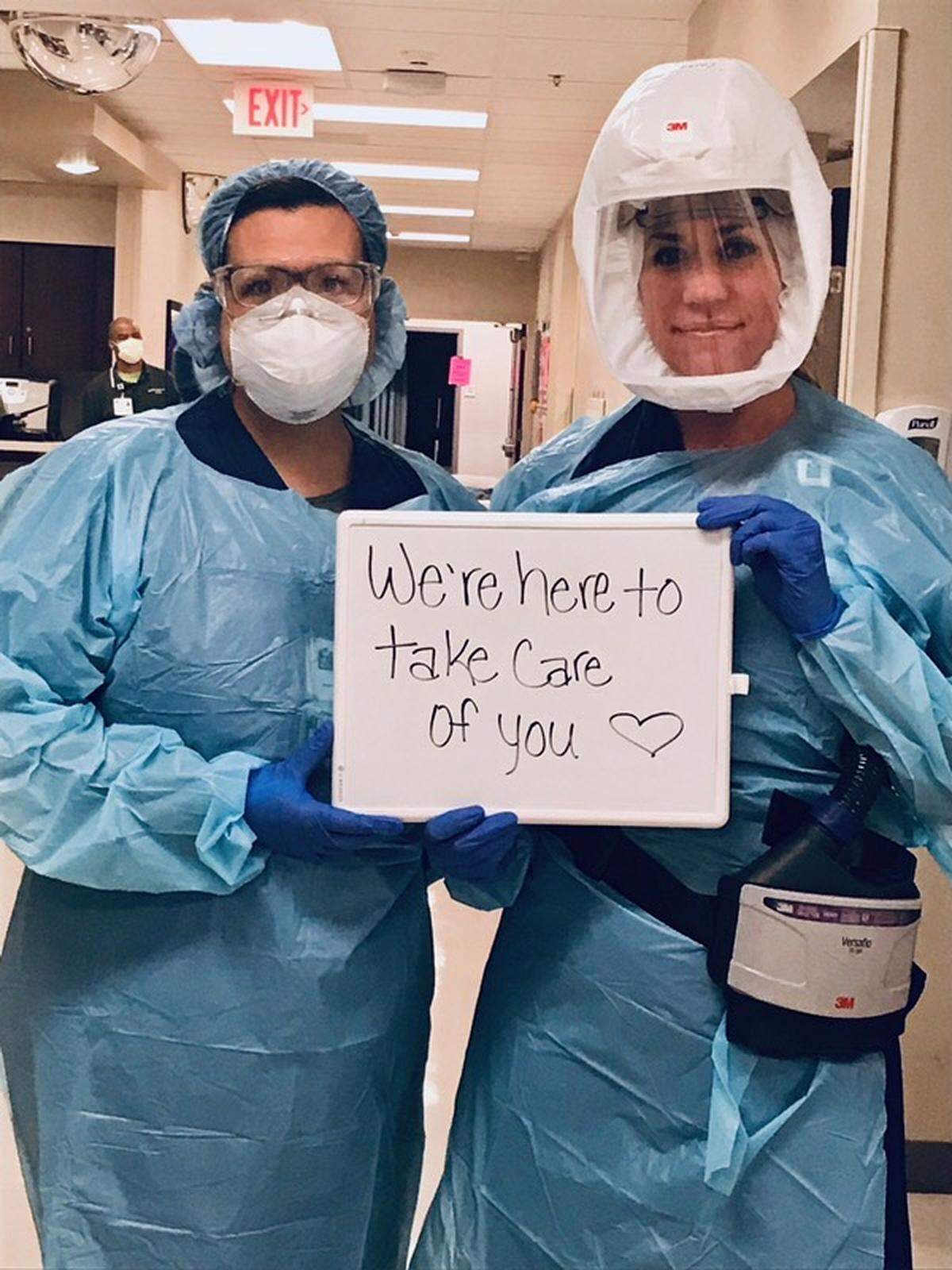
Before nurses enter each room at Lee’s Summit Medical Center, they dress in full face covers. They wear gowns and gloves, masks and shoe covers.
Enacting every precaution possible, they attempt to limit their time in each room — there were five other patients during Brown’s stint there this week —in an effort not to obtain the virus.
“We’re in a war,” said Chris Hamele, assistant vice president, public relations for the HCA Midwest Health System. “You want your equipment; you want your resources; because that is the only way to win the battle.
“But with that, how do you also balance the emotional and spiritual (reasons) of why we do what we do?”
In a matter of hours, Brown said she felt depression set in. Her husband drove to the hospital, stood in the parking lot and called his wife as he waved. But she couldn’t see him. Others called, too, but she felt too ill to talk.
“The nurses are who kept me sane,” Brown said. “I had wonderful care. I really, really did.”

The nurses are under instructions to limit their contact with coronavirus patients and treat those awaiting test results as part of the battle. So they provided Brown with their personal phone numbers. Rather than ringing a buzzer for help, she could send messages with precisely what she needed. She built up a list before calling.
One came anyway. In one of the four nights, a nurse walked into the room in her full protective gear and stood six feet from the bed.
And just talked.
She was scared, too, she said. Fearful of the unseen enemy. Fearful she could get it. Worried she would pass it on to her family and friends. Worried people weren’t taking any of this seriously enough.
She stayed awhile that night.
They talked.
They prayed together.
They cried together.
“It was very emotional — I am very emotional just talking about it,” Brown said. “Just the time and compassion of this nurse was such a warm feeling.”
Much of a nurse’s job is providing comfort in a time of discomfort or fear. Physically. Emotionally.
But those elements have been taken to an extreme — in terms of difficulty and importance. How does one provide comfort when patients are more scared than ever? How does one provide comfort when he or she has been told to minimize time in the room?
“We find ourselves connecting more with these patients because we are not only their care givers, we are their support person and, in some cases, their communication between them and their family,” said Casey Rozolsky, an registered nurse at Lee’s Summit Medical Center.
“Our (equipment) doesn’t prevent us from making a personal connection — COVID-19 or not,” added Casey Thomason, also a nurse at LSMC. “We won’t let the personalized care we provide our patients stop because of a pandemic.”
This story was originally published April 3, 2020 at 6:56 PM.