‘Stay strong, stay safe, and stay home’: KC region leaders unite against coronavirus
The clearest, most succinct version of Kansas City area officials’ message Sunday imploring residents to stay home to limit the spread of the novel coronavirus came from Jackson County Executive Frank White, Jr.
“Stay strong, stay safe and stay home,” White said.
White made the plea Sunday at Union Station, where he stood alongside officials from Kansas City and Johnson and Wyandotte counties as they took questions about the stay at home order issued the day before.
The order, issued on the authority of each jurisdiction acting in concert, goes into effect across the Kansas City region at 12:01 a.m. Tuesday and requires residents to stay home unless they are venturing out for activities “essential to the health and safety” of themselves, family members or friends, such as getting medical attention or food.
It will be in effect for 30 days as health officials monitor the spread of coronavirus, or COVID-19. As of Sunday, more than 32,000 cases of the virus had been identified across the U.S., according to Johns Hopkins University. At least 400 people have died from it.
White and the other officials convened for the extraordinary news conference Sunday to provide clarity on the stay-at-home order and make sure their message is clear: this measure is necessary to save lives. Kansas City Mayor Quinton Lucas answered questions via Facebook Live earlier in the day.
“Without these efforts, we believe the spread will continue and our healthcare systems will be overburdened,” said K. Allen Greiner, chief medical officer for the Unified Government of Wyandotte County and Kansas City, Kansas.
The sweeping order instructs residents to stay home unless they are performing essential activities, which include obtaining medicine or medical care, getting food or household supplies, engaging in outdoor activities while observing proper social-distancing, going to work or caring for family members. Businesses are to “cease all in-person operations” unless the organization is deemed “essential.”
The order is the latest in a series of escalating steps meant to limit the spread of the virus, which as of Saturday had been found in at least 90 people in Missouri and more than 60 in Kansas.
Lucas barred restaurants from serving dine-in customers and suspended gatherings of more than 10 people early last week. He first declared an emergency March 12.
White said those who acted quickly and decisively saved lives.
“We are united by the necessary actions we have taken to support and protect the people of our communities — most importantly those who are the most vulnerable,” White said. “We will emerge from this stronger, better and more united than ever.”

At the news conference, Rodney Hammer with the Blue River–Kansas City Baptist Association asked that churches be added to the list of essential activities so they can convene while observing social distancing. He said they may need more than 10 staff members just to operate a live stream.
White said the officials could look into it, and Ed Eilert, chairman of the Johnson County Board of Commissioners, noted church staff members could still continue operations as long as they’re not gathered in groups of more than 10.
But Greiner said seeking exemptions to the order “is not going to save lives.”
“Staying home is going to save lives…We need to think about what’s the safest thing,” Greiner said. “And to try to find ways to get 10 people together in a park or otherwise is not going to save lives, and it’s not going to help our hospitals from ending up completely full of people and having people dying in emergency rooms because we don’t have enough equipment to keep very, very sick people alive.”
The stay-at-home order
The “CORE4” of Wyandotte, Johnson and Jackson counties and the city of Kansas City issued their orders together Saturday. On Sunday, Leavenworth County in Kansas and Platte County in Missouri followed suit.
Greiner said the move was essential to limit the coronavirus spread because the Kansas City area has “had a significant problem with regional testing capacity.”
“Part of the urgency of this stay-at-home order is that without the ability to do testing widely across the population and test absolutely everyone who has symptoms — like fever, cough, shortness of breath — we need to reduce the spread this way because it’s unlikely we’ll be able to test everybody and know who has it and who doesn’t,” Greiner said.
Under the order, residents can still participate in “essential activities.” That means they can go to work if their employer is deemed an essential business. Grocery stores are open. Restaurants can fulfill pick-up, drive-thru and delivery orders but are barred from serving dine-in customers.
Weddings, funerals and similar ceremonial services are not considered essential activities.
Lucas said it was “heart-breaking” to him that funerals and weddings cannot be held as usual. Funerals, he said, frequently are attended by at-risk populations. Social distancing has to be observed in such cases.
The businesses deemed “essential” and allowed to continue in-person operations and numerous and defined broadly. They include banks and financial institutions; health care organizations; grocery stories and pharmacies; home maintenance workers, such as electricians and plumbers; mailing and shipping services and businesses that supply essential businesses.
Residents are ordered to observe social distancing requirements, which include staying six feet away from other individuals, washing hands frequently and for at least 20 seconds or using hand sanitizer, cleaning surfaces and not shaking hands.
“What we clearly know about COVID-19 tells us that we need to take this action,” said David Alvey, Mayor of the Unified Government of Wyandotte County.
Alvey noted officials have been accused of acting out of fear. He said he will “freely admit” he fears for the health and safety of the community.
“We experience well-founded fear, but we do not cower, and we do not hide. That is not the spirit of Wyandotte County or of the Kansas City region,” he said.
The orders should be largely self-enforced, Lucas said. The city would seek to use agencies such as the department of regulated industries and the health department as necessary.
Breaking the rules of the order, however, in Kansas City is considered an ordinance violation, punishable by up to $500 fine and up to 6 months in jail.
“In terms of police involvement . . . I do not want them in the position of asking people where they’re going.”
Some populations, such as the homeless, will be hurt worse during the pandemic, Lucas said. He encouraged leaders and individuals to support those at-risk groups.
“I encourage any of you who has the opportunity to provide financial support to do so,” he said.
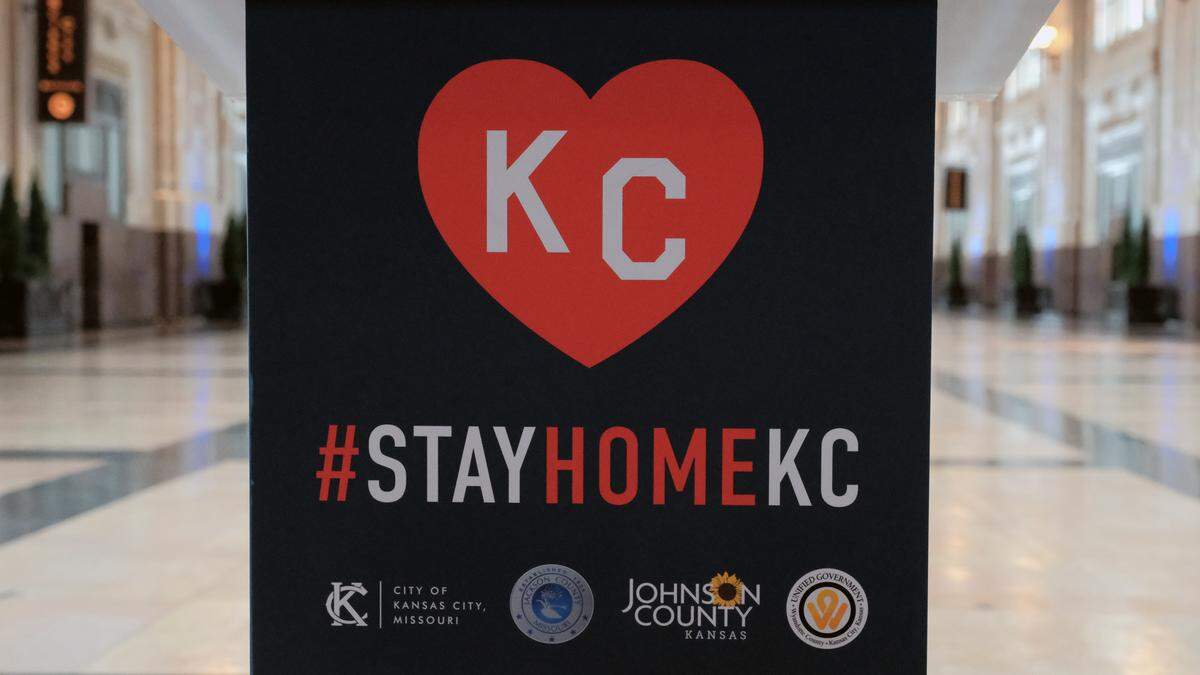
Working as a region
That officials from all three counties and Kansas City appeared together was in part meant to demonstrate that limiting the coronavirus spread would demand regional cooperation.
Lucas noted that the last time area leaders gathered at Union Station was for the Kansas City Chiefs’ Super Bowl parade.
“At that time, we recognized that there were no lines,” Lucas said. “Nobody was asking if you were a fan from Kansas or Missouri or anywhere else. We recognized that we stood as one and one community, and that’s why we’re back here today. In times of celebration, in times of pain, in times of sacrifice, we recognize that there aren’t lines — that our regional distinctions or boundaries or different jobs or different titles matter less because public safety, public health, our community’s survival are so important.”
Lucas said he is often asked when the crisis will end, but that he doesn’t know.
“What we know is that we’re going to do what is necessary to make sure our community is safe,” he said. “There’s no reason to go out and hoard. There’s no reason to go out and fight others.”
Though there are many business sectors deemed essential, Eilert said he hopes those organizations would work with their employees to ensure safety.
“This is serious, and it’s only with the total cooperation of our community . . . can we be successful in mitigating the spread,” Eilert said.
“Together we can make a difference in the issues and the challenges that we face today.”
This story was originally published March 22, 2020 at 1:04 PM.