
Need a (free) mammogram in Kansas City? Here’s how to get one and why doctors worry
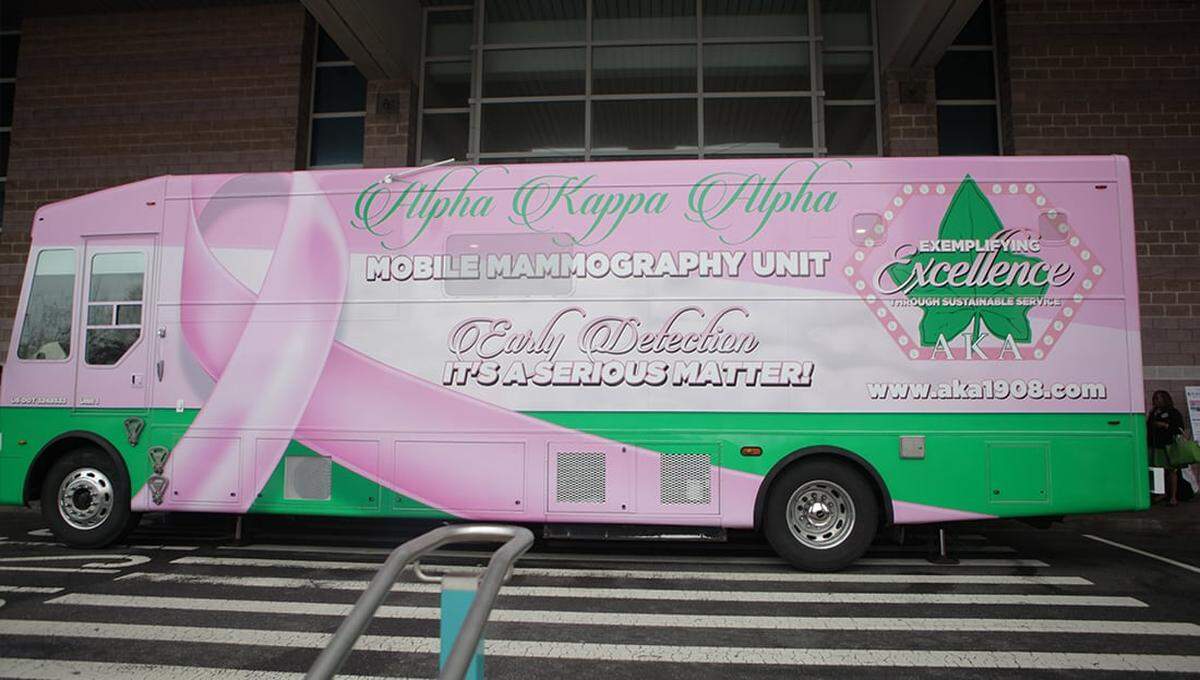
It will be hard to miss as it rolls through Kansas City — a mobile health unit emblazoned with a large pink breast cancer ribbon and the words Alpha Kappa Alpha in fancy green script.
Women — and men — have been offered free 3D mammograms on the “supermobile” in parking lots of North Carolina Walmarts and San Francisco churches. But the Black sorority brings it to the Kansas City area for the first time on Friday and Saturday.
In the past year, COVID-19 and the people it killed laid bare grave health disparities affecting people of color — disparities that efforts like mobile mammography units are addressing in the United States.
Lack of insurance, language barriers, lack of proper follow-up care and lack of rural doctors can keep people of color, poor people and rural residents unhealthy. For women and their breast health, when early cancer detection can be the difference between life or death, those issues can have deadly consequences.
“We know now that Black people are dying of COVID at a disproportionately high rate. And we know that, according to the CDC, Black women are less likely to develop breast cancer, but they’re 40% more likely to die from it compared to white women,” said breast radiologist Dr. Amy Patel, medical director of Liberty Hospital’s expanded state-of-the-art Breast Care Center that opens in June.
“That’s a pretty dismaying statistic.”
The new breast care center will serve the Northland and northwest Missouri. As it was planned, Patel said she’s been adamant about “expanding outreach into the community” to serve more women, whether they have insurance or not. “We have to reach these women,” she said.
If anything good came out of COVID, said Patel, “it’s that now we are really, as a community, really taking this seriously and shining a light on how horrible the disparities really are and how they worsened because of COVID and we need to act. And I think mammography vans are a great way to be able to close the gap to health care disparities.”
Alpha Kappa Alpha is on a similar mission.
The sorority focuses “on all those health disparities that not only affect Black women but brown women as well. So women of color in general, we know that we’re not always screened, we don’t always receive the care that we deserve,” said Tanesha Thompson, a Head Start coordinator in Kansas City and Midwestern representative to AKA’s international program committee.
“We know that with breast cancer, early detection is key. So if Black women and brown women are not getting those screenings and those mammograms, we’re already at a disadvantage.”
The mobile unit, stopping in both Kansas City and Kansas City, Kansas, will be the centerpiece of health fairs offering other cancer screenings, COVID-19 testing and vaccines. The KCK location will host a blood drive, too.
“It’s an event not just about breast cancer, but about overall wellness,” said Thompson. “Of course, our mammogram unit is our showstopper. But we’re really trying to bring awareness and prevention into all areas that affect us.”
Screen 100,000 women
The mobile unit hit the road in 2019 when the sorority set out to provide mammograms to 100,000 women across the country, going directly to thousands of women who might not otherwise have access, said Twyla Woods Buford of Kansas City, AKA’s Midwestern regional director.
The mammogram unit was scheduled to come to the Midwest on two previous occasions. But in March 2019, “it was to travel to Omaha but there was a flood and our unit got stuck in the flood,” said Thompson.
Then last year, two days of appointments in Oklahoma City were canceled because of the pandemic.
The visit here was set up to serve both Kansas Cities. More than 400 members of the sorority live in the area.
“We know in both of those areas there are families that are uninsured or underinsured,” said Thompson.
“We also know that in Kansas City, Kansas, they have a big Hispanic population, and we kept that in mind, wanted to make sure those individuals as well who may be undocumented or not have resources to get medical care were able to get a mammogram with us.”
Black women die at higher rate
A 2018 study showed mobile mammography units can be effective in reaching medically underserved women. It said such efforts should target women from racial and ethnic minority groups, low-income households and the uninsured.
One such mobile unit, called the “Ma’am Mobile,” visits 225 locations a year in Arkansas, stopping at hospitals that don’t offer mammography services, factories, schools and community events.
Distance and transportation can be a big a hurdle, said Patel.
Women with limited access to health care are more likely to have been diagnosed with late-stage breast cancer, said Patel, who belongs to a Missouri task force working to screen women in areas of the state where breast cancer mortality rates run high.
Studies also have shown that Black women who have abnormal mammograms face more delays in getting follow-up care when needed, said Patel.
Anyone who gets a mammogram on the AKA bus will get a referral for a follow-up if necessary, said Thompson.
Mobile units like the AKA bus have been around for a while, said Patel. But as disparities worsen for some communities, “we know that mobility is probably the best way to get to a lot of these patients. Especially with me in the large rural population that I serve, I think it’s really important,” she said.
In Missouri, said Patel, women who live in 19 rural counties travel more than 45 minutes one way to get a mammogram.
AKA members in Kansas City left flyers about the mobile unit coming “all over Kansas City. We spread the word so we could have enough people coming,” said Rhonda Harris of Kansas City, a long-time member of the sorority and one of the event planners. “We want anyone who wants one to get one.”
Getting a free mammogram
The mobile unit will be open from 8 a.m. to 5 p.m. Friday at The New Bethel Church, 745 Walker Ave. in Kansas City, Kansas, and from 8 a.m. to 5 p.m. Saturday at the Kansas City Health Department, 2400 Troost Ave.
You can get a mammogram if you don’t have insurance, are at least 40 years old, have not had a mammogram in the past year and have no current breast symptoms or complaints.
You don’t need a doctor’s referral to get screened. People are asked to register, but Harris said they can take a few walk-ins. Register at assuredimaging.com/AKA, or call 888-233-6121.
Thompson, who has been on the bus, said it will have the feel of being in a doctor’s office. Only the woman being screened will be allowed onboard for privacy, and there won’t be lines of people waiting to get on.
And, because the pandemic is still here, COVID-19 guidelines apply. Masks and social distancing will be required.
Meanwhile, both Kansas and Missouri run programs that offer mammograms and other health screenings to women who meet certain age, income and insurance guidelines.
In Kansas, the Early Detection Works program — kdheks.gov/edw — provides breast and cervical cancer screenings.
In Missouri, the Show Me Healthy Women program offers a map of providers who participate in the program at health.mo.gov.
.jpg)