
Missouri has one of highest rates of lung cancer in the country. Experts know why
Missouri has some of the highest lung cancer rates in the country, according to an American Lung Association report released Wednesday. The culprit? You can draw a straight line between lung cancer and smoking.
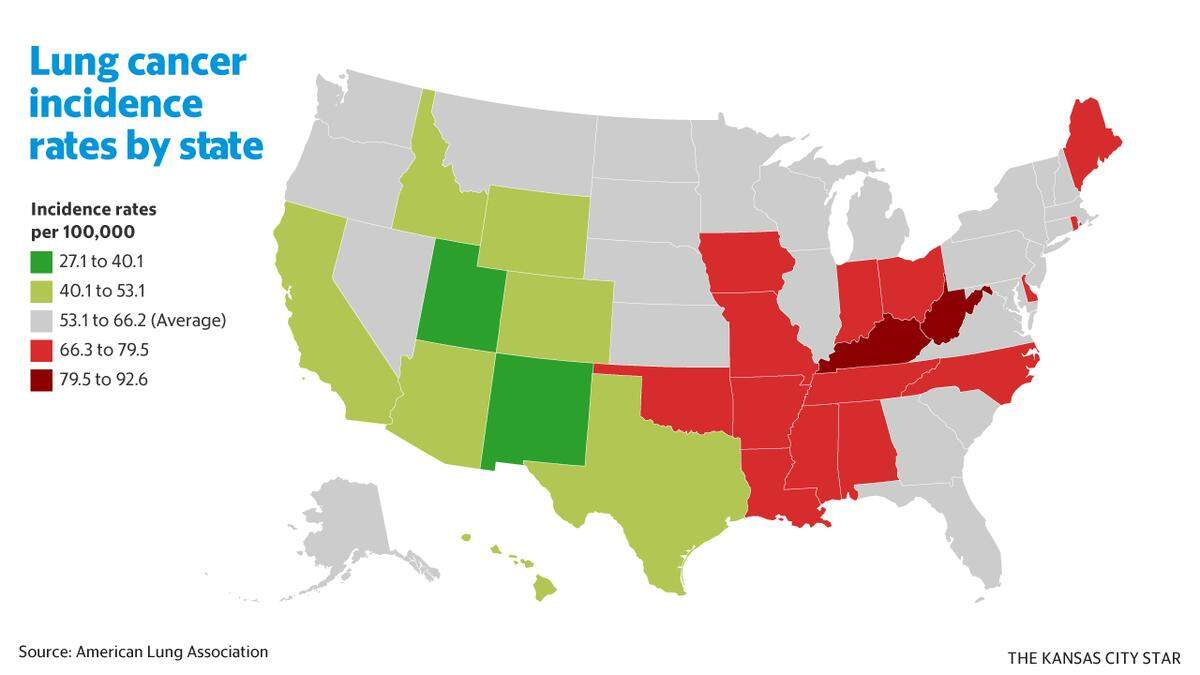
The second “State of Lung Cancer” report reveals the toll, state by state. Nationwide, the incidence of lung cancer — the number of new cases — is 59.6 per 100,000 people.
Kentucky, one of the top three tobacco-producing states in the country, is the worst in the nation, with 92.6.
Missouri was deemed “below average” at 73.2, worse than 44 other states.
Sara Prem blames some of it on the popularity of cigarettes in the Show-Me-State, which has the 10th highest adult smoking rate in the United States, according to the Missouri Department of Health and Senior Services. But low tobacco taxes are a factor too, said Prem, an advocacy specialist with the American Lung Association in Kansas & Greater Kansas City.
“We do know that the majority of … lung cancer occurrences are the result of smoking,” she said.
To paint a picture of lung health across the country, the report collected information about each state in 2018 — new cases of lung cancer, cases treated surgically, early diagnosis, screening of people at high-risk for the disease and more.
There is good news: The five-year survival rate — the rate of people still alive five years after diagnosis — has increased over the last decade, from 17.2% to 21.7%.
On that, Missouri was below average again with a 19.6% survival rate — 30th in the nation, the report found.
The report’s information about lung cancer in Kansas is limited.
The lung association requested data about each state from the North American Association of Central Cancer Registries, or NAACCR. Kansas was concerned about patient confidentiality because the NAACCR data included such information as age, sex, race and ethnicity, said Sue M. Lai, director of the Kansas Cancer Registry, a database of all Kansans diagnosed with cancer.
For next year, she said, the registry is working with NAACCR “to minimize the risk of potentially identifying an individual with lung cancer.”
Information about the incidence of lung cancer in Kansas is published on several websites, including the state registry and the Centers for Disease Control.
The CDC reports that in 2016, the rate of new lung and bronchial cancer cases in the Sunflower State was 55.4 per 100,000 people, a healthier rate than the 2018 rate for Missouri and the national average.
“I think the big takeaway is that every state can do more somewhere. Every state is good at something and worse somewhere else,” said Zach Jump, national director of epidemiology and statistics for the American Lung Association.
Where there’s smoking there’s lung cancer
Lung cancer is the leading cause of cancer deaths of men and women in the United States, accounting for about one in four deaths, the lung association says.
Lots of things can sicken your lungs — exposure to radon gas, air pollution, secondhand smoke.
The lung association’s report is meant to encourage discussion about how to lower cancer rates by protecting the air we breathe and promoting radon testing, smoke-free public policy and quit-smoking programs.
The group is also concerned about the possible health effects of vaping, but it’s too early to identify what they could be, said Jump. With smoking, “we expect a very long lag time between when someone smoked and when they get lung cancer. We’re talking 20, 30 years,” he said.
“And that’s why we haven’t really looked at vaping in terms of the lung cancer burden because we don’t expect and have no evidence to suggest it will be impacting it anytime immediately.”
Though smoking is still the leading cause of lung cancer, “this report didn’t look too heavily at smoking,” said Jump. “We kinda touched on it because it is so important to lung cancer, but we also have other reports that look at smoking so we didn’t want to reinvent the wheel too much.”
Nationwide, smoking has fallen off a cliff, from 67% in 1965 to 14% in 2017, according to lung association estimates.
But Missourians haven’t kicked the habit. Even pregnant women in Missouri smoke — at an alarming 15.3% rate, more than double the national average of 7.2%, according to the state health department. Smoking during pregnancy increases the risk of health problems for babies, the CDC warns.
Kansans are still lighting up, too, according to the Kansas Department of Health and Environment. A little more than 17% of adult Kansans smoke, the department says.
“You can’t separate lung cancer from smoking,” said Prem. “And so if any state is not trying to reduce tobacco use, then they’re going to see this impact on lung cancer. They’re going to continue to have issues with lung cancer.”
Missouri’s penchant for smoking earned it a place in Truth Initiative’s “Tobacco Nation,” the 13 states with the highest adult smoking prevalence in the country. The nonprofit public health organization is one of the leading anti-tobacco voices in the country.
Missouri — along with Alabama, Arkansas, Indiana, Kentucky, Louisiana, Michigan, Mississippi, Ohio, Oklahoma, South Carolina, Tennessee and West Virginia — has “consistently ranked in the top 25% of U.S. adult smoking since 2011,” the Initiative reports.
Missouri also has the lowest tobacco tax in the country, which frustrates anti-smoking advocates like Prem, who said, “we know that tobacco tax is a tool for tobacco control and prevention of use.”
That argument was supported by a study published last year in the scientific journal PLOS One that analyzed the relationship between excise taxes and smoking in each state from 2001 to 2015.
It found that higher tobacco taxes “were associated with declines in prevalence of cigarette smoking. The effect was strongest in young adults (age 18–24) and weakest in low-income individuals (who make under $25,000).”
Screening for lung cancer
Some parts of the country do better than others in a variety of measures for lung health. Consider lung cancer survival rates.
Connecticut, New York, Minnesota, Maryland and Colorado posted the highest lung cancer survival rates in the country; Alabama, Mississippi, Louisiana, Kentucky and Alaska the lowest.
And new cases of lung cancer? Kentucky, West Virginia, Arkansas, Mississippi and Tennessee posted the five highest rates.
“I think one trend that you probably see somewhat consistently … many different areas of health, you see the South faring poorly. And we definitely see that for a couple of these measures,” said Jump. “Smoking is higher in the South, and smoking is the No. 1 contributor to lung cancer. Then we also see survival is worse down there as well.”
Lung health advocates are concerned that only 4.2% of high-risk Americans who are eligible for early screening actually get it, according to the report’s findings. If lung cancer is caught before it spreads, the likelihood of surviving five years or more improves to 56%, the group says.
The cost of screening could be an issue. “Medicaid beneficiaries are disproportionately affected by lung cancer, yet standard Medicaid programs are one of the only healthcare payers not required to cover lung cancer screening,” the report says.
Screening rates were higher in states where Medicaid covered the cost, said Jump. Medicaid pays for the screening in Missouri, but not in Kansas, according to the report.
People are considered high-risk if they currently smoke, have quit smoking within the last 15 years, or are between ages 55 to 80 and have a 30 “pack year” smoking history, meaning they’ve smoked a pack a day for 30 years, two packs a day for 15 years, three packs a day for 10 years, and so on.
The lung association estimates 8 million Americans fit that description “and should talk to their doctor about getting screened.”
In 2015 the federal government began recommending a low-dose CT scan for high-risk Americans based on a large, multi-year study that found a 20% reduction in lung cancer deaths among people who were screened.
But in Missouri, only 5.2% of eligible residents have been screened, the report found. Screening rates varied widely from state to state — from 12.3% in Massachusetts to almost none, 0.5%, in Nevada, the report says.
The group this month kicked its “Saved by the Scan” campaign into a higher gear with new advertising. People can take a quiz at lung.org to see if they are eligible for a scan.
“That was definitely something that we were interested in,” said Jump. “We saw the range between states for screening and said why?
“And I think that’s one hope of this report, not just for screening, but all the data points is to start that conversation of why are these differences there? What are the driving factors? What can we do as the next step to figure out what’s leading to these?”
.jpg)