
KC rules say no new drive-thrus near streetcar. McDonald’s sued to upgrade theirs
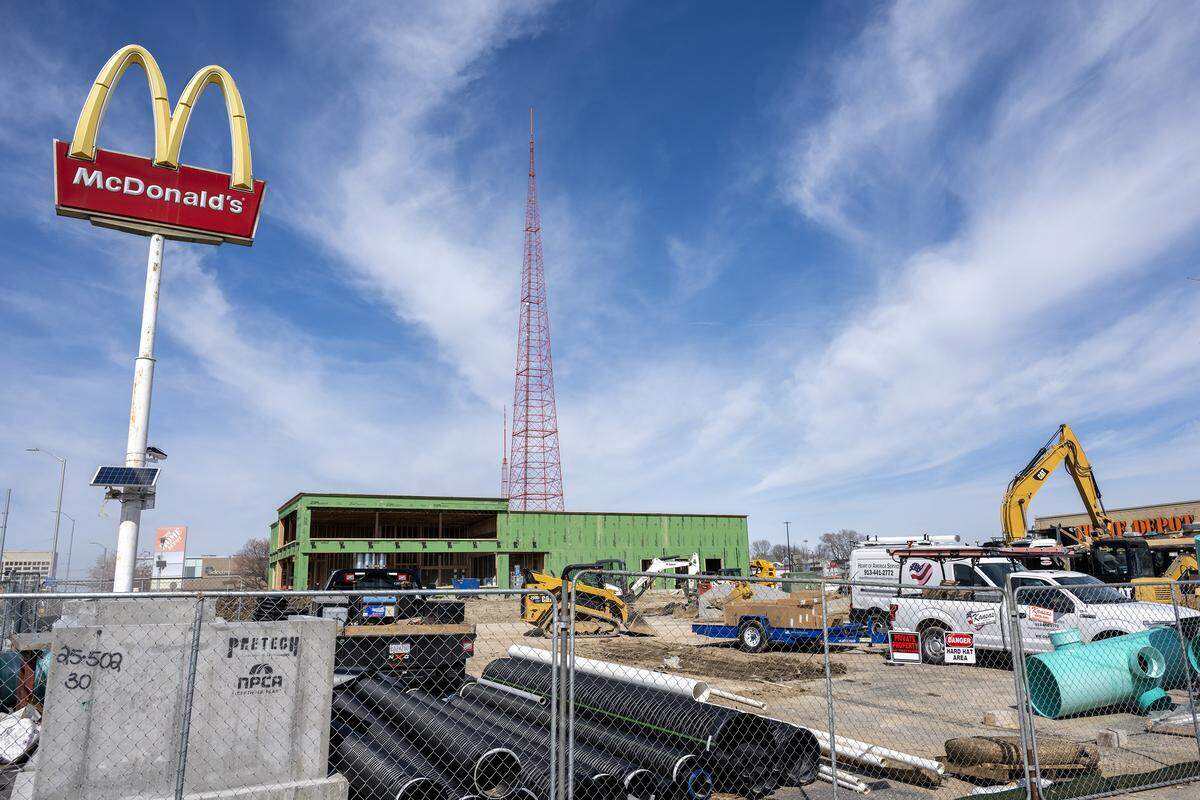
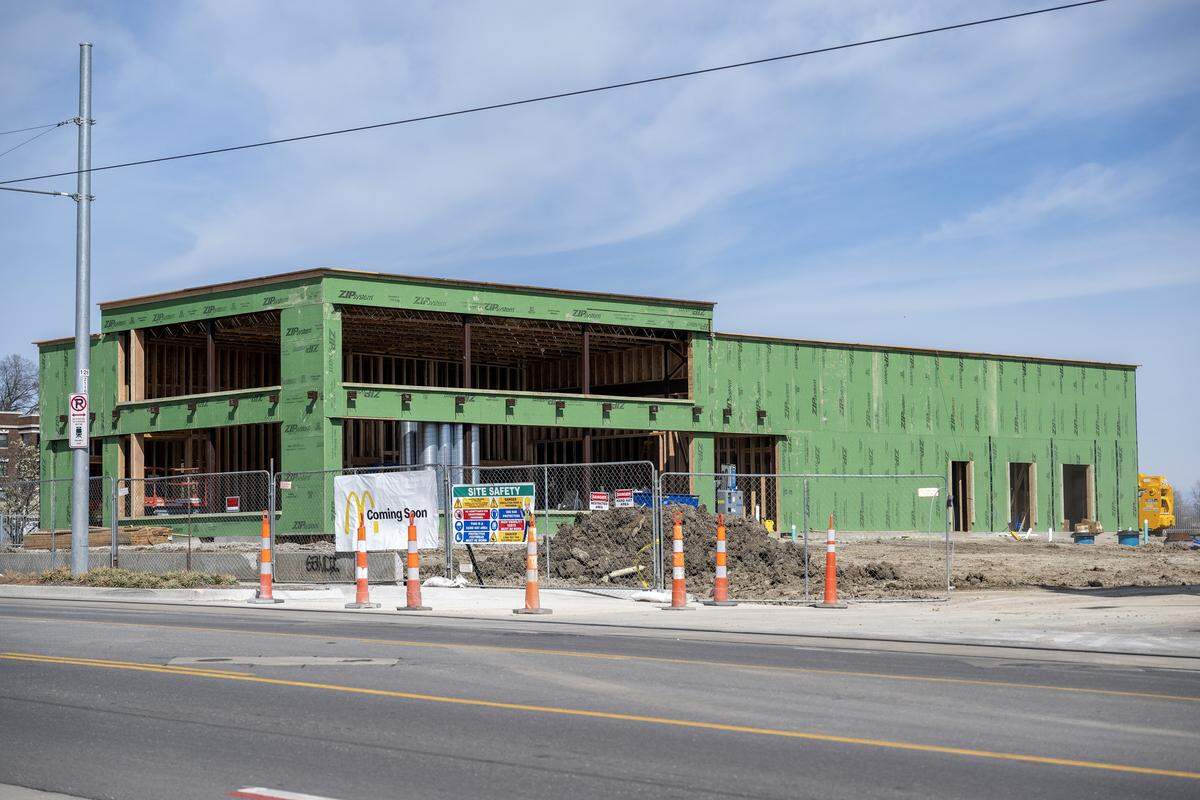
After years of planning, a mainstay McDonald’s near a busy Kansas City corner is getting a full-works renovation: complete demolition, a new restaurant building with a modern facade, improved landscaping — and a double drive-thru design, with two lanes that merge, to more efficiently move cars.
But the revamped restaurant didn’t come without a fight.
In its aim to rebuild and improve its outdated restaurant, the fast food giant’s real estate arm took the city to court — and won — to help bypass regulations along what is now the streetcar line that aim to make the Main Street corridor more walkable.
Plans to rebuild the McDonald’s, 3255 Main St., go back to at least 2017. The old building, which has been demolished and is now a construction site for the new structure, dated back to the 1980s and was in need of an upgrade.
Located in midtown, the McDonald’s opened during an era of development in Kansas City that was more friendly to suburban-style retail in the urban core: big box stores like Costco and Home Depot with big parking lots near fast food restaurants with drive-thrus.
But as plans for the streetcar extension began to take shape, the city passed a new set of standards and rules called the Main Corridor Overlay District that limit what can be built in the area to encourage more walkable, pedestrian-friendly development along the route.
The McDonald’s is within blocks of what is now the Union Hill streetcar stop.
In the years since, more dense development has sprouted up along the streetcar extension, which opened in Oct. 2025, or is expected to come online soon, including dozens of new colonnade-style apartments and new lofts in a rehabbed historic building, both near the McDonald’s site.
The aging 1980s McDonald’s, with its drive-thru, was allowed to remain as it was under the city’s old standards.
But the multi-million dollar plans to knock the restaurant down and build a new one meant McDonald’s would be subject to the new development rules for the area. Most notably: No new restaurant drive-thrus allowed.
The McDonald’s development team first reached out to the city in 2017; a first set of plans to rebuild the restaurant stalled in light of the new Main Street standards and a city staff error, according to an email McDonald’s presented at a hearing years later.
They then asked the city to narrowly change its new rules so their drive-thru plans could proceed.
The Plan Commission signed off on that revision in June 2022, ahead of a final City Council vote, which would have allowed the plan to move forward.
But that vote never happened, and the request expired.
The standstill spurred a years-long dispute over what future development along Main Street should look like.
Drive-thru at odds with city rules
Taking a new tack, McDonald’s came back to the city in 2023 requesting a special approval, called a special use permit, to allow the drive-thru on a property where it normally would not be allowed.
Two city bodies needed to approve that request before it could go to the City Council: the city’s Plan Commission and its Board of Zoning Adjustment.
The proposal remained at odds with the standards for walkable, dense development along Main Street. Other elements of the design conflicted with city standards and would need approved exceptions, too.
“The proposed Special Use Permit conflicts with state and local laws, as well as local policies,” a city staff report said in 2023.
During city hearings, midtown residents who supported the city’s aim to make the area where they lived more friendly for pedestrians, cyclists and public transit called for officials to uphold the standards for Main Street. They wanted the restaurant to add more outdoor seating, less parking and a walk-up window instead of the drive-thru.
“If we allow businesses to have exceptions to the overlay, then we will lose the whole intent of the overlay,” one area resident wrote at the time.
One example critics have brought up was a McDonald’s in Minneapolis: What was once a suburban-style McDonald’s near the University of Minnesota campus was demolished, rebuilt and ultimately preserved as part of a dense, mixed-use development that added housing units to the neighborhood — just without a drive-thru.
But McDonald’s officials said their customers preferred the drive-thru and that the business needed it to be sustainable.
Mark Bryant, lawyer for McDonald’s, said in a hearing that the old building already had a right to exist in that form while being totally non-compliant with the Main Street standards, while a new building would be closer to the Main Street vision with better landscaping and architecture while better serving customers.
“This is more about a need to rebuild a restaurant that is outdated, outmoded and frankly ugly than it is about adding a drive-thru, because a drive-thru exists at this location right now,” he said.
The Plan Commission agreed, voting to recommend McDonald’s proposal in 2023.
“If we deny their ability to renovate, it’s still going to exist, and we’re going to have a longer project, a sadder-looking location that’s probably not operating at the highest efficiency, not serving customers as well, not treating their employees as well, and who’s winning?” plan commission member Tyler Enders said at the time. “I don’t think the city wins in that situation, that we really showed McDonald’s, ‘You better stick to these standards of this overlay.’”
State law gives city pause
But the other city body that needed to approve the permit, the Board of Zoning Adjustment, ran into a legal question. City staffers feared that board didn’t have the legal authority to OK such a change under state law.
The kind of permit McDonald’s was seeking — a special use permit — is what developers might request, for example, to build more units than usual on a residential lot, an exception to the rules, or to build a data center in certain types of business district where a permit is required under city code.
But making way for a drive-thru when the rules specifically prohibit one would be a more uncertain use of that permitting tool. City staff suggested that granting the permit could go against state law.
Missouri law dictates that Kansas City’s zoning board can approve changes or make exceptions regarding “construction or alteration of buildings,” but it can’t approve changes or exceptions for a property’s “use of land.”
Kansas City is the only city in Missouri with that prohibition under the law.
And the city’s own code also says that the zoning board cannot make an exception for the “principal use” of a property.
It’s technical, but the legal question revolved around whether permitting the drive-thru on Main Street changed the property’s “use.” Would it be considered an exception to the zoning rules for the property’s “use,” which the zoning board cannot legally grant — or would it be more like granting an exception to rules around the height, size or density of a building, which are not considered changing the “use,” and which the board can do?
The McDonald’s team argued that the city board would have the authority to approve an exception to the Main Street rules as the “use” would be a restaurant with the drive-thru as an accessory to the restaurant.
But city staff argued that the drive-thru restaurant would be a “use” and emphasized that the placement and design of the building is to accommodate a drive-thru and that a majority of sales come from the drive-thru.
The zoning board decided in September 2023 that it could not legally hear the case requesting a drive-thru permit.
McDonald’s sues KC and wins
The zoning board’s decision stalled the project and prompted McDonald’s to file a lawsuit in October 2023 asking a judge to weigh in.
McDonald’s argued that the drive-thru is “simply an access point to services provided by a restaurant.” The city argued that the zoning board’s decision was correct and that McDonald’s “failed to cite any Missouri statute or case law” that supported its position.
Ultimately, a judge sided with McDonald’s in April 2024, reversing the board’s decision and sending the case back for another hearing, which happened in November 2024, less than a year before the streetcar extension opened.
City staff again opposed a permit to build the McDonald’s with a drive-thru for reasons beyond state law and said it could negatively impact the neighborhood’s character.
They argued that the drive-thru permit still wouldn’t comply with city code or meet various rules for approval and could set a bad precedent for Main Street.
“We know creative options are possible,” city planner Ahnna Nanoski told the zoning board, pointing to the mixed-use McDonald’s in Minneapolis.
The development team again argued that a new building would be an improvement over the 1985 restaurant and be more in line with the Main Street standards, while exceptions were necessary to make it happen.
“They’re not asking you to do anything that’s really out of the ordinary. They’re not even really asking you to add a second drive-thru,” Bryant said. “At the end of the day, that building is going to be served by one pay window and one food delivery window, just like the current restaurant is.”
McDonald’s then received a final verdict from the zoning board after more than half a decade in November 2024: The Main Street restaurant could be rebuilt, drive-thru and all.
Main Street is changing with streetcar extension
But Laura Burkhalter, an interior designer on the Midtown KC Now board who has been involved with the Southmoreland neighborhood association, opposed the McDonald’s plan for years in public testimony.
In a 2024 hearing, she described the situation as “a lack of imagination by McDonald’s to come up with a solution that is a better use for this site,” pointing out the significant investment in adding transit to the area.
With construction underway, she told The Star she stands behind her view at the time.
Burkhalter said Main Street should have a grander vision and questioned why a big company should be excused from the city’s requirements.
The streetcar now runs nearly six miles, from River Market and down past the Plaza, and the Main Street McDonald’s construction site is visible as it zooms through midtown.
It will have a drive-thru, plans show. Plans also show bike parking, outdoor seating and new signage with an updated building design.
The streetcar also passes by more construction sites for buildings that, when complete, will add hundreds of new residents in the middle of Kansas City, including the new construction ArriveKC apartments and Driven Development’s workforce housing alongside the ABC building rehab, which are becoming mixed-use lofts.
Some scars are visible, too, like the hole in the ground where the 137-year-old Jeserich Building stood on the corner of 31st and Main before it was demolished — with a proposal for a future mixed-use building — or the historic Southwell Building near 39th Street, which faces a dangerous building case.
Meanwhile, the streetcar is seeing its highest ridership yet. Another extension, to the Berkley Riverfront, is on the way, and city officials have floated a new line to the 18th and Vine district.
“It’s doing the work that we intended it to do,” Burkhalter said of the Main Street extension. “It’s bolstering a lot of other people that might have been a little shy about it or kind of unsure in other communities, and we’re excited about seeing opportunities for expansion in other areas of the city.”
This story was originally published March 18, 2026 at 12:45 PM.