Facebook could invest $40B in Kansas City data center, rake in billions in incentives
Facebook’s parent company says it could invest up to $40 billion in its newly announced data center in Kansas City’s Northland.
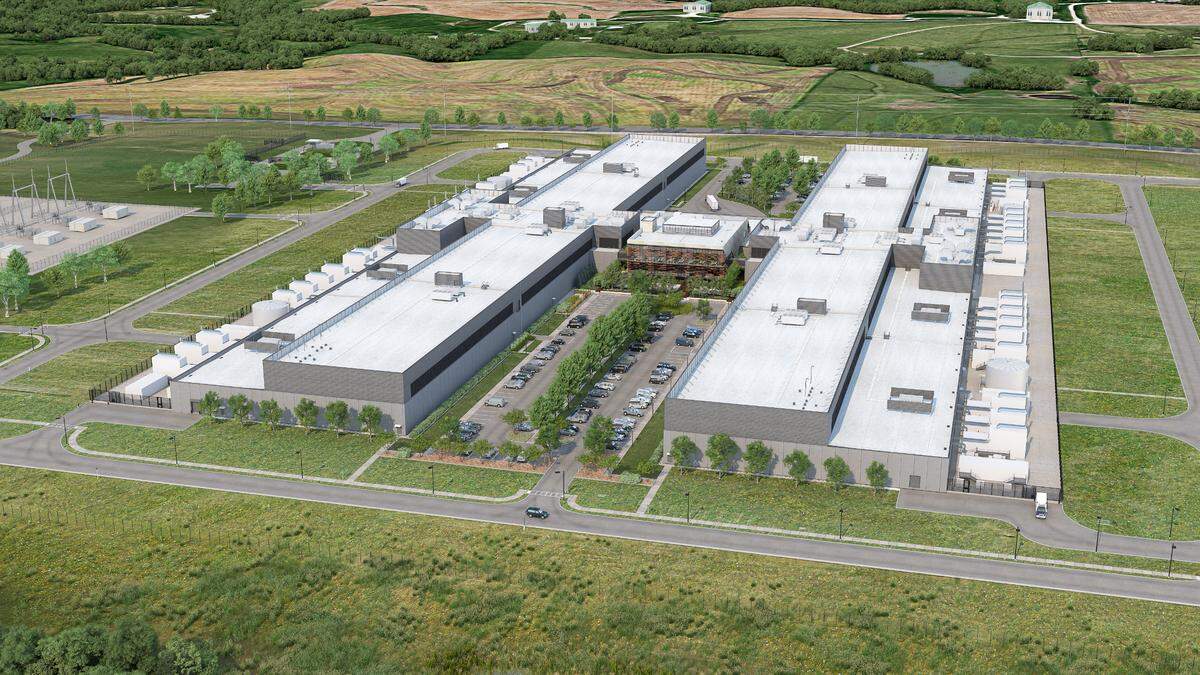
The firm on Thursday rolled out plans for an $800 million data center at the Golden Plains Technology Park, an 882-acre site developed by Diode Ventures, a subsidiary of Overland Park’s Black & Veatch.
Political leaders who gathered at Union Station heralded the news as a major development for Kansas City and the state. A private investment of $800 million would far surpass the scale of recent projects in the region and the state, said Missouri Gov. Mike Parson.
But that $800 million pledge could be just the beginning for Meta, which runs Facebook, Instagram and WhatsApp. Meta spokeswoman Melanie Roe said the company could invest as much as $40 billion at the site in land acquisition, construction, and development of a larger data center campus.
“What we are announcing today represents an $800 million capital investment by the company, but we are prepared for a long term partnership,” Roe told The Star.
A $40 billion investment is more in line with original plans for the Golden Plains Technology Park. That was pitched last year as a massive data center complex that could see more than $100 billion in private investment.
In April 2021, the Kansas City Council unanimously approved a development plan for the site that gives data centers there access to more than $8 billion in local tax incentives, if the park is fully built out as planned.
Incentive watchdog group Good Jobs First says such an incentive award would be the largest ever in American history.
Data centers within the Golden Plains park are eligible for 25-year, 75% tax abatements on real property, which generally includes the land and buildings. Additionally, data centers there can receive 100% tax abatements for personal property, which covers the costly equipment and hardware that fill those buildings. Those items represent the vast majority of a company’s investment in data center development.
That means Facebook could access billions in Kansas City incentives for a $40 billion investment there.
Likewise, the state has made nearly $1.8 billion available to the tech giant through its data center incentive program. The company can benefit from an exemption of sales and use taxes for the next 15 years, said Amy Berendzen, spokeswoman for the state Department of Economic Development.
“This program is performance based, so the actual incentive amount will depend on the company’s investment over the coming years,” she said.
Similarly, the massive property tax breaks available to Facebook will only be awarded once the firm makes an investment. And the size of the awards will depend on the scope of its data center development.
“If they build it, they get the benefit. So our incentive is only as large as the project,” said Dan Moye, a director at the Kansas City Economic Development Corporation, which worked with developers to draft the incentive plan.
Meta is among the nation’s wealthiest companies with profits of nearly $40 billion last year.
While local school systems, libraries and City Council members debate the merits of many incentive awards, those for the data center complex proved noncontroversial. No one spoke against the proposal last April at City Hall and the Council unanimously approved the $8 billion in potential property tax breaks.
Kansas City Councilwoman Teresa Loar, who represents the Northland’s second council district, said the rural property would likely never see major development without the data centers.
“It’s just all farmland right now,” she said. “There’s nothing up there.”
While the companies that build data centers will see reduced tax rates, Loar noted that the taxes they do pay will bring millions in new revenue to the city, schools and other taxing jurisdictions.
“I think it’s a good deal,” she said.
At Union Station Thursday morning, Loar likened her feelings about Facebook’s project to a proud parent who’s just had a baby.
“I have never been so excited about a project,” she said. “This is it. This is the big one.”
Loar has lived in the portion of Kansas City that sits north of the Missouri River since the late 1960s.
“We did have running water in the Northland (at that time) but not much more. And to see what we’ve got in our future here is just beyond belief,” she said.
In recent years, states and cities have competed mightily to land hyperscale data centers, which are growing at a rapid clip as devices and apps drive up demand for data processing. While many companies have central data centers to power their operations, hyperscale refers to data centers that house thousands or tens of thousands of servers.
Last year, Synergy Research Group reported that the total number of hyperscale data centers increased to 597 at the end of 2020, and had more than doubled since 2015.
Amazon, Microsoft and Google collectively account for over half of all major data centers.
Researchers note that data centers don’t bring the kind of economic growth to a region that a new factory or corporate headquarters would deliver.
While they may be massive and expensive, they employ relatively few people: Facebook, for example, said its 1 million-square-foot data center in Kansas City would employ up to 100 workers.
Still, local officials on Thursday pledged that the arrival of Meta would lead to more investments from big tech firms.
“There will be more coming,” said Tim Cowden, president and chief executive of the Kansas City Area Development Council. “Meta’s a leader. There will be more companies that will see this that will follow.”
In addition to its state and local incentives, Meta also received a discounted rate on electricity from Evergy, the area’s publicly traded electric monopoly. The utility will also build a new substation at the park to power new data centers.
Data centers consume large amounts of energy to power their servers and huge volumes of water to cool them. The Kansas City Council last year agreed to craft a water services agreement to serve the Great Plains park, but officials this week said no agreement had been finalized.
Officials with Evergy would not disclose details of the preferential power rates given to Meta but did say they will power the facility with 100% renewable energy.
“Evergy’s competitive rates, access to renewable energy and reliable service are key to attracting a business like Meta,” said spokeswoman Gina Penzig. “Missouri has enabled Evergy and other utilities to offer economic development rates to help communities attract new business.”
This story was originally published March 25, 2022 at 5:00 AM.