Years before KC streetcar expansion on Main St., development begins to boom in Midtown
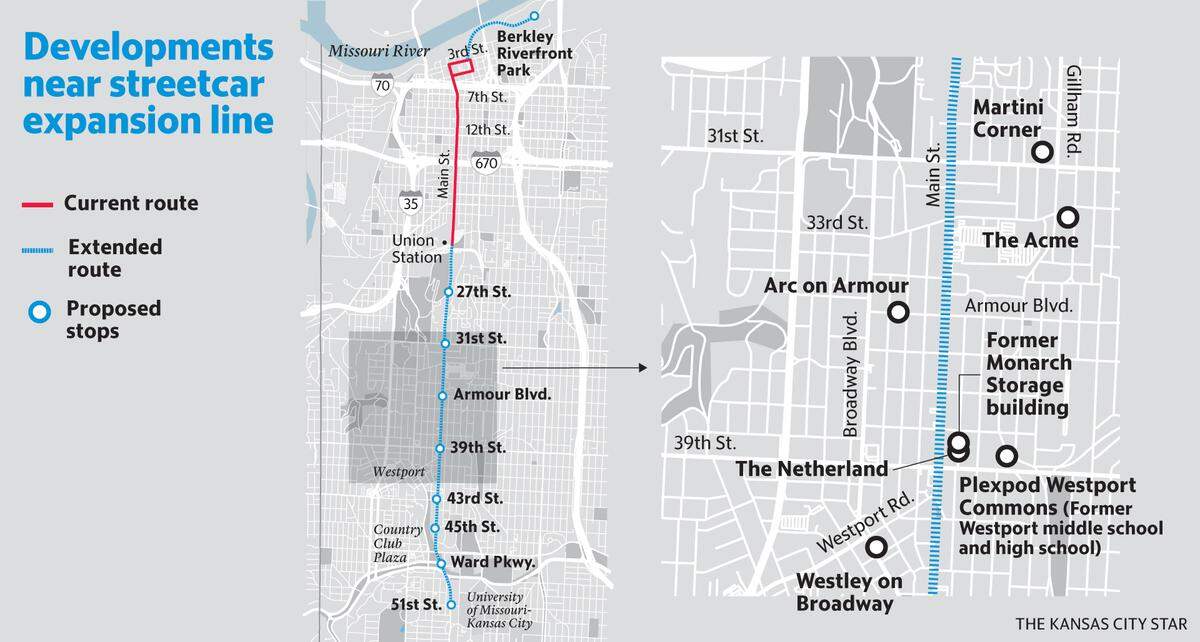
On a new rooftop bar opening high above Main Street, Caleb Buland looks out over his growing real estate portfolio along the planned streetcar route.
His company, Exact Partners, has already restored two century-old, multi-storied apartment buildings. Coming up: a boutique hotel, food hall, concert venue, offices and more residential — an estimated $75 million investment that will keep the developers busy until late 2024.
Just as they are wrapping up, a $351 million expansion will bring the KC Streetcar to Midtown in 2025.
Buland didn’t pick the Main Street strip for its streetcar access, but he said it should attract more developers to join him in Midtown’s revitalization.
“New food services, new housing and new experience options so you can walk up and down Main again,“ he said. “I think having the streetcar come to Main is going to be really key on kicking off that walkability. It’s just a net benefit for everyone involved.”
Local officials expect to see more Midtown development now that the streetcar’s extension — from Union Station all the way to the University of Missouri-Kansas City — looks to be a reality. The massive infrastructure project got a major boost in August, when the federal government awarded more than $50 million in grant funds to help finally make it a reality. Streetcar leaders expect construction to begin in 2021 or 2022.
The streetcar’s starter line preceded some $2 billion in downtown development projects and officials expect a similar building spree to follow the planned route extension — an addition poised to reshape several neighborhoods in the heart of the city.
Kevin Klinkenberg, who runs the nonprofit community and economic development agency Midtown KC Now, thought the pandemic might slow down the pace of development along the route.
“But it has not. In fact, momentum is building,” he said. “We’ve been excited because the streetcar is still four years away from running, but there’s incredible interest on the part of developers and property owners.”
Aside from new apartments and offices, Midtown has seen new restaurants and stores open, including the Midtown Market grocery store, even amid the coronavirus pandemic.
The nearly 4-mile extension will certainly change Midtown, an area that has been transforming for decades. But it will also change the streetcar.
The two-mile starter line, with stops at the River Market and Power & Light District, has proven a popular draw on its own. But the extension puts the KC Streetcar closer to its goal of serving as the backbone of a mass transit system capable of moving crowds of people across different parts of the city.
“We will be picking up more traditional commuter patterns,” said Tom Gerend, executive director of the Kansas City Streetcar Authority. “We’re serving not just entertainment and major business districts, but residential neighborhoods. So absolutely we expect the function in that regard to shift significantly.”
Linwood to 39th Street
Exact Partners now owns multiple Main Street parcels from Linwood to 39th Street. Buland, an architect, and his partner, attorney Ilan Salzberg, renovate old buildings or build new ones on empty lots.
“If you put good things in places people will come,” Buland said.
The Netherland, their 11-floor loft apartment building at 3835 Main St., is more than 90% occupied.
While the Spanish revival-style building, circa 1928, made the National Register of Historic Places in 1979, it was rapidly deteriorating.
In mid-1981, the city evacuated the mostly elderly residents on fixed incomes. The crumbling facade was dangerous and if “high winds or lightning hit the building, its brick veneer would come tumbling down,” city officials said at the time.
Residents later returned but other redevelopment plans fizzled over the years. It had been empty since 2008, Buland said.
Exact Partners snapped up the building about four years ago and spent two years taking it down to its concrete floors and beams. It opened in May with 114 loft apartments and rents from $750 to $1,250.
The Canary Bar + Bistro — created by the owners of Julep Cocktail Club in Westport — will soon open on the first-floor lobby, as well as on the rooftop, one of the highest rooftop bars in the city.
Just to the north, Exact Partners redeveloped the 7-story Monarch apartment building, where residents will start moving in this week. It boasts a rooftop wave pool, a yoga studio and two floors of commercial space that will house boutiques.
And just to the north of the Monarch, a parking lot will make way for a new five-story apartment building with two levels of underground parking.
Exact Partners also recently acquired and will upgrade a two-story brick building at 3901 Main St. with offices on the second floor, retail and bank on the first.
Another building, at 3215 Main St., will be for health care tenants, including some offering affordable health care options.
Their barrel roof building at 3620 Main St. — the historic Kansas City National Guard Armory — will be renovated for a boutique hotel, concert venue and food hall. More residential is planned nearby.
Midtown will continue to change
While the downtown line has proven popular with residents, Gerend said it was always intended to go beyond Union Station. In the future, he expects the streetcar to help transform Midtown the way it has reshaped downtown.
“The way people have embraced and utilized the streetcar downtown has really changed how people have accessed our city, where they go. It’s been a point of pride,” he said. “Think of how many pieces of infrastructure we’ve built in the last 20 years that are a point of pride. There really aren’t that many.”
At its peak in the 1950s, Midtown was home to more than 73,000 residents. But like other parts of the city, it saw population decline amid the rise of the American suburb following World War II.
By 2017, Klinkenberg said Midtown was home to about 29,000 people, a number he hopes will increase as the streetcar comes on board.
“The streetcar is also a great opportunity to just continue to make Midtown more walkable in general and kind of reverse some of the changes that were made in the ’50s and ’60s that made Midtown sort of a drive-through area,” he said. “We really want this to be a drive-to destination, a walk-to destination and not some place people just speed through. This streetcar provides the opportunity to change that whole narrative about the middle of the city.”
While the streetcar has certainly fueled interest, Midtown has been redeveloping for years. The Opus Group recently opened the 256-unit Westley on Broadway apartment complex in Westport. And Mac Properties has invested millions to bring more than 1,600 apartments to market.
That Chicago-based company has opened 30 apartment buildings since it began working in the area in 2007. Mac Properties has refurbished old buildings and brought new ones to market like 3435 Main, the city’s first modular apartment building.
Klinkenberg expects the development of the area to continue to push prices up, with or without the streetcar.
“I think people should expect prices to go up because the area is in demand more than it used to be,” he said. “Not just the Main Street corridor but all of Midtown is recovering from the time period where it had a lot of abandonment.”
But Midtown’s diversity of housing options, from apartment buildings to historical homes, has made it a more affordable option than pricey areas like downtown or the Crossroads Arts District.
Neighbors feel mix of excitement, trepidation
Doris Yonker, treasurer of the Heart of Westport Neighborhood Association, said most people in her neighborhood are excited about the streetcar.
In a lot of ways, the historic Westport area is much like a small town, with its own post office, library and stores. Yonker said the streetcar will make the area even more accessible and walkable for visitors and residents alike.
“I’m looking forward to it,” she said. “We have had a number of businesses open up along the way even though it’s going to be a few years before the streetcar gets here.”
But even before the streetcar, some have worried about rising prices. A renter in the area for 18 years, Yonker said her monthly rent increased by $150 about two years ago. So she does worry that some will be priced out of the neighborhood.
“We don’t want the people who work in our stores and shops to have to live in Raytown because they cant afford to live here,” she said. “That is absurd.”
Costs will undoubtedly increase for many along the route. To fund the extension, voters in the area approved two new revenue streams in a 2018 election: a 1-cent sales tax for the area and a new property assessment. That assessment is similar to traditional property taxes, but will also include usually tax-exempt institutions like churches and nonprofits, who will pay at a reduced rate.
“I sort of get tired of hearing the streetcar’s free. Because no, it really isn’t,” said Scot Stockton, president of Old Hyde Park Historic District Inc., a neighborhood association. “We’re paying for it whether we use it every day to get to work or once a month for recreation. It costs us the same amount.”
The special assessment means that the owner of a home valued by the county at $200,000 will pay an additional $266 per year, streetcar officials said. The owner of a commercial property with a market value of $1 million that is located within the assessment zone would pay an annual special assessment of $1,536.
Aside from higher taxes, Stockton said some residents are just worried about how the streetcar may change the area. Main Street runs right through the Old Hyde Park Historic District. That corridor has plenty of surface parking lots or small one-story buildings that could easily be redeveloped.
And some are worried about how future developments could encroach on the historic neighborhood and disrupt traffic and parking.
“Everyone keeps saying well you’re going to have the streetcar,” he said. “Well, that’s fine, but that doesn’t help if you’re inviting friends from Overland Park. They’re going to drive here and park. The streetcar is not the end-all-be-all for transportation.”
Still, Stockton said he’s not necessarily against the streetcar. While it’s unclear how much things will change, he expects it will ultimately help Midtown.
“The bigger concern is the not knowing,” he said. “I’m hoping it will be a positive for what it’s costing and the time and all of that that’s been put into this.”
Pain before progress
The streetcar will undoubtedly increase traffic for retailers along the route. But they’ll have to deal with years of construction before the extension ever opens.
That could prove particularly challenging for stores and restaurants that have struggled through months of declining sales because of the coronavirus pandemic.
Steve Maturo, owner of Museo, a classic modern furniture store in Union Hill, said his employees and customers will be inconvenienced during the construction phase.
“But in the long-term it will be great for Union Hill, the neighborhood we are in. And it will create more visibility for us,” he said. “I think the improvements along the corridor will be stunningly beautiful when it is all done.”
Laura Norris, owner of Ragazza Food & Wine at 4301 Main St., has been supportive of the streetcar expansion. But she knows downtown restaurants struggled with parking and access issues during construction of the starter line. She hopes they can speed up the expansion and minimize the disruptions, such as construction workers taking up needed parking space.
“It’s absolutely to my advantage to be on the streetcar line,” Norris said. “But coming out of this year with COVID, when our sales are 40 percent of what they were, it’s going to be difficult. There were financial resources for COVID. There won’t be for the streetcar. Wake me up in 2025.”
For 52 years, Pryde’s Kitchen and Necessities has sold all manner of cooking gadgets, cutlery and appliances from its building in the heart of historic Westport. Owner Louise Meyers, who purchased the store from her father 20 years ago, expects the streetcar to bring in more development.
“I think you’ll see a lot of big construction and big money,” she said. “I don’t think you’ll see a lot of small businesses just simply because they can’t afford to because the real estate will be too high.”
Stores like hers are constantly trying to compete with online behemoths like Amazon. For Meyers, there’s nothing like coming into a fully stocked store, exploring the merchandise and discovering new things.
That experience, though, requires foot traffic. And that’s the conundrum for stores like hers, who can expect to be both hurt by construction and helped by the eventual crowds that the streetcar promises to deliver.
“If you can survive the pain of progress, the density, prosperity and explorative excitement will ensure the rebirth of the main artery of Kansas City,” she said.