Why a Johnson County town’s push to get broadband is headed toward a DA investigation
City leaders told residents in Spring Hill — a growing community tucked away in south Johnson County — that their notoriously unreliable internet service would soon improve, igniting hope that they could effortlessly stream Netflix or pay the bills online without relying on a mobile hot spot.
But recently in some quarters, hopes for fiber optic internet at every home and business have twisted into suspicions over how the city government operates.
Critics question the City Council’s plan to spend hundreds of thousands of taxpayer dollars on a so-called dark fiber network that would connect only a few city buildings before residents and businesses get access. And a secret bid process — paired with one council member’s aggressive lobbying for a preferred vendor — raised wider questions.
Allegations of corruption and secrecy were so overwhelming that the mayor has called for the Johnson County District Attorney’s Office to investigate the actions of the City Council in this town of 7,000.
“My main goal is I just want fiber. I want a reliable internet source. I don’t want to have to worry about it being down for a day or two,” said Shannon Frodsham, who moved with her family to Spring Hill last year. “Why can’t the citizens know what’s going on? What are they hiding?”
Councilman Tyler Graves, who took office last month, said on Facebook that the process has elicited serious accusations of corruption and theft at City Hall. While he said he understood distrust of government at the federal level, he reminded his followers that local elected officials are friends and neighbors.
“A little over one month in and this has been one of the worst experiences I’ve ever been part of,” he wrote.
Now with controversy swirling and an inquiry underway, it’s unclear how the city will move forward. Or when people like Frodsham will finally get a reliable connection to the web.
‘We moved back in time’
Last year, Frodsham thought she’d found the perfect home for her young family of four when they moved to Spring Hill.
The town seemed to have everything her family needed: Homes in the right price range. A quiet, small-town feel. Easy access to Interstate 35, making regular trips to Children’s Mercy Hospital for her son with special needs less daunting.
But after moving in, Frodsham quickly learned what Spring Hill often lacks: reliable high-speed internet.
Though it’s one of the fastest growing cities in Kansas’ wealthiest county, Spring Hill has been ranked among the rural cities with the slowest internet speeds nationwide. And residents say the spotty access has affected all aspects of life there, from how home values fluctuate to how businesses operate.
“I feel like we moved back in time 20 years,” Frodsham said. “My husband works from home, so it’s really put a damper on our source of income. And we just can’t move right now and lose money on a house when we’ve got all of these medical bills coming through.”
Craig Dutcher tells a similar tale. When he moved from Kansas City to Spring Hill, he said his internet bill nearly doubled.
Yet, every day he wonders whether his internet connection will last long enough to send some emails, check Facebook and back up his iPhone.
“Right now, I probably have bottom-tier internet, let’s just put it that way,” Dutcher said. “Our family usually runs internet off of Verizon hot spots. Or we’ll go to McDonald’s for the free Wi-Fi and get our work done that way.”
Like many rural Kansas communities, Spring Hill has for years struggled with access to broadband. Even with two providers in town — CenturyLink and Suddenlink — city leaders reported frequent outages, causing government offices to lose access to both internet and phone service.
A 2017 city survey found the town was home to pockets of residential areas with limited to no internet access.
Hope for broadband comes — and goes
This past year, Dutcher started seeing signs advertising a new fiber internet option popping up around his neighborhood.
“There was some excitement that we were finally going to get some decent service,” he said.
He and others hoped the signs, put out by area company RG Fiber, meant the city’s efforts in recent years to attract a new internet provider had been successful.
At the beginning of 2017, the City Council had launched a seven-member broadband task force that started examining the feasibility of a public broadband utility or private partnership.
That process played out in the open. Task force meetings were held in public with agendas and minutes posted to the city’s website.
The city agreed to pay $60,000 to consulting firm CTC Technology and Energy to conduct a feasibility study. In a 175-page report, the Maryland-based company addressed the challenges Spring Hill faces, saying the town lacks the scale needed for a stand-alone fiber service.
But it also said the town needs to plan for the future, as its population quickly expands along with other outlying areas of Johnson County.
With parts of the town sitting in both Johnson and Miami counties, in many ways, Spring Hill is stuck in the middle — between sprawling suburbia and a quieter rural way of life. With nearly 600,000 residents in 2018, Johnson County was nearly 18 times larger than Miami County, which was home to about 33,700 people that year.
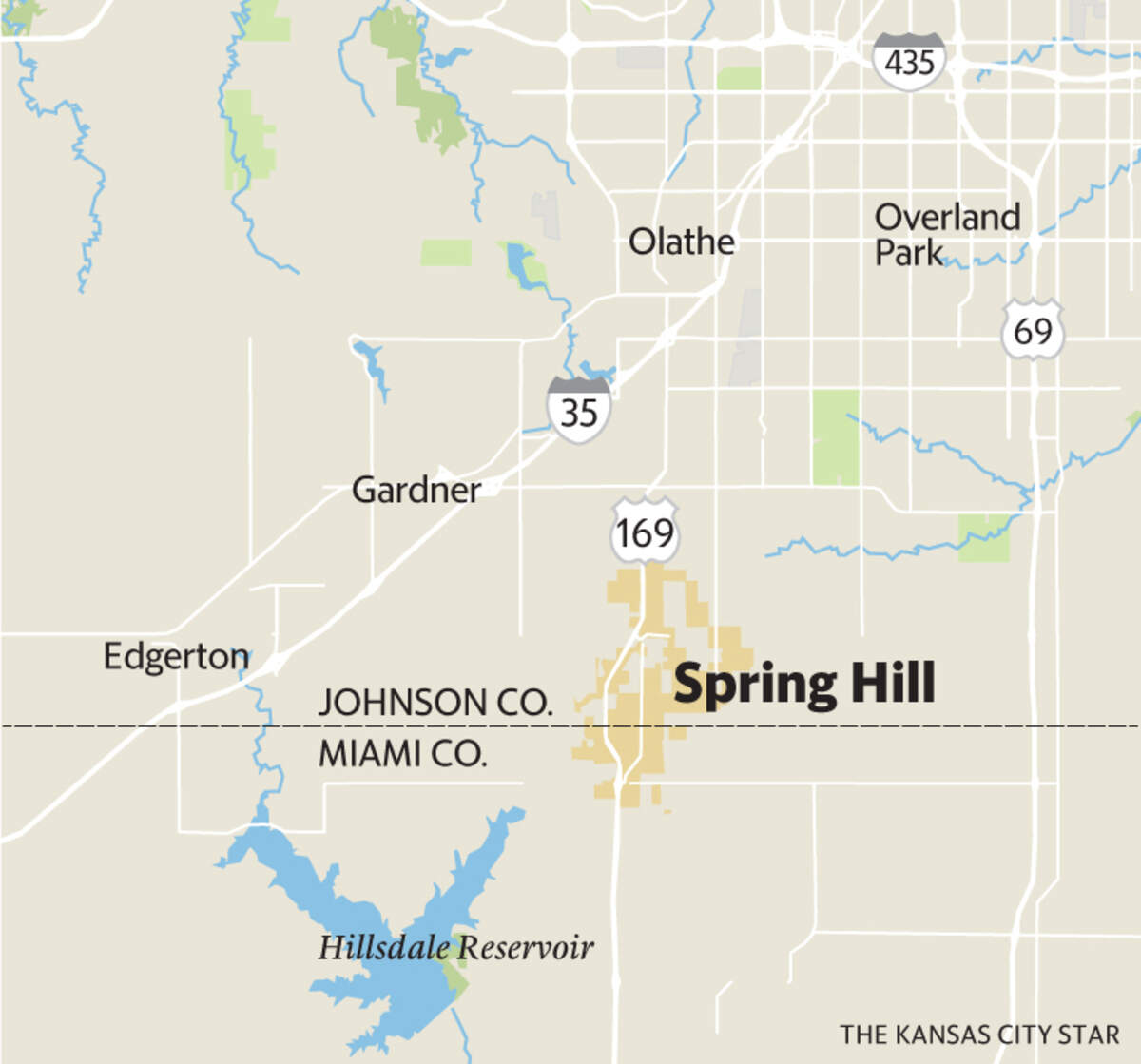
The town faces similar growing pains to other Johnson County cities, including increasing interstate congestion and rising home values. Off of U.S. 169, the exit resembles any old suburb with a nail salon, restaurants and a gas station filling out a bustling strip mall near a large apartment complex and expansive subdivisions. But a visit to the fabric store, coffee shop or antique store in the one-block-long downtown paints a picture of a quintessential rural Main Street.
The consultant report laid out a path for the city to follow, including issuing a request for proposals for a company willing to bring broadband to town.
Meanwhile, the signs advertising the long-awaited fiber service began popping up.
The city itself advertised RG Fiber’s arrival and invited residents to attend a launch party in September: “Gigabit-class Internet service could soon be arriving at your doorstep. Learn more about fiber, how it gets to your front door and more,” an announcement on the city website read.
After years of work to improve service, someone finally stepped forward and seemed interested in Spring Hill.
But slowly, RG Fiber’s signs started disappearing.
Building dark fiber
Spring Hill’s consultant advised that the city consider a so-called dark fiber network. Though models vary, dark fiber involves leasing out capacity of the fiber optic cables that propel high-speed internet. The consultant said Spring Hill could construct and maintain the cables for every resident and business and lease the system to a private partner.
The company estimated it would cost between $4.8 million and $5.4 million to construct such a fiber network.
After the consultant’s work concluded, the city in August issued a request for proposals, seeking “a creative partnership” with an internet company to provide 1 Gigabit per second service. It promised to waive permit and inspection fees, among other incentives.
“The City views fiber-based broadband connectivity as an essential utility,” the request said. “Every home, business, nonprofit organization, government entity and educational institution should have the opportunity to connect.”
But the request also asked for a partner to build out a dark fiber network, connecting eight city facilities, including the aquatic center, police station and a park. Aside from improving the city’s internet connections, that work could serve as a starter system and save the bidder money. A private broadband provider could lay its own fiber for homes and businesses starting with trenches dug for the city’s needs.
Now, some residents are questioning whether the City Council has pivoted to prioritizing municipal buildings over a wider citywide fiber project.
The bids were due by the end of September, even though RG Fiber had already been finalizing its plans to move into Spring Hill outside of the formal procurement process. With that company’s commitment uncertain, the city then started to shield the process from public view.
Public lacks information
In issuing a request for proposals, the city required companies to sign a nondisclosure agreement.
So unlike other items on the council’s agenda, residents could not view the proposals before the council voted.
Still, the interest from providers was clear: 12 companies submitted bids, including RG Fiber. A committee that reviewed the proposals determined the best prospect was from Allo, a subsidiary of Nebraska-based Nelnet, a federal student loan servicer.
The city budgeted $350,000 to spend on the project as part of its five-year capital improvement plan, with the money likely going toward a fiber network connecting city buildings.
But at a Jan. 23 meeting, Council President Steve Owen asked whether the city should even be selecting a firm, given the wide interest from multiple companies wanting to invest in Spring Hill.
“We’re going to spend $350,000 and it’s supposed to bring in more competition,” he said. “But I think we’re actually scaring competition away by doing it because we’re picking a winner.”
Councilwoman Andrea Hughes, who served as a liaison between the council and the broadband task force, urged the council to accept Allo’s proposal — and to do so quickly.
In the days leading up to the vote, Hughes took to Facebook several times, urging Spring Hill residents to attend the meeting and back her preferred vendor.
“Tell the City Council that you want the City to begin Contract negotiations with Allo Communications NOW no more delays,” she wrote multiple times. Of the 90 comments on one post, she wrote 22, including seven near-identical ones urging residents to come support the committee’s plan.
Fueling public suspicions is the broadband consultant’s ties to Allo. When it bid to work with the city, CTC touted its “deep relationships” with internet providers, including Google Fiber, MetroNet, Ting Internet and Allo. From that list, only Allo submitted a formal proposal.
Neither Allo nor CTC officials could be reached for comment.
Hughes maintained that the city must act to improve sluggish service, writing that larger companies like Google, AT&T and Spectrum “did not see the dollars and cents in Spring Hill” and were not interested in coming to town.
But existing service providers were interested in expanding locally.
One of them, Suddenlink, was among the dozen companies that submitted proposals. That company wrote that projects were already underway to bring 1-gigabit broadband service by the end of the year.
Suddenlink sought no incentives and said its expansion plans were independent of the city’s effort to build a dark fiber network.
RG Fiber proposed the city spend $250,000 — a full $100,000 below the city’s own estimate for the project. But as the council prepared to vote on the measure, someone asked which of the prospective bidders was the lowest.
Hughes said the decision came down to two providers, and “when you added in all the extras, there were two that were very similar in costs.” Without seeing the bids, residents had to take her at her word.
But RG Fiber owner Mike Bosch said that statement was a “blatant misrepresentation” of his company’s bid.
Allo did not include an estimated cost to the city in its proposal, noting it would depend on the construction cost and time frame. But in city documents comparing each bid, Allo’s cost was listed as $350,0000 — $100,000 more than RG Fiber’s proposal.
After tabling a decision once before, Hughes on Jan. 23 urged her council colleagues to move forward with Allo that night. They followed her lead, voting 3-1 to begin final contract negotiations with the Nebraska company.
“If you kill this today, you kill three years’ worth of work, and people are stuck with what they have now for the existing future with no plan to make it better,” Hughes said before the vote.
But the controversy was only just beginning to unfold. Residents raised questions and lobbed accusations. And the public started requesting records to figure out what the city was up to.
Area company questions investment
RG Fiber, once the city’s promised solution, now is sitting on the sidelines.
“There’s an active effort to undermine RG Fiber’s efforts and we’re not really sure the reasoning or the rationale. And it’s hard for us to move forward in good faith,” Bosch told The Star. “Because we’re talking about investing millions of dollars over time, and if we’re going to be fighting an uphill battle we’d rather spend the money somewhere else.”
In 2014, Bosch had owned a software company in Baldwin City. But the town’s slow internet — serviced predominantly by legacy telephone wiring — complicated business. So rather than wait for a major carrier to improve things, Bosch said he took matters into his own hands and RG Fiber was born.
The company first provided fiber connectivity in Baldwin City, home of Baker University. And it recently connected homes and businesses in De Soto, another Johnson County community that struggled for years with internet.
Aside from being fast, he said RG Fiber’s reliability is top-notch — beating that of even Gmail, Google’s email system.
But Bosch’s work hasn’t been without controversy: He has left a trail of business disputes in his wake, including a high-profile battle in 2014 with another internet provider seeking to provide service in Lawrence.
Still, Spring Hill welcomed his business early on.
The mayor introduced Bosch at an RG Fiber launch party last year, which the city publicized on its Facebook page, while noting the request for proposal process would continue.
“We have an RFP out there,” Mayor Steven Ellis said at that event. “We’re going to see what interest there is, but at the end of the day I am delighted to report that the problem’s solution is on its way.”
RG Fiber ultimately received the second-highest score from a committee that judged the bids. City leaders say they still want the company to come into town — after all, competition will help keep prices down. But Bosch said he’s hesitant to invest now that city leaders seem to have identified a favored vendor.
So for now, he’s waiting to see what the city does.
Secrecy fuels suspicions
Residents might have scrutinized an effort to spend $350,000 on the project regardless, but many say the city’s secrecy has fueled their suspicions.
The bids eventually did become public. City Attorney Frank Jenkins advised the council that confidentiality agreements would not preempt the disclosure requirements of the Kansas Open Records Act. And that’s how residents — and The Star — obtained copies of the 12 proposals.
City leaders said they required the privacy agreements to encourage more companies to respond. without publicizing business secrets like detailed financial information. And Hughes said the city also wanted to protect any maps showing proposed locations of fiber lines to prevent saboteurs.
Hughes is an attorney at Commerce Bank, according to her LinkedIn profile, with previous experience serving as the deputy counsel for Leavenworth County.
“We’ve never done this kind of RFP before,” she said in an interview with The Star, noting consultants pushed for the nondisclosure agreements.
Residents have only intensified their scrutiny in recent weeks. Several asked questions of council members at a Feb. 13 meeting. And more say they plan to do the same at the Feb. 27 regular meeting.
With what spotty internet service they do have, locals have taken to social media to trade accusations of impropriety and kickbacks while digging for more information.
Lawrence attorney Max Kautsch, whose practice focuses on First Amendment rights and open government, said the entire point of open meetings laws is to allow the governed to know what the government is up to.
“And without a fair and transparent bidding process, there is no way for the public to challenge or verify the decisions of the governing body,” Kautsch said. “I don’t think the city has any choice but to put itself back in the position where it should have been in the first place — to allow for the proper input from the public.”
For many residents, that means the city should start its procurement process over again, but this time in an open process.
Investigation could stall process
The pushback has been severe enough to convince the mayor to seek an independent review of the process. A day after the council voted to approve Allo’s proposal, Ellis asked the Johnson County District Attorney’s Office to investigate “allegations of impropriety in the process.”
A spokeswoman for the office said it had received no information from Spring Hill.
The mayor said he appointed special counsel from the Kansas City, Kansas, law firm McAnany Van Cleave & Phillips to gather information on the city’s procurement process. The firm will then hand over material to the Johnson County DA, he said.
Ellis, who as mayor did not vote on the project, told The Star he doesn’t believe the council acted inappropriately. But he wanted to respond to the backlash and let an impartial arbiter review the facts at hand.
“When a number of residents start raising these types of concerns, I want their voices to be heard,” he said. “And I want to ensure there was integrity in the process.”
But with no word from the county’s top law enforcement official, critics remain suspicious that the city will approve a contract anyway.
One resident, Roy Riffel, peppered council members with questions at the council’s most recent meeting. He reminded the group that broadband was a major theme of recent campaigns.
“One thing I can’t stand about politicians is when they run, they make all these promises and all these things they want to do,” he said. “They never do it. They just know what the taxpayer wants and what the voter wants.”
In an interview, Riffel questioned the ongoing costs of building and maintaining a city dark fiber network. While the city’s internal internet needs were mentioned early on, he said that only recently became the primary driver of the process.
“The goal was to get the citizens internet,” he said, “and now it’s, ‘Get the city’s internet and then we’ll worry about the citizens later.’”
Some have complained that the independent review will only prolong the city’s years-long attempts to expand high-speed internet access. But even as that investigation proceeds and the city works to negotiate a contract with Allo, other internet providers have kept busy.
Residents say both CenturyLink and Suddenlink continue to improve speed, evidenced by the commercial vans spotted around town as crews install fiber.
“Today I have 1 gig in the city limits,” Riffel told the council. “They upgraded my entire neighborhood.”
For an already suspicious community, that work — done at no cost to taxpayers — contradicts the city’s premise that it must act to usher in broadband.
Suddenlink officials could not be reached for comment. But CenturyLink spokeswoman Linda Johnson said that company had made “significant network investments” in many parts of town, providing speeds of 940 Mbps — just shy of 1 gig — to more than 500 locations in the city with more to come.
Hughes doesn’t deny that providers are expanding in tandem with the city’s controversial procurement process. But she said it’s actually evidence that the city’s work is successful.
“Competition is working,” she said. “I mean, it wouldn’t be competition if you didn’t keep the pressure on, now would it?”
This story was originally published February 24, 2020 at 5:00 AM.