With Kansas City mayor’s support, Waddell & Reed set to get millions to leave JoCo
A downtown office tower, one of the last vestiges of Kansas City’s economic development “border war,” passed through a Kansas City Council committee on Wednesday.
And despite its massive scale, the incentive package has support from several City Council members and Mayor Quinton Lucas, who has often been skeptical of subsidizing downtown projects.
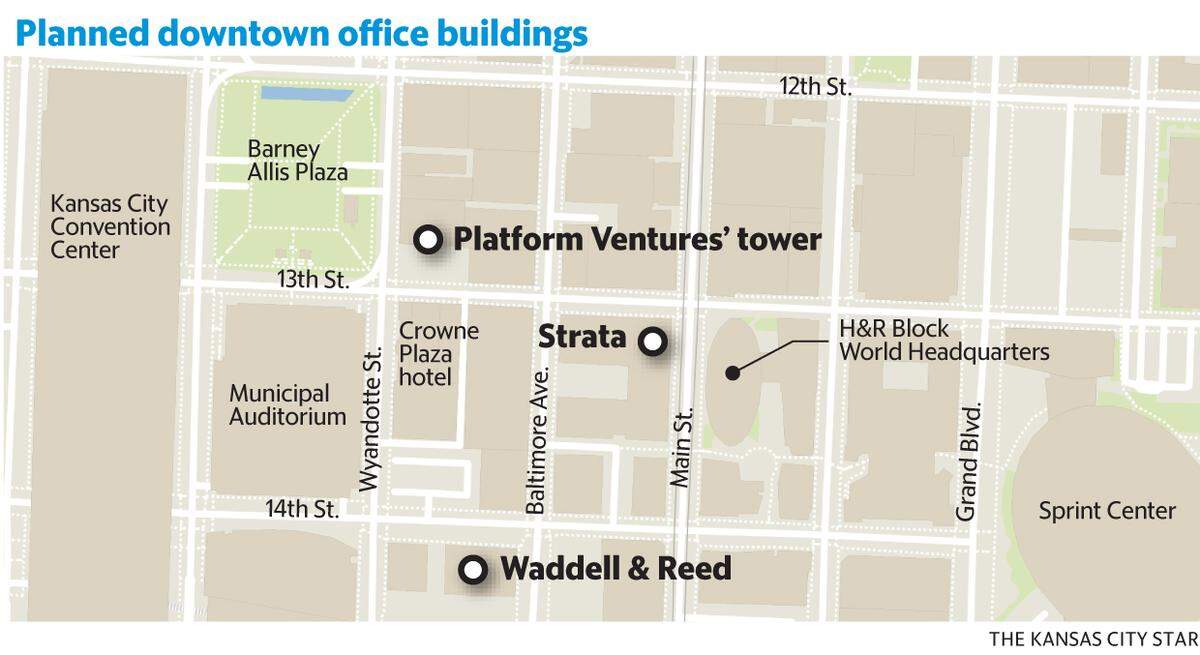
Members of the Neighborhood Planning and Development Committee voted 3-1 in favor of the city’s incentive package — worth more than $40 million over 15 years — for Overland Park-based Waddell & Reed to build a new headquarters and move more than 900 employees to 14th Street and Baltimore Avenue.
Waddell & Reed, a financial services firm, has already received about $62 million in state incentives from the Missouri Works program for those jobs and another 120 it plans to add over the next six years. That brings its total incentive package to more than $106 million.
The company’s move is expected to be one of the last and among the most prominent in the longstanding “border war,” which critics say wastes taxpayer resources by granting subsidies to companies moving back and forth across the state line without creating additional jobs for the region.
Governors from both states signed an agreement in August pledging to end the use of tax incentives to lure companies with little benefit for the wider region. They said that practice has cost the states hundreds of millions of dollars with little to show for it. In agreeing to end state subsidies for such moves, Kansas Gov. Laura Kelly, a Democrat, pushed Missouri cities to scale back their use of local incentives, too.
But their agreement left room for moves, like Waddell & Reed’s, that were already underway. Critics pointed to the project as a prime example of what was wrong with the previous practice.
“We’re talking about a lot of tax abatement for no new jobs that’s going to be constituted by people who live here,” said Councilman Brandon Ellington, 3rd District at-large.
But in an interview with The Star, Lucas, who has championed economic development reform, defended the heavily subsidized move, pointing out that it will bring a significant amount of jobs to downtown and revitalize an under-performing block. He noted that other proposals have sought subsidies for speculative development and asked for city guarantees on parking.
“This project and the proposal before us do none of those,” Lucas said, “and so I think it is a much better deal that is presented to the council than we saw with projects like Strata, than certainly we saw with Hotel Bravo and better than almost any project we’ve seen in the past year.”
Members of the Kansas City Tax Increment Financing Commission Board in October voted against a 23-year incentive agreement for Hotel Bravo, a luxury hotel projected to cost $63 million to build.
Waddell & Reed’s $140 million structure, to be built by a developer that has not been announced, is expected to surpass the price of the $133 million Strata development, a 25-story speculative office building at 13th and Main streets that is also being subsidized with state and local incentives.
Developer Platform Ventures has proposed a third office tower for downtown, at 13th and Wyandotte streets. Developers have all said the market is strong enough to handle all three plans.
Members of the Enhanced Enterprise Zone Board, which is under the umbrella of the Kansas City Economic Development Corp., in October recommended giving Waddell & Reed a 15-year, 75% tax abatement worth an estimated $28.4 million. The company is also seeking a sales tax exemption on construction materials worth $2.7 million. And it wants a redirection of half of the new earnings and utility taxes created at the site, netting it about $13 million.
Several agencies, including Kansas City Public Schools, opposed the deal, arguing the subsidy was too large.
Shannon Jaax, director of planning and real estate services for the school district, noted the EEZ Board did not require an outside analysis of whether the requested incentives were appropriate. Other tax incentive-recommending boards, including the Tax Increment Financing Commission, require such a study.
“But while this may not be required, shouldn’t we consider that when we’re talking about $44 million in local incentives to a company to move 13 miles?” Jaax said.
Waddell & Reed’s move from 63rd Street and Lamar Avenue and other Johnson County locations has been a source of confusion for officials in Kansas. David Frantze, an attorney representing the firm, said Waddell & Reed had always planned to build a new headquarters, but Kansas officials had another impression.
“I think that people are a little concerned about it because it wasn’t as we thought it was going to be,” Kelly said in a recent interview with The Star. “We thought it was just a simple matter of Waddell & Reed moving across the border into leased space on the other side. As we all know now, that was not the case. And it probably would have been good to be a little more upfront about that.”
Still, Kelly, said the pact between the two states is intact as far as she’s concerned. And she said the state won’t stand in the way of Waddell & Reed’s move since it was already in the works before the bistate agreement.
“I don’t know that it would have changed what we did or how we reacted,” Kelly said, “but it would have been nice to know.”
Blake Schreck, president of the Lenexa Chamber of Commerce, said the Waddell & Reed move stoked tensions in Kansas economic development circles. He said the local incentives were never discussed on the Kansas side until after the two states reached their agreement.
“If we’re going to be really picky, that’s kind of a technical violation. You can honor the state stuff, but if there was new local stuff after we signed the agreement, then that’s a gray area.”
“It’s got some eyebrows raised over here,” he said. “We’re watching closely.”
Lucas said he was not concerned the deal would renew border war tensions.
“I think everyone was aware that the Waddell & Reed project was in existence at the time the border war truce was signed,” Lucas said, “so I don’t believe there’s been anyone duped. There’s nothing duplicitous with this.”
The same committee on Wednesday put off until January a vote on an ordinance that would apparently preclude future projects like the company’s move. The proposal would limit to 10 years the term of any property tax abatement granted to a company planning to move to Missouri from Kansas.
Cities in Missouri can currently offer 25-year abatement periods, which those in Kansas argue puts them at a disadvantage because they can offer only 10-year deals under state law.
Lucas said he planned to meet with Kelly this week. Before he agrees to rein in Kansas City’s offerings, he wants to see “significant and repeat players in the incentive business,” including cities in Johnson County, join the conversation.
“An economic development disarmament does not need to just be state of Missouri, state of Kansas and Kansas City, Missouri,” Lucas said. “I think it also needs to include Overland Park. It needs to include Olathe. It needs to include Lenexa and Kansas City, Kansas.”
“We remain excited about the possibility of bringing our workforce of approximately 1,000 employees to a distinctive new building inside an enhanced enterprise zone in downtown Kansas City,” Waddell & Reed spokesman Roger Hoadley said in a statement Wednesday. “We’re eager to share more details once we have a fully executed and signed lease agreement.”
A lawyer for Waddell & Reed previously said the firm would pay a rent of at least $40 per square foot — well above the norm for office space in downtown or any part of the metro. Data from commercial real estate firm Cushman & Wakefield showed the average asking rate for Class A office space in downtown was $21.73 during the third quarter of this year.
This story was originally published December 4, 2019 at 6:06 PM.