
Workers with wintry jobs bundle up and get it done
Tracking volatile Kansas City winter weather can be a guilty pleasure for office workers. Few things are more enjoyable than watching traffic reporters shivering in the cold, or someone shoveling snow while sitting in front of the computer with a hot cup of coffee.
Winter weather is merely a nuisance for most people, occasionally requiring them to leave the house earlier in the morning or scramble to find child care when school is canceled. However, for some workers, dealing with snow, ice and bone-rattling wind chills is a way of life.
The main challenge
There is nothing quite like a broken water main to shatter the calm of a winter evening at home. Mike Edrington, utility supervisor for WaterOne in Lenexa, has been answering the call for more than two decades.
“During the cold months, a lot of water meters freeze up,” he said. “We get two or three calls a day, 365 days a year. We have a crew call-out board, and there are very few nights when someone doesn’t get called out. It usually has to do with frozen water running across the road because of a broken main.”
WaterOne is an independent, nonprofit drinking water utility that serves Overland Park and many other communities in Johnson County. Edrington and his crew are responsible for 2,600 miles of water mains covering 272 square miles. The average time to repair a break is four hours, and Edrington gives credit to his crew.
“We take pride in taking care of our employees,” he said. “We make sure everyone has hats, gloves, protective gear and plenty of warm clothes to keep safe. The biggest thing is to stay dry, take breaks and get out of the wind.”
Surprisingly, the warmest place to be is underground. “The temperature below ground is warmer than it is above,” he said. “We often see steam rising from the hole.”
Dedication to his customers and crew keeps Edrington venturing out when he would rather be indoors.
“I like the challenge,” he said. “It’s important to make sure our customers have water. We have a good group, and we make it fun to get the job done. The pipes don’t know it’s cold out, so we’ve got to be there for our customers.”
Ice-cold milk
There are no snow days on a dairy farm. A dairy cow is an eating machine that must be milked twice a day and constantly fed, 365 days a year.
The Neill family of Freeman, Mo., near Harrisonville, milks 73 Jersey cows. After the spring calving season, it will be back up to full strength, with 140 cows being milked.
Eric and Julie Neill, along with sons Callaway and Carter, know that at least one of them must be in the dairy parlor every morning at 5 and each afternoon at 3. The building design accommodates 36 cows at a time. While 18 cows on one side are being milked, the others are being prepped for their turn. “When we are milking a full herd, it probably takes about three hours,” Julie said.
Rolling out of a warm bed and into a cold barn may seem daunting, but it’s not as bad as it sounds, she said. “There is no heat in the dairy parlor,” Julie said. “But we stay warm while milking, because each cow can give off 18,000 BTUs of heat.”
The Neills simply layer up and go about their business in cold weather. Julie is more concerned about the safety and health of her herd than her own comfort. “Freezing water can be a big challenge,” she said. “When it gets icy, cows need a safe place to walk and not hurt themselves.”
After milking, udders are treated with a dip that protects against chapping, as well as possible illnesses such as mastitis that can force a cow to be removed from production. Between milkings, it’s time to provide the feed that fuels production.
“A big part of the job is keeping the animals fed,” Julie said. “My husband handles most of the feeding. Although we haul feed with a tractor that has a cab, we constantly have to get in and out of it. We are outdoors a lot.”
Even under the worst conditions, the Neills love what they do and wouldn’t have it any other way. When taking a day off is not an option, they roll up their sleeves and get to work.
“Farming is a lifestyle,” Julie said. “You have to do it or risk losing everthing.”
Carving a niche
A famous Missourian said to get out of the kitchen if you can’t stand the heat. That is roughly the career path that Jeff Addison, owner of Cool Carvings in Grandview, has taken.
“I had my own catering business and realized there are a lot of good caterers but not many people carving ice,” he said. “I decided to get out of the kitchen and into the freezer.”
Addison started as an apprentice chef at the old Adam’s Mark Hotel in the early 1990s. The executive chef gave him an opportunity to carve ice sculptures for Sunday brunches. In 2003, he began carving full time. “It takes a lot of time, practice and patience -- and lots of broken ice,” he said.
Most of his business is generated by wedding and event planners; hotels; convention centers and caterers. Nearly all of his carvings are for indoor display, which means they have a shelf life of about 12 hours under proper conditions.
Addison uses a machine that makes around 30 300-pound ice blocks each week. His carving room is kept at 40 degrees year-round, and he uses a chainsaw, chisels, a sander and other tools to create his art.
“The biggest challenge is to keep myself from getting too wet,” he said. “The chainsaw produces a lot of snow and water. I layer on the outside, wear steel-toed boots, waterproof pants and coat, ear protection, safety glasses and three pairs of gloves.”
Although a 40-degree room can sound appealing on a hot day, winter is a much better time to work.
“In summer, it takes twice as long to make the ice,” Addison said, “ and it takes a lot more packaging and insulation to transport it in freezer trucks. Cold weather makes it a lot easier to do my job.”
Career going down hill
Weston is a charming town, although it may not be the most likely place to find a self-confessed ski bum from Southern California. But for Darin Pond, guest services director at Snow Creek, things have turned out just fine.
“I have a huge passion for skiing and love to share that passion with others,” he said. “I’m 47, and skiing is something I can do my whole life.”
Pond moved to the area because of family ties and has worked for Snow Creek for nine years. During that time, he has done nearly every indoor and outdoor job, in all weather conditions.
“I have seen ice and wind chills of minus-20, which is pretty darn brutal,” Pond said. “Any exposed skin can freeze. It’s not so much the temperature as the wind. Minus-5 with the sun out and no wind can feel warmer than 20 degrees on a gloomy, windy day.”
Although he gets two months off during the summer, there are few breaks during ski season. He has found that skiers come out during even the harshest conditions.
“The cold is absolutely manageable,” Pond said. “One thing I always tell people is that if you dress properly, it’s not as bad as you think. I have learned what clothes to buy and how to dress. If that doesn’t work, you just suck it up.”
After all, no snow means no skiing. “If it were not for Snow Creek,” he said, “I wouldn’t be very happy living in Missouri.”
It’s a jungle out there
Missouri winters also can be tough for animals that are better-suited for the plains of Africa. Animal supervisor Josh Murray has the job of keeping animals safe and warm on both sides of the swinging pedestrian bridge in the Africa section of the Kansas City Zoo. His responsibilities include gorillas, monkeys, cheetahs and birds.
“Most of the animals I work with are locked inside when it’s lower than 35 degrees,” he said. “Cheetahs and leopards are a little hardier and can take temperatures down to about 25 degrees. The animals stay warmer than we do.”
Murray doesn’t mind the cold as much as going in and out of warm buildings on cold days. “We have a lot of African animals that like it fairly warm,” he said. “It’s hard to go into 70-degree buildings and back into 5-degree cold. I do what everybody else does – dress in layers. I wear three layers when I am outside but one layer in the warm buildings. I pretty much have to cope with it, but it does add to the head colds and migraines.”
Unlike many workers, zookeepers can’t simply come in a few hours later if the weather is bad.
“We have a plan in place for ice storms and power outages, such as generators in some of the buildings,” Murray said. “If bad weather is in the forecast, some of the staff brings in cots and sleeping bags and stay overnight to take care of the animals if the rest of the staff is stuck in traffic.”
For Murray, coping with winter comes with the turf.
“I like everything about my job,” he said. “It’s not a glorious career, but it’s one that every kindergartner wants to do. The animals all have their own personalities, and I work with people who are passionate about their jobs.”
Patchwork business
Most Kansas City winters are not known for continuous freezing weather but for unpredictable patterns of cold and warmth. That can be hard on health but great for the pothole repair business.
“The cycle of freezing and thawing is what creates potholes,” said Nate Hunter, lead estimator for Obermiller Construction in Harrisonville. “We use a product called cold patch, which provides a temporary patch until spring, when we replace it with a permanent patch.”
The company’s Cheryl Obermiller bills herself as “The Pothole Queen.” The business does any maintenance work involving parking lots, including asphalt, striping, sealing and painting. Hunter spends about half of his time outdoors.
“Winters typically are fairly slow, because we can’t do any asphalt work when it is below 45 to 50 degrees,” he said. “We can’t do anything when it’s less than 10 degrees. Our biggest challenge in the winter is getting our equipment to the job site.”
One nice thing about the pothole business is that there is seldom an emergency situation.
“We may have an urgent call on rare occasion, such as someone having a pothole right in front of their store with shopping carts hitting in,” Hunter said. “Otherwise, if the roads are too bad, we usually postpone instead of running the risk of hurting ourselves or someone else.”
The iceman cometh
Many businesses deal with the cold by necessity. Chris Giocondo, president of Arctic Glacier Premium Ice in North Kansas City, does it by choice. For the past 25 years, his company has made cubed ice for delivery to customers throughout the region.
Ice production is not a cold as it sounds, he said.
“It’s not what most people would envision,” Giocondo said. “Ice is produced in a cold room that operates at 34 degrees. None of our employees works at that temperature. Technology does most of the cold work.”
In fact, winter often is the best time of year to operate the business. Icemakers work faster and more efficiently when the outside temperature is low. One of the few challenges with ice is driving on it when the weather is bad.” We provide our route drivers with what they need in all climates,” he said.
The most challenging season is summer, when temperatures peak and demand soars.
“Elevated temperatures for long periods of time are when the system gets stressed,” Giocondo said. “If our machines can keep up at that time of year, then we can handle the rest of the year.
“We have to produce during the summertime, when we have our three biggest days of the year. Demand for ice on holidays is unprecedented, and we manufacture 24 hours a day.
July 4 is our Super Bowl.”
Skating through life
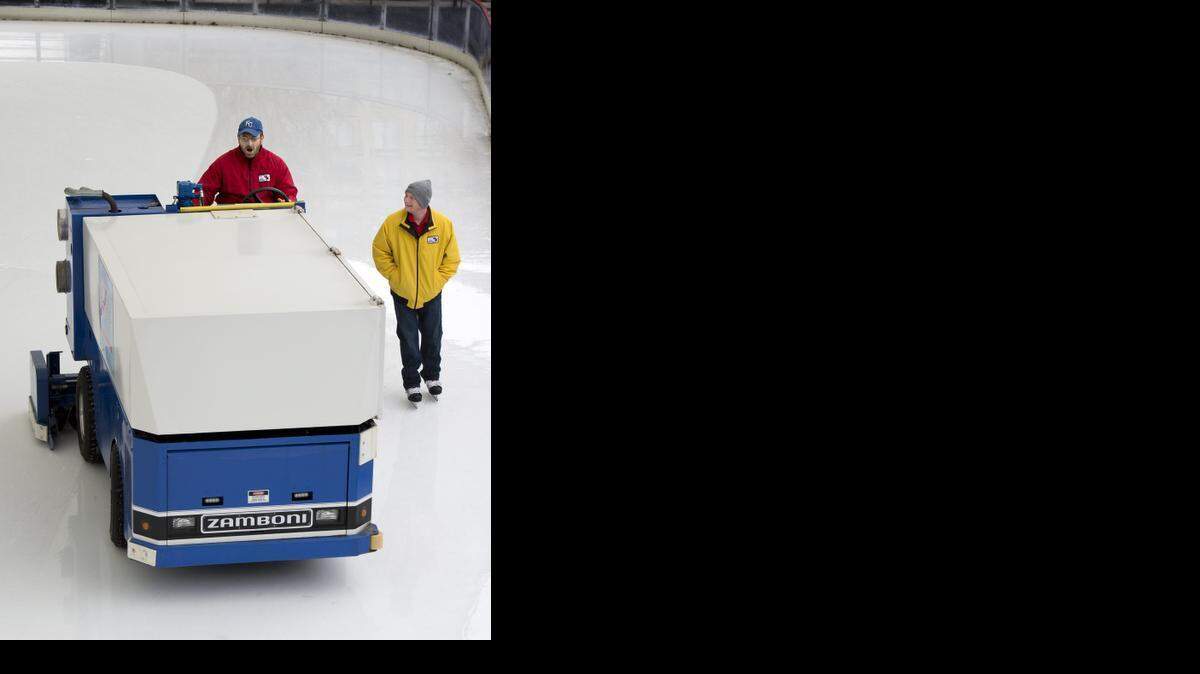
Brandon Luft grew up on a Colorado farm and never set foot on an ice rink until he was hired to run the Crown Center Ice Terrace eight years ago. “I take care of everything that has to do with the skating rink, from maintaining the ice to scheduling workers to handling the money,” he said.
Luft and his crew made the ice for this skating season in late October. Their biggest challenge in the winter is not the ice but the snow that can blow onto the exposed surface. They have to shovel it off the ice before opening to the public.
With a background on a farm, he usually shrugs off the cold weather that comes with the job. Only one day has gotten to him.
“One day last January, the high was 11 below zero when I arrived at 9 a.m.,” he said. “The area between the rink and the building next to it creates a wind tunnel. I have no idea what the wind chill was, but my face felt like it was going to crack when I was smoothing the ice with the Zamboni. That’s the first time I ever felt that.”
An old foot injury prevents him from skating, but driving the Zamboni is a fun perk to the job.
“I knew nothing about driving it when I got here, but I learned quickly because of my experience on tractors,” he said. “The skaters always cheer and holler when you do it, and sometimes they do the wave. It’s pretty cool.”
Cold-weather tips
Common sense and careful planning can go a long way toward making cold-weather jobs safer and more comfortable. The Occupational Safety and Health Administration offers these tips:
Recognize environmental and workplace conditions that may be dangerous.
Learn the signs and symptoms of cold-induced illnesses and injuries and what to do to help workers.
Train workers about cold-induced illnesses and injuries.
Encourage workers to wear proper clothing for cold, wet and windy conditions, including layers that can be adjusted to changing conditions.
Be sure workers in extreme conditions take a frequent short break in warm, dry shelters to allow their bodies to warm up.
Try to schedule work for the warmest part of the day.
Avoid exhaustion or fatigue, because energy is needed to keep muscles warm.
Use the buddy system so one worker can recognize danger signs.
Drink warm, sweet beverages (sugar water, sports-type drinks) and avoid drinks with caffeine (coffee, tea, sodas or hot chocolate) or alcohol.
Eat warm, high-calorie foods, such as hot pasta dishes.
Remember, workers face increased risks when they take certain medications, are in poor physical condition or suffer from illnesses such as diabetes, hypertension or cardiovascular disease.
This story was originally published February 2, 2015 at 10:12 PM.