
Nationwide, there’s a decline in supply of turkeys, but consumers shouldn’t feel the pinch at Thanksgiving
The national supply of turkey for this year’s Thanksgiving dinner is down slightly from last year, and wholesale prices are higher.
But don’t change your meal plans; you’ll be able to gobble down as usual, thanks to grocers giving consumers their traditional price breaks on the birds.
The National Turkey Federation says that despite the decline in supply, there will be plenty of turkeys in supermarkets to satisfy demand. The higher wholesale prices paid by grocery retailers will have little correlation to what they’re charging customers who will continue to get deals.
That’s because turkey is a traditional “loss leader.” Many stores charge less for the hens and toms than they paid for them in an effort to attract shoppers — who then will fill their carts with all the other holiday fixings.
According to the U.S. Department of Agriculture, the national turkey supply this year is at its lowest point since 1986, largely because of lingering effects of the 2012 drought. That led to higher feed costs and caused growers to reduce their flocks.
For all of 2014, turkey production is expected to total 235 million, the lowest since 1986’s 207 million. Production peaked in 1996, at nearly 303 million. About 45 million turkeys are expected to be sold this November.
John Zimmerman, a Northfield, Minn., grower who produces about 300,000 turkeys a year, said he reduced his production because of higher feed and transportation costs. His costs for a component of turkey feed, soybean meal, reached an all-time high this year.
The turkey growers’ pinch echoes that of beef producers, who also thinned their herds because of the 2012 drought and higher feed costs. Beef herds this year are the smallest since 1951.
But that doesn’t imply a holiday meal shortage this November. The turkey trade group says growers will meet demand for Thanksgiving, even though they expect consumption to be down from 46 million birds last year.
“We would have heard it by now if there was going to be a problem,” said a turkey federation spokeswoman. “Our suppliers seem very confident.”
That confidence may partly reflect the higher prices growers are getting paid by the food distributors. Prices last week in the frozen turkey market were an average of $1.16 a pound for toms and $1.18 a pound for hens, up from $1.03 and $1.04 last year. Many grocers didn’t pay that wholesale price, though, because they’d contracted earlier in the year to buy at lower prices, often in the $1.02 to $1.07 a pound range.
“Wholesale prices may be up, but that does not equate to higher prices in the store,” said Tara Deering-Hansen, a Hy-Vee spokeswoman.
By the time the birds land in the frozen food bins, prices to consumers are all over the map, ranging from free with a different purchase, to coupon discounts for spending certain amounts in the store, to “we’ll-match-any-competitor,” to loss-leader pricing, and all the way up to a wholesale markup, depending on the store and location.
Price Chopper kept turkey prices the same as last year and foresees plenty of turkey this season, said Casie Broker, director of marketing. Price Chopper is asking 78 cents a pound for hens and toms.
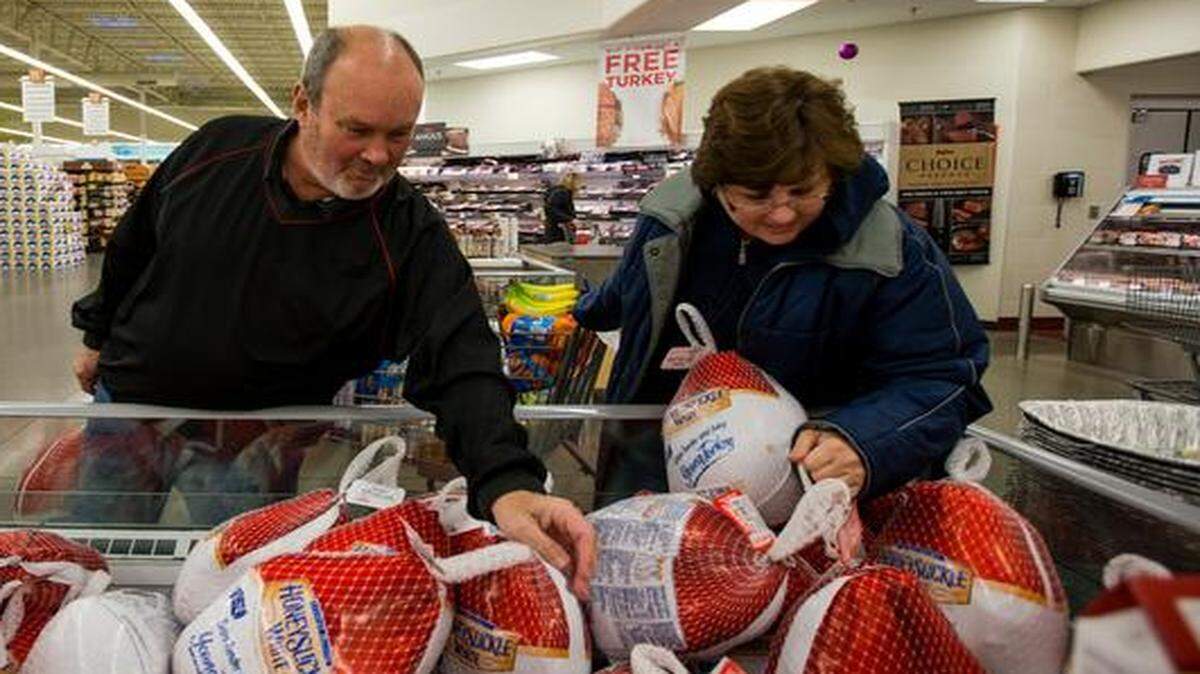
Hy-Vee stores are offering free 10- to 14-pound Honeysuckle turkeys with the purchase of a ham.
Newspaper advertising indicates that most area supermarkets are charging 78 cents to 99 cents a pound for their lower-priced turkeys and about $1.19 a pound for their higher-priced name-brand ones.
Prices for fresh, never-frozen turkeys are higher at stores that offer that option, or about $1.59 a pound at some locations.
A good thing about price or supply problems in the turkey trade is that it only takes three to five months to raise a turkey to market, so flock sizes are expected to rebound quickly.
Corinne Alexander, an agricultural economist at Purdue University who tracks the industry, noted that lower-priced feed already is showing up, and lower turkey prices are expected next year.
Finally, even if the price of cranberries or other parts of the Thanksgiving meal are higher, gasoline prices have tumbled, so at least it costs less to get to the store.
The Star’s wire services contributed to this report.
To reach Diane Stafford, call 816-234-4359 or send email to stafford@kcstar.com.