
In Michigan, Ford begins production of the aluminum-bodied F-150
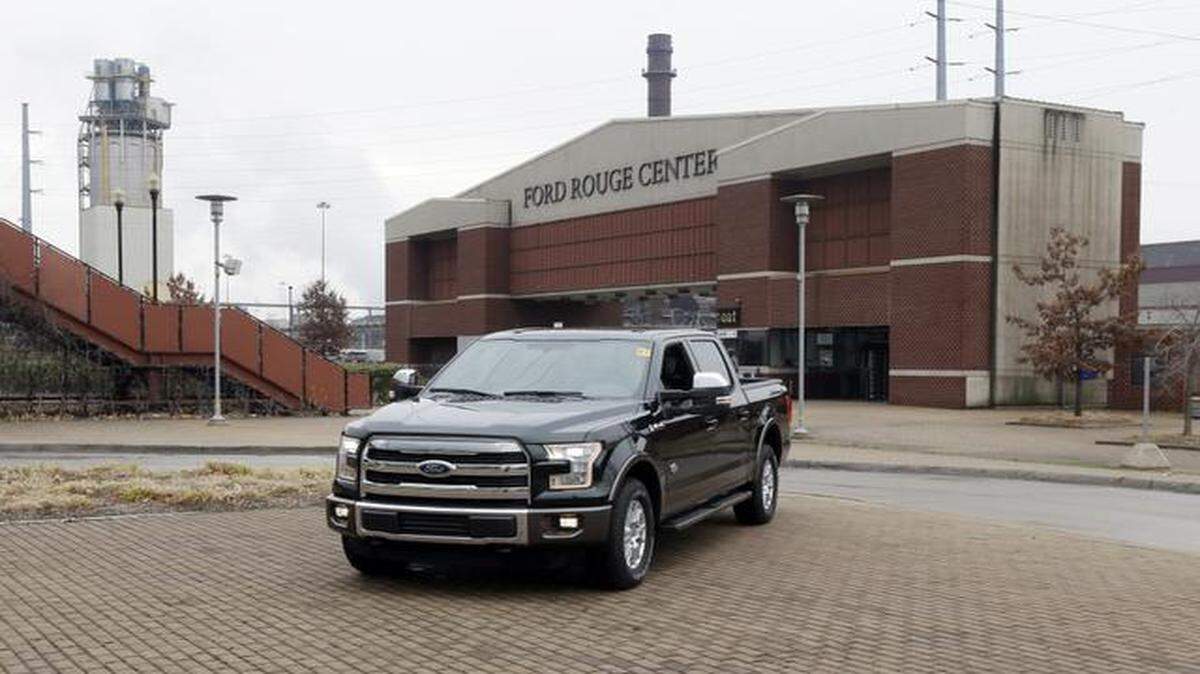
At Ford Motor Co.’s Rouge factory, where Henry Ford began building Model A cars almost 90 years ago, the automaker on Tuesday officially began manufacturing an advanced, aluminum-bodied F-150 pickup, its top selling and most profitable model.
Much like Henry Ford’s changeover from the Model T to the Model A in 1928, the birth of the 2015 F-150 has been painful, costing the company sales and profits this year as it closed the Rouge and the Claycomo assembly plant in the Kansas City area to install new tools and machinery to prepare for the largest production ever of an aluminum-bodied vehicle.
“We recognize this is the most watched launch in the industry,” said Raj Nair, Ford’s product development chief, adding that the introduction is on schedule. “We know the importance of getting the F-150 right.”
The new F-150s will arrive at U.S. dealerships next month.
Not everyone believes Ford can pull off the truck makeover smoothly.
Morgan Stanley analyst Adam Jonas called the new truck “one of the most audacious engineering projects in Ford’s history” in a June report titled, “We expect a challenging truck changeover.”
Ford’s third-quarter profit fell 34 percent to $835 million as it lost about 90,000 units of F-150 production this year while the two truck plants closed for 13 weeks.
On Tuesday, Ford executive chairman Bill Ford, great-grandson of the founder, helped roll out the first 2015 F-150 with the automaker’s new chief executive officer, Mark Fields. When he was CEO 13 years ago, Bill Ford pushed through a $2 billion overhaul of his family’s famous factory in a bid to make it environmentally friendly, including outfitting it with a 10-acre (4 hectare) “living roof” blanketed in sedum, a succulent ground cover.
“The all-new F-150 continues to advance my great-grandfather’s vision of building vehicles we can be proud of and our customers can depend on,” Bill Ford said in a statement.
Ford has a lot riding on the new F-150. The $8,000 to $10,000 in gross profit each truck hauls in accounts for 90 percent of Ford’s global automotive earnings, Jonas has estimated. He said the new F-150 can’t command a high enough price to cover the cost of aluminum, which can be almost three times pricier than steel.
Margins on the aluminum truck are expected to be lower because of “a combination of upfront costs and competitive reaction from” General Motors’ Chevrolet Silverado and GMC Sierra and Fiat Chrysler’s Ram, Jonas wrote in a September note downgrading Ford stock to “underweight.”
Ford raised prices on the new truck by 1.5 percent, or $395, on the base model XL, which starts at $26,615, to 7.9 percent, or $3,615, on the high-end King Ranch version that starts at $49,460. Ford said more than 250,000 online shoppers had configured and priced a truck on its F-150 website, a record.
The truck sheds as much as 700 pounds to improve fuel economy, mostly by using aluminum instead of steel in its body. Efficiency is the most important feature to pickup buyers, Fields said on Bloomberg Television.
In 2013, Ford’s F-Series was the top-selling vehicle line in the U.S. for the 32nd consecutive year, with sales rising 18 percent to 763,402. That helped drive Ford’s North American pretax profit to a record $8.78 billion last year.
Ford told investors on Sept. 29 that pretax profits this year will fall to $6 billion, short of its goal of $7 billion to $8 billion.
The automaker will lose more production next year as it takes six weeks to convert its F-150 factory at Claycomo. When running, the Rouge and the Kansas City plants will have the capacity to produce more than 700,000 trucks annually. In September, the company announced it would add 1,200 jobs at the Claycomo plant.
This story was originally published November 11, 2014 at 9:24 AM.