Angry union members confront Boilermakers president outside federal courthouse in KCK
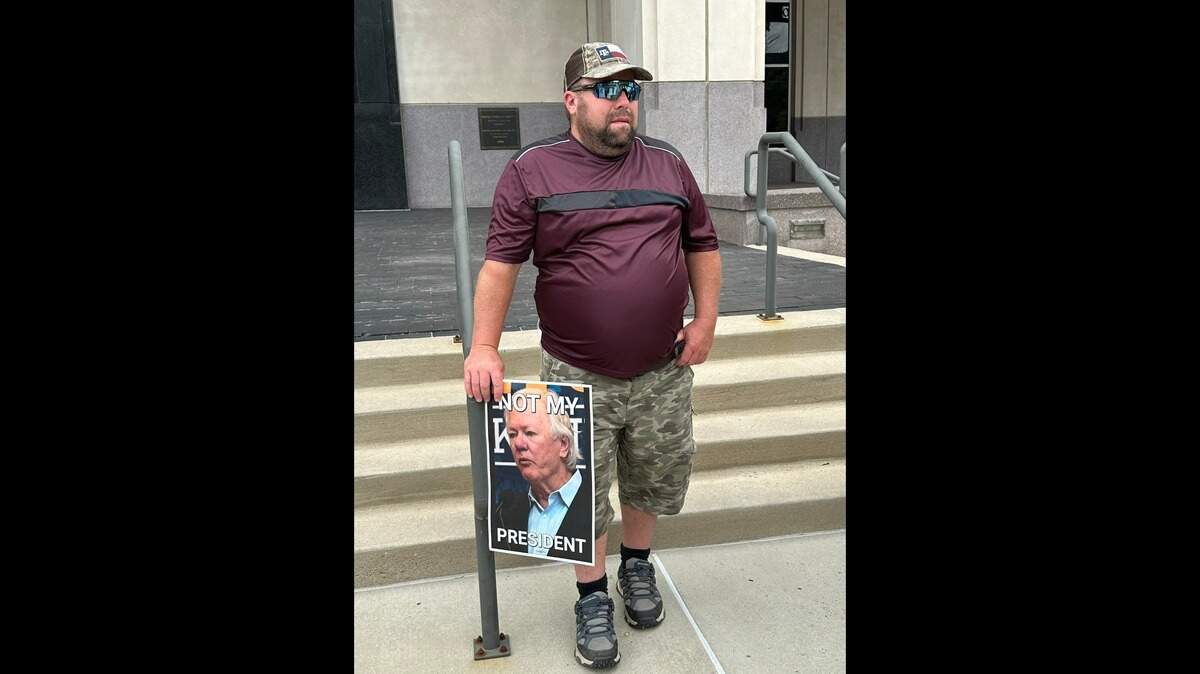
The battle over who controls the Boilermakers union erupted outside the federal courthouse in Kansas City, Kansas, Thursday afternoon following a hearing on whether Newton Jones will remain international president after being ousted by the union’s top executives.
Two dozen rank-and-file members confronted Jones as he left the courthouse.
“Prison for the president!” some chanted, holding signs with a photo of Jones and the words “Not my President.”
“We do not trust you,” said Adam Mendenhall, of Kansas City-based Local 83, who started the chant. “You’re a snake. You guys are crooks! You’re a scam, Newt. The membership wants you gone.”
Jones, dressed in a dark suit and maroon tie and holding a copy of the union’s constitution, stood there for several minutes while the shouting continued. He described his ouster as a coup.
“I’m sorry that you guys feel that way,” he said quietly, adding that everything he’d done had been in the interest of all union members.
“I think the vice presidents have worked very hard to do a good job,” he said. However, he added, “I think we’ve got crossways.”
At the end of the day, the question of who’s in charge of the union remained unresolved. Chief Judge Eric F. Melgren, of the U.S. District Court for the District of Kansas, said he needed to study the matter further before issuing a ruling.
“I have a couple matters I think need a bit more development on my end before I can rule,” he said. He said he would issue a written order “promptly” but wasn’t more specific on when that would be.
At issue Thursday was whether the international vice presidents who voted to remove Jones had properly notified him of a May 30 hearing on internal charges filed against him and whether the three who voted constituted a majority of a quorum.
The courtroom was packed, with some forced to listen to the hearing via an audio feed in an overflow room.
The case of the dueling Boilermakers presidents landed in federal court last month, but after an intense hearing, Melgren said then that another hearing was needed.
He issued an interim preliminary injunction that kept Jones in power at least until Thursday’s hearing. But the judge also placed restrictions on the longtime union president that were designed to keep his spending in check.
The union’s infighting became public in early June when its top executives voted to remove Jones over allegations of misusing union funds for personal gain. Since then, there’s been an ongoing conflict over who is in control.
At the June hearing, Melgren ordered a stay of the actions by the union’s executive council to oust Jones as president and the council’s decision to elect retired international vice president Warren Fairley to replace Jones.
But Melgren also ordered that any efforts to remove the executive council members from office for expelling Jones be stopped. And he said that Jones’ action to remove them from other appointments, such as committees and trust funds, would be stayed, saying it was clearly done in retaliation for the officers ousting him.
Melgren said at the end of Thursday’s hearing that his June order would remain in place until he issued the next one.
The allegations against Jones went public after three members of the union’s executive council — Tom Baca, of California; Arnie Stadnick, of Canada; and Timothy Simmons, of Alabama — issued a decision June 2 to remove Jones from office. The council ruled that Jones had violated a section in Article 17 of the Boilermakers’ constitution that deals with the misappropriation of funds.
Another executive council member, John Fultz, of New York, was not eligible to participate in the decision because he filed the internal disciplinary charges against Jones that led to his removal. The council’s fifth executive council member, Lawrence McManamon Sr., of Ohio, did not attend the hearing at which the decision was made, nor did he vote to remove Jones. The executive council is composed of the union’s five international vice presidents and Jones.
The union’s executive council found that Jones ordered the union to give his wife, Kateryna, more than $100,000 plus benefits in back pay “for apparently no union purpose while she was living in the Ukraine” and spent more than $20,000 in union funds for flights to Ukraine “to visit his wife and to go to the home which he owns in the Ukraine.”
Jones and his wife also turned in about $40,000 in receipts for meals for them and other family members when at their home in North Carolina — some “quite lavish and expensive” — with no justification for the expenses, the executive council found.
Jones, 69, has denied misusing union funds and said the executive council had no authority under the union’s constitution to dismiss him.
The union represents about 46,000 workers in the United States and Canada who assemble, install and repair boilers, fit pipes and build power plants and ships.
During the June 20 hearing, Melgren wanted to know what Jones’ wife did for the union. The union’s attorney, Michael Amash, said she was a special assistant to Jones.
“What’s her salary level?” the judge asked. He appeared surprised when the executive council’s attorneys said it was $165,000.
During the confrontation outside the courthouse Thursday, Mendenhall asked Jones why his wife is on the payroll.
“She’s my trusted assistant,” he said.
“What does the average boilermaker make a year?” Mendenhall shot back.
The case ended up in federal court in Kansas City, Kansas, after the union filed a civil suit against Baca, Stadnick and Simmons, requesting a temporary restraining order and then an injunction to prohibit Jones’ removal. Though the lawsuit was filed by the union, many members say it doesn’t represent their feelings and they want no part of it.
The union executives fought back, filing a counterclaim against Jones, his wife and International Secretary-Treasurer William Creeden. They asked the court for a temporary restraining order followed by an injunction enforcing their decision to remove Jones.
The counterclaim alleged that Jones misappropriated hundreds of thousands of dollars from the union and its members. But instead of putting a stop to the practice, it said, Creeden authorized the transactions. And because Baca, Stadnick, Simmons and Fultz participated in the internal disciplinary process that led to Jones’ ouster, they said, Jones had “engaged in a campaign of retaliation” against them.
Jones limited their travel, the document said, and removed them from long-held appointed leadership positions. And he filed internal disciplinary charges against Baca, Stadnick, Simmons and Fultz, accusing them of violating the union’s constitution.
Prior to Thursday’s hearing, a group of rank-and-file boilermakers — some traveling from Colorado, Ohio, Massachusetts, Pennsylvania, Arizona and Texas — rallied in support of Jones’ removal.
Robert Zimmerman, of Local 29 in Boston, said he was anxious to see if Jones would show up for the hearing.
“This is very important,” he said. “We need to get the corruption out. It’s a handful of guys spending money that’s not even theirs. It’s the working man’s money.”
Jared Moss, of Local 132 in Galveston, Texas, attended the hearing in June and returned for the one Thursday.
“Hopefully, they’ll wrap this thing up today,” Moss said. “It’s beyond time for Jones to go. You leave people in power for too long, corruption settles in.”
This story was originally published July 27, 2023 at 6:03 PM.