
Is closing a Starbucks store after a union vote illegal? KC lawyers say it’s complicated
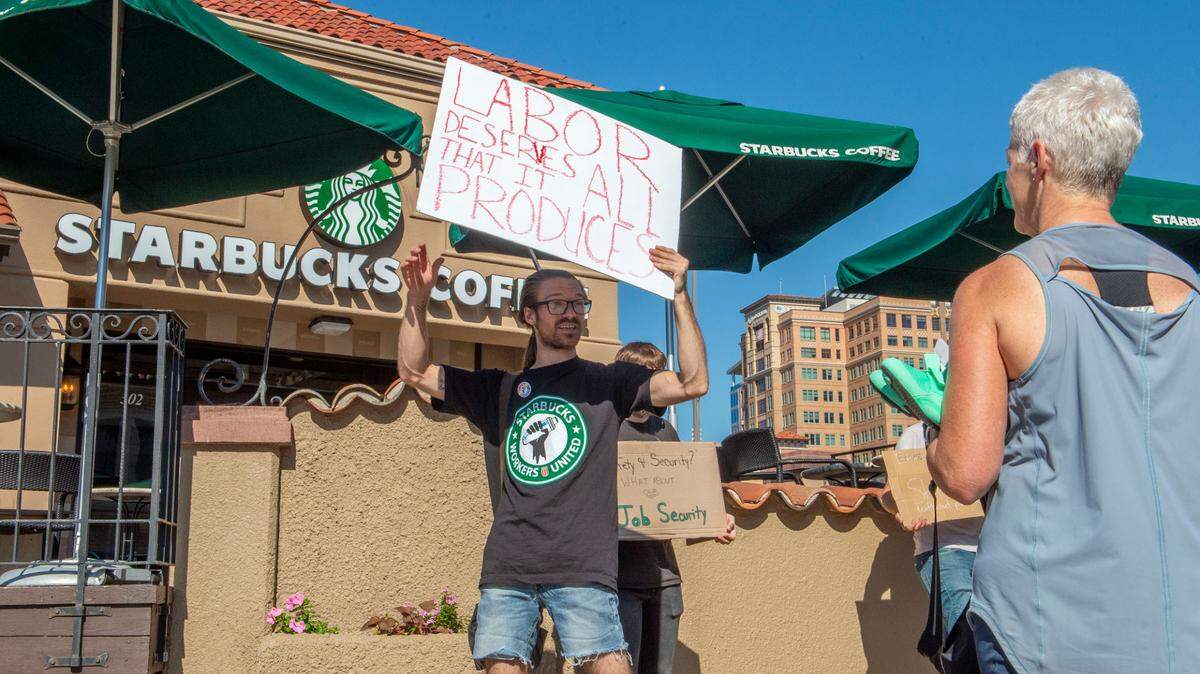
Starbucks workers at the coffee chain’s Plaza location were surprised by sudden news Monday afternoon when the company shut down their store.
The popular spot had recently voted on unionization, reaching a tie with three votes still being contested. Workers claimed victory, saying that the remaining votes would likely tip the vote in their favor.
Now, they may never find out — Starbucks’ corporate offices closed the store without warning, citing “safety” as its reasoning. Workers countered that the store was no less safe than other locations or nearby retail shops, and that the company’s sudden decision amounts to retaliation — something the coffee giant has been found guilty of before.
In May, the National Labor Relations Board charged the company with unfair labor practices at two Kansas City area locations, including the Plaza store, where managers allegedly threatened and fired employees engaged in efforts to unionize.
At the Plaza location, employees faced stricter dress code enforcement as a result of their union activity and were threatened with a loss of future raises and benefits, according to the complaint.
We talked to labor lawyers about the store closing and when a situation is considered union retaliation.
Can a company close a branch or location just for unionizing?
No. Closing a location and firing its employees just for unionizing would be a violation of the National Labor Relations Act of 1935.
However, it’s often difficult to prove that unionization was the reason for a company’s store closure.
In this case, Starbucks cited “safety concerns” as its reason for closing the Plaza shop.
“We apply the same focus on safety at unionized and non-union stores and are closing non-union stores where we are similarly challenged in providing a safe environment for our customer and partner experience,” a Starbucks spokesperson said in a Tuesday email to The Star.
What recourse do employees have?
According to labor lawyer Mike Amash, workers who are laid off for their union efforts have the option to file charges against their employer for violating their rights under the National Labor Relations Act. Amash works for Blake & Uhlig P.A., a labor and employee benefits law firm based in Kansas City, Kansas.
In Kansas City, these charges would then be investigated by the enforcement division of the NLRB’s sub-regional office, which is in Overland Park.
Is filing labor rights charges the same as taking the company to court?
Not quite. Former employees would not need to hire a lawyer in order to file these charges. That’s because the NLRB’s sub-regional office would be in charge of investigating the company for wrongdoing. The decision would be made internally by the NLRB, rather than by a judge or jury in a traditional courtroom setting.
If Starbucks’ former employees chose this path, it would then fall upon the company to prove that their reasoning for closing the Plaza location is legitimate. Starbucks would have to convince the NLRB that it really did close the store out of safety concerns, and not as retaliation for workers unionizing.
What consequences can a company face for union retaliation?
The exact consequences vary in each case, but Amash noted that they can involve paying back wages and benefits to the employees a company has laid off. In an extreme case, he added, Starbucks could even be forced to reopen its Plaza store, re-hire its former employees, and recognize their union vote’s outcome.
The Plaza location’s employees have not indicated that they plan to file charges against the company.
What happens if employees don’t file charges?
If no charges are filed, Starbucks will not have to prove that safety concerns were the motivating reason to shut down its Plaza location. The company is free to shut down other locations too, as long as it can provide reasons for doing so that are not related to unionization.
Outcomes in labor board cases often stick to the individual level, with the company having to pay out damages for specific incidents rather than facing large-scale punishments like fines for retaliatory behavior.
What does this mean for other unionization efforts in Kansas City?
Amash noted that anti-union techniques by large companies are often intended to discourage other workers from unionizing their workplaces. However, the NLRA protects workers who aim to bargain collectively and has overseen the creation of thousands of successful labor unions around the country.
The Star’s Robert Cronkleton contributed reporting.
.jpg)