
These women — a Missourian and Kansan — hold a key to your pocketbook and the economy
Meet Esther George and Michelle “Miki” Bowman. Each holds a key to your pocketbook.
George is an economic insider, a Missouri native and occasional farmer who has built her career at the Federal Reserve Bank of Kansas City.
Bowman is a new face on America’s economic scene, a Kansan who clipped coupons for a local grocery even though her family owns a bank.
Anyone looking for a home loan, paying down a credit card balance or stuffing a savings account should be watching them. Each will vote this week — and throughout 2019 — as the Federal Reserve decides whether to raise interest rates yet again.
Only 10 votes will be cast at the Fed’s policy session on Tuesday and Wednesday, giving the outcome a heavy dose of Midwest perspective.
“We got to have people from the so-called fly-over states that can communicate to the (Fed committee) what’s going on out in the real world,” said Bruce Morgan, a former Kansas City-area banker who has served on the Fed’s consumer advisory panel.
Americans already feel the Fed’s four interest rate hikes from last year, the most recent coming in mid-December.
Financial markets slumped badly ahead of that last hike as economists warned the U.S. economy may fall into recession in 2020.
The outlook heightens the impact of steps the Fed takes this year and the role George and Bowman play in those decisions.
The Fed insider
The biographies of George and Bowman highlight common themes. Midwestern roots. Ties to agriculture. Active roles in bank supervision.
Neither was available for interviews, citing their busy January schedules and a media blackout as Fed policy meetings approach.
More often than not, George has traveled to these Washington sessions to push against the path Fed policy was taking.
The 61-year-old native of Faucett, Mo., started at the Kansas City Fed as an assistant examiner in 1982. She worked in its bank supervision, research and personnel departments and became its chief operating officer before being named president in October 2011.
Fed insiders have described George as bright, respected and approachable. They also said she readily shares her opinions on policy and other matters regardless of who else is present.
So it has been, during George’s previous Fed meetings in Washington. Like other regional Fed presidents, she always takes part in the debate but votes on the policy decision only during every third year. She holds a vote at each of the Fed’s eight policy meetings scheduled for 2019.
In prior voting years, George dissented 12 times to push against the committee’s policy decision. Generally, she has pressed the group to act more quickly than it has to move away from zero percent interest rates and to unwind other unprecedented steps the Fed took to help the economy recover from the Great Recession.
“She will continue to be the voice of the hawk,” said economist Chris Kuehl at Armada Corporate Intelligence.
Hawks at the Fed are seen as guards against inflation, or policymakers who emphasize the Fed’s job of keeping prices stable while pursuing maximum employment.
Their counterparts are considered doves, who are seen as more tolerant of inflation in pursuit of maximum employment.
It means hawks are more likely to vote for higher interest rates than doves are.
During a speech earlier this month, George made clear that she’s willing to be patient about increasing interest rates further. More hikes may be called for, she said, but the Fed can pause as it evaluates the impact of its four increases from 2018.
The Kansan goes to Washington (again)
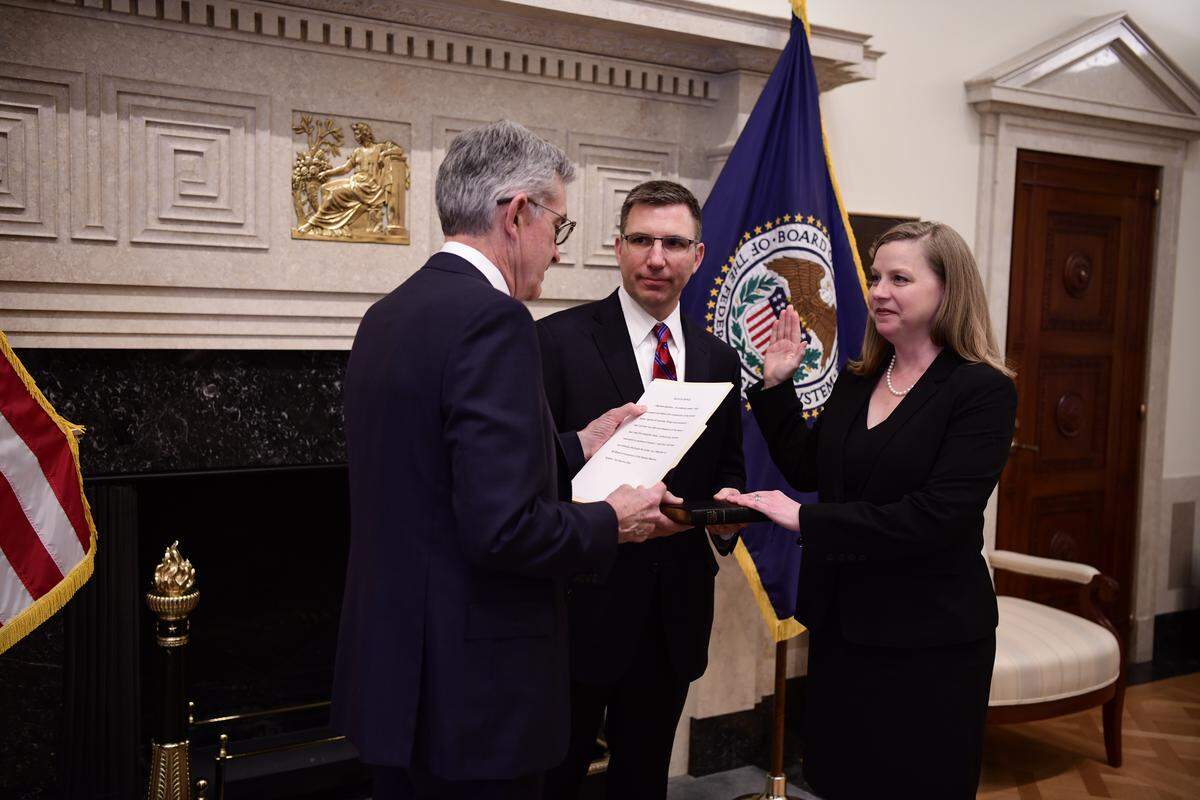
Bowman, 47, comes to the Fed’s policy committee as a member of the Fed’s board of governors, nominated by President Donald Trump and confirmed by Congress. Governors always have a vote on the Fed’s policy.
But her time at the Fed may be limited. Bowman is completing the last year of an unexpired 14-year term on the board that ends Jan. 31, 2020. She would leave the Fed then unless Trump re-appoints her to a new full term.
December’s Fed session was Bowman’s first and only policy meeting. She voted to raise interest rates, and there were no dissenting votes. In Kuehl’s terms, she has yet to earn her wings as either a hawk or dove.
Bowman also has yet to speak publicly about her thoughts on Fed policy, leaving economists and analysts to guess her views on the economy and policy choices.
“I wish I had a speech from Michelle Bowman,” said Tim Duy, a University of Oregon professor who writes about Fed policy and the economy at Tim Duy’s Fed Watch.
While being considered for the Fed, Bowman often was described as the Kansas state bank regulator and former vice president of family’s community bank in Council Grove, Kan.
Her life experiences have been more worldly.
Bowman’s family moved a lot in her youth because of her father’s career in the U.S. Air Force. Bowman was born in Hawaii and lived much of her youth in Illinois, near St. Louis. After graduating from high school in Council Grove, Kan., she went to the University of Kansas and earned a law degree at Washburn University, in Topeka.
Washburn helped launch Bowman’s career as a Republican policy adviser in Washington. Her first stop was as an intern for then-U.S. Sen. Bob Dole, another Washburn-educated lawyer.
Other federal jobs followed, at a House subcommittee, at the Federal Emergency Management Agency or FEMA, and then at the U.S. Department of Homeland Security as a deputy assistant secretary providing policy advice in its earliest days.
Bowman’s Washington stint ended in 2004.
She’d gotten married, and her husband’s job took the couple to London. The couple’s two children were born during the five years they lived in England.
Bowman started her own consulting business, and she remained active in party politics as chair of Republicans Abroad UK. It’s how she met Emily Landis Walker.
Walker said they registered American citizens so they could vote absentee in U.S. elections. They rehearsed for and held policy debates during the 2008 presidential campaign.
“She’s really very smart and very politically astute,” Walker said. “She has a lot to offer.”
Walker and others described Bowman as diligent in learning about issues, especially by listening to what others have to offer.
That remained true after Bowman returned to Council Grove in 2010 to work at the family’s bank, said Angela Schwerdtfeger. She worked with Bowman on several committees, from the local chamber of commerce board to one aimed at starting a farmers market in the little town.
“Before any decision-making went through, she always wanted to listen to what everybody had to say and learn all she could about the subject,” Schwerdtfeger said.
Christy Alexander, a closer friend, said Bowman has remained down-to-earth despite her Washington years and travel abroad.
“None of that has clouded her perspective of what a regular person lives like,” Alexander said.
As an example, Alexander recalled the last time her family visited the Bowmans for dinner. It was right before they left for Washington.
“This lady, who’s getting ready to take her position as a governor of the Federal Reserve, hands me a Ziploc bag full of coupons that were good for our local grocery store and she wasn’t going to get to use,” Alexander said.
This story was originally published January 28, 2019 at 5:30 AM.