
Starbucks steps into the conversation about race
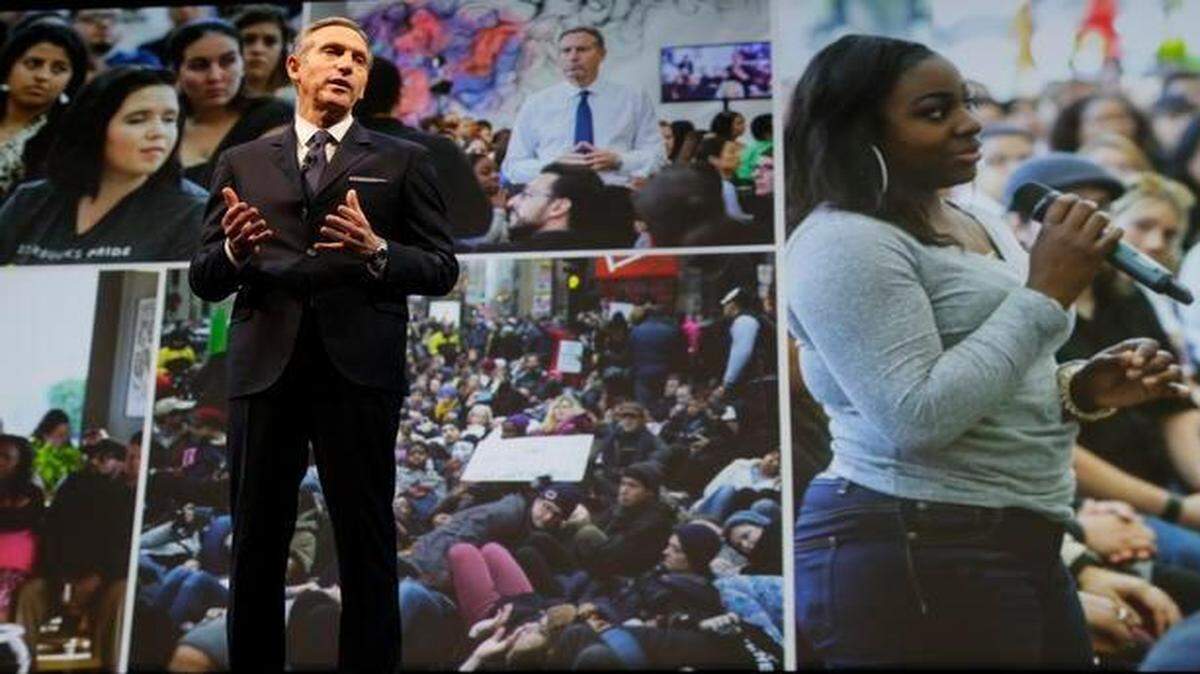
Starbucks CEO Howard Schultz on Wednesday defended the company’s new “Race Together” campaign, which has been criticized for being naive and even using racial tensions to boost its bottom line.
The push by the chain best known for its Frappuccinos asks its U.S. workers to write “Race Together” on cups. Starbucks also plans to start publishing “conversation guides” on the topic, with questions like “How have your racial views evolved from those of your parents?”
During its annual meeting in Seattle, Schultz said the company is trying to use its massive reach for good: “Some in the media will criticize Starbucks for having a political agenda. Our intentions are pure.”
The campaign is the latest example of a big company trying to tie its brands to big social issues. The move comes as consumer brands acknowledge that customers are increasingly drawn to companies that project a feel-good image or embrace social causes.
But the move, which has sparked a backlash on social media, also illustrates how those efforts can fall flat if customers don’t see a clear correlation between the cause and the company’s products.
Reaction to the initiative has been swift and harsh, with people saying it is opportunistic and inappropriate for a coffee chain to try to inject itself into such an important issue.
Gwen Ifill, a co-anchor of “PBS NewsHour” who is African-American, might have had the best line in a tweet Tuesday: “Honest to God, if you start to engage me in a race conversation before I’ve had my morning coffee, it will not end well.”
Other online comments were vitriolic, calling Starbucks tone-deaf and obnoxious. Many pointed out that the company’s leadership is predominantly white, while many of its baristas are minorities.
The attacks grew so hostile that Corey duBrowa, the senior vice president of global communications at Starbucks, temporarily deleted his Twitter account Monday.
“Last night I felt personally attacked in a cascade of negativity,” duBrowa wrote in a post on Medium on Tuesday.
Schultz said he didn’t think Starbucks would solve the country’s “centuries-old problems of racism” but did think it could make a difference. He said workers don’t have to participate, and stores will make customers another drink or cover up cups if they don’t like the message.
“This is not a marketing or PR exercise,” Schultz said.
The Starbucks effort, whatever its fate, is part of a pattern of companies trying to project some sort of feel-good image or embrace social causes.
At the annual meeting in December for Yum Brands, the company that owns KFC, Taco Bell and Pizza Hut, CEO Greg Creed said fast-food chains must evolve from being perceived as “impersonal and industrial” to being able to “demonstrate that we do care.”
Laura Ries, a branding consultant based in Atlanta, said that addressing important issues of the day has also become a way for companies to make themselves a part of the conversation. Otherwise, nobody is sitting around on Twitter discussing brands, she said.
Dove soap has generated widespread praise for its campaign celebrating “Real Beauty” by featuring women who don’t look like the typical models. Always, which makes products for women, also got praise for an ad that ran during the Super Bowl seeking to empower young girls. But those were messages that had ties to the products. People don’t associate their morning coffee with race.
“There’s nothing wrong with talking about race relations,” Ries said. “But is it something people naturally associate with Starbucks? It’s not.”
Inserting itself into national issues is not new territory for Starbucks. In late 2012, the chain asked workers to write “Come together” on cups to send a message to lawmakers about stalled budget negotiations.
And in 2013, the chain placed newspaper ads saying that firearms were not welcome in its cafes after they became the site of gun rallies. But the company stopped short of an outright ban.
Schultz said at the time that Starbucks was neither for nor against guns, underscoring that even a company that wants a voice in national conversations has to be careful about alienating customers.
Stock split, delivery details
At its annual meeting, Starbucks said:
▪ It’s planning a 2-for-1 stock split effective April 9 for shareholders of record on March 30. It’s the first such move in almost a decade for the company, whose shares reached a record high last month.
▪ It will launch delivery in parts of Seattle and New York in the second half of this year. No minimum purchase will be required. A flat delivery fee will be charged, the exact amount to be determined. Delivery time should average a half hour.
This story was originally published March 18, 2015 at 6:52 PM.