Northland residents fight against development near forest: ‘A place of refuge’
AI-generated summary reviewed by our newsroom.
- Residents oppose proposed parkway through northern Line Creek Forest.
- About 50 acres were cleared along Barry Road in 2022 by MD Management.
- Longtime advocates warn a road could lead to further forest development.
Tucked into the Northland lies a quiet, peaceful refuge — a place for people and animals alike to enjoy the “magnificent” forest in the midst of the sprawling city. A place some fear may be in danger.
Kansas City’s Line Creek Forest is where various species of birds, squirrels, deer, minks, fish and turtles call home. It’s where neighbors go to connect with nature after a busy day downtown, where bird enthusiasts visit to search for woodpeckers, cardinals and owls, and where joggers, bike riders and walkers escape to for a secluded morning outing.
And for many residents, the Line Creek Forest is a place worth fighting for.
Chunks of the forest, a majority of which is privately owned, have already been torn out to make way for development and new school buildings, but the city’s proposed major street plan has once again set off warning bells for citizens like Bill Nichols, who has been advocating to protect the forest for over 30 years.
As part of the proposed street plan, the city is recommending a parkway go through a section of the northern part of the forest located just north of the Interstate 29 and Interstate 635 intersection. While the approval of the plan doesn’t necessarily mean a street will be built in the area, neighbors fear it could attract developers.
And the destruction of more woods would be devastating, Nichols said.
“There’s a 600 acres worth fighting for,” he said.
A three-decade long fight
Nichols first began his fight to protect the forest in 1988 when he sent letters to the Missouri Department of Conservation requesting the forest be deemed a conservation area.
Then, in 2017, he picked up his advocacy again after learning the Park Hill School District purchased 272 acres at 68th and Wakomis in April 2017 and planned to construct two school buildings on the land.
At the time, Nichols teamed up with a group of fellow concerned citizens to advocate for the preservation of the forest and ask the district to save as much wooded area as possible.
Their advocacy resulted in conversations with district leaders, city council members and Missouri Department of Conservation representatives. The group even led a petition that garnered around 12,000 signatures over the course of a year.
“It was kind of hard. We had to be sensitive, because basically, you’re pitting trees against kids, right? Who’s gonna win in that battle?” he said.
Both Hopewell Elementary and the home of the district’s LEAD Innovation Studio were ultimately constructed on the ground, but the district still owns around 150 acres of undeveloped land in the forest.
Despite some of the forest being removed, the group continued to advocate for the forest for several years until the movement started to die off around 2022, Nichols said.
But efforts have ramped back up in recent months as the city has been discussing updates to its major street plan, which identifies potential connector streets throughout the city, including a proposed realignment for the Line Creek area.
A group of community members have rallied together to write letters to the city council, speak at public meetings and continue sharing their message and movement.
Currently, the street plan lists a parkway that would run directly along the Line Creek Trail through the middle of the forest. Now, city officials are considering realigning the street to instead curve around a majority of the forest to “try to minimize the most destruction as possible.”
However, even if the extensive 52-page plan is approved by city council later this spring, it does not mean a street will be constructed in the area, according to Councilwoman Lindsay French, who lives in the Line Creek area.
“It kind of appears like we’re going to come in tomorrow or the next day, or within a year or two, and actually construct this road. And that’s not what that is at all,” she said. “It’s for when and if any development were to occur, there is a plan mapped out to what they need to follow per city standards.”
Still, Nichols and other advocates worry for the future of the forest.
“If you’ve got a road, then there’s going to be development. And if there’s going to be development, then you need a road,” Nichols said.
“No road period,” added Lisa Linscott, a fellow advocate. “I don’t think anyone wants any more development, and they certainly don’t want the city proposing a road to promote development, and I think that’s exactly what they’re doing.”
‘A place of refuge’
“It used to be a place of refuge, of peace, a place where you could go to kind of quiet your mind and clear your mind, your sanctuary,” he said.
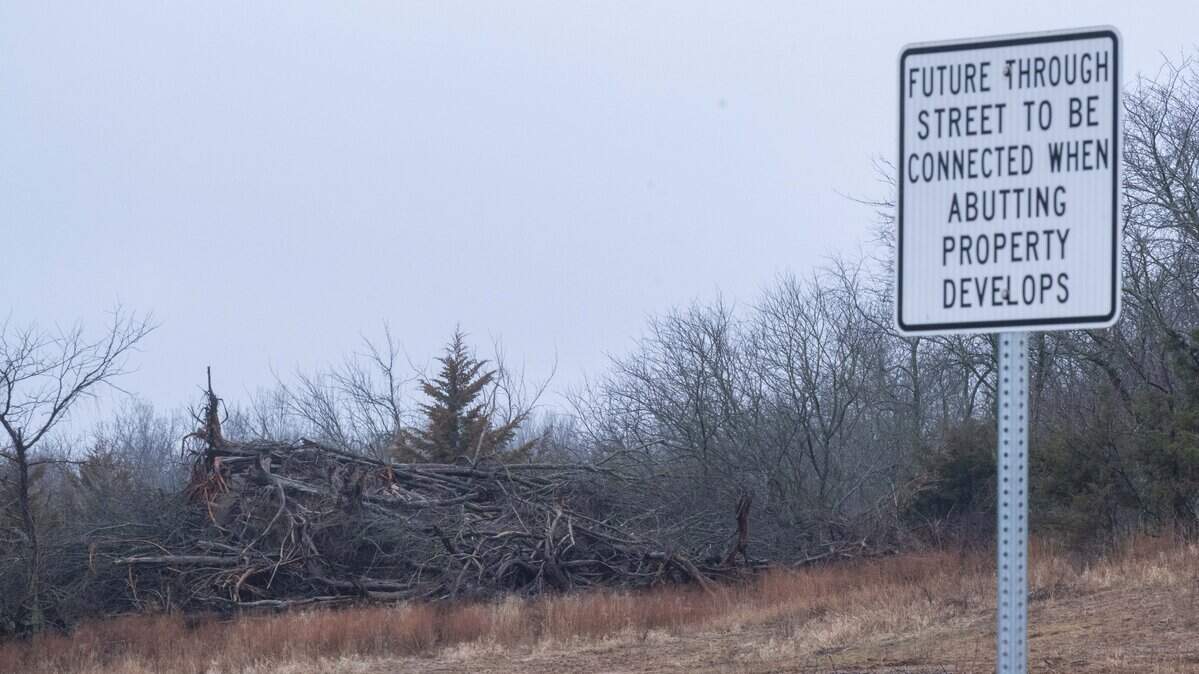
But now, Nichols said he doesn’t visit Line Creek Forest anymore, not since around 50 acres of forest owned by MD Management were cleared along Barry Road in 2022.
“I just can’t see it. I can’t look at it. I’m reluctant to even drive down Barry Road because I know I’ll look over and I’ll see what they did,” he said. “It’s kind of like driving down the road and seeing somebody’s pet dog lying dead on the side of the road, you know, you just don’t want to look. You don’t want to go by it.”
The woods, wildlife and natural habitat of the forest are some of the main reasons Linscott decided to move to the area, she said, and the loss of the Line Creek Forest would be “devastating to everyone in the Northland.”
“(The forest) means everything to me really,” she said. “I just think it’s tragic.”
Lisa Owens, who has lived next to the forest for 25 years, said the Line Creek Forest is a safe haven for a wide variety of wildlife, from rabbits and raccoons to groundhogs and river otters. Over the past quarter of a century, she’s personally observed approximately 170 species of birds within the wooded walls of the forest.
Owens has spotted coyotes, crayfish, snakes, bats, foxes, skunks and a wide array of butterflies and moths on her daily walks through the forest. She even remembers a family of beavers who once lived in the small creek that runs through the woods.
Earlier this year, she found a dead otter on the side of the road.
“I’ve seen real time effects on the wildlife around here. It’s been very sad,” she said. “It’s a shame because it’s a beautiful spot.”