
Kauffman Center organ needs love amid COVID-19. This Grammy nominee makes that happen
Jan Kraybill was about to have the busiest performance season of her career.
With her new album, “The Orchestral Organ,” up for three Grammy Awards this year, she had concerts scheduled across North America.
Kraybill’s world nowadays — just like everyone else’s — is vastly different.
She plays in public venues only to check on the three organs she is charged with caring for: two at Community of Christ in Independence and the Julia Irene Kauffman Casavant Organ at the Kauffman Center for the Performing Arts.
And instead of programs rich with music by Johannes Brahms, Sir James MacMillan and Herbert Howells, Kraybill is playing just a few pieces and running musical scales only to make sure the organs are in good shape while concert seasons are scrapped under COVID-19 stay-at-home orders.
Sitting at the organ in an empty Helzberg Hall at the Kauffman Center is an emotional gig for Kraybill.
“I was so happy to be back there and hearing those pipes again,” Kraybill says about her first time back in Helzberg. “It’s lonely, and, of course, as I am walking in I am thinking about all those people that I miss.
“How much we’ll treasure it when we get back there. The heavy concerns that sometimes I would enter that hall with now completely fade just thinking of the privilege of making music in a hall that is a world class hall with musicians who are world class musicians and genuinely nice people.
“How much I miss them all.”
Yearning for music
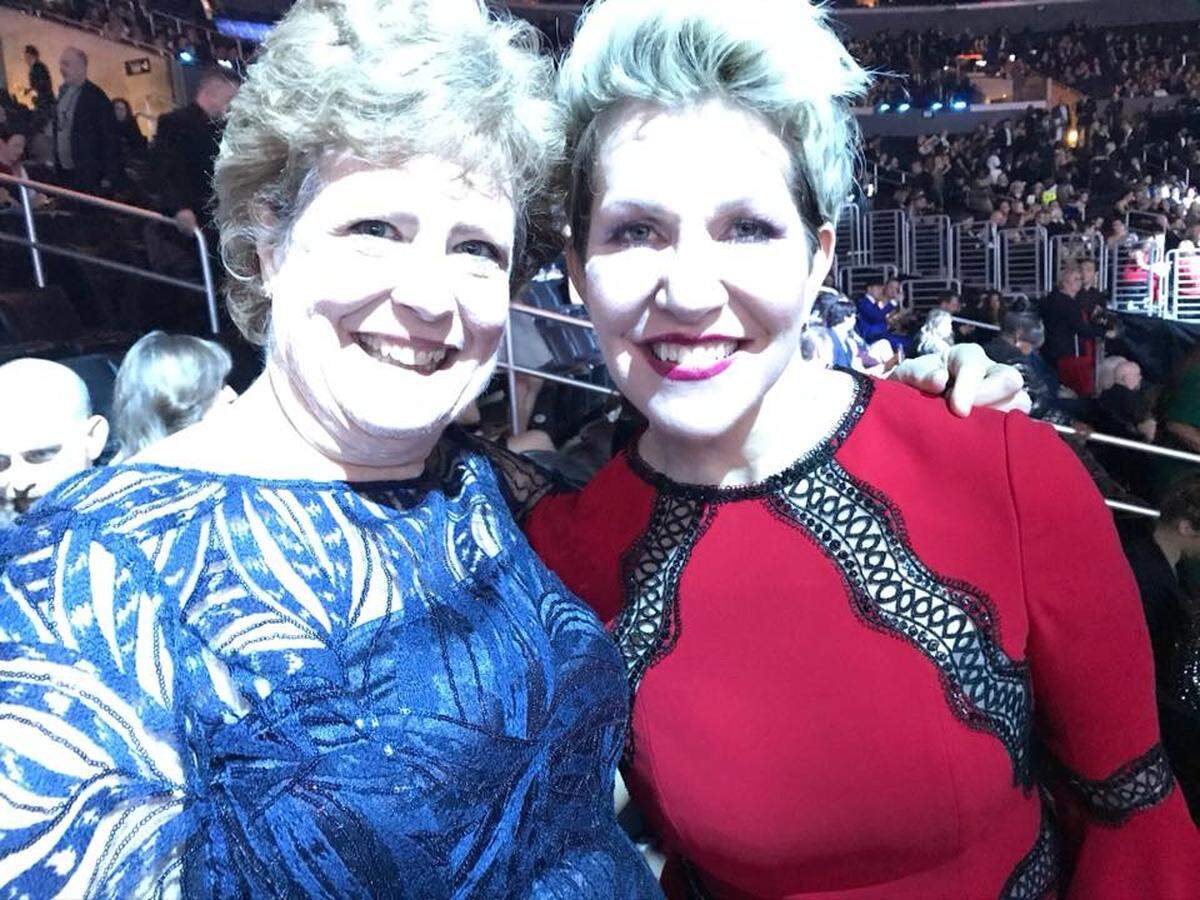
Before COVID-19, Kraybill’s calendar was one of rock star status. On Jan. 26, she walked the red carpet to attend the 62nd Annual Grammy Awards in Los Angeles.
It was on the Kauffman organ that Kraybill recorded “The Orchestral Organ,” which earned her a Grammy nomination for best classical instrumental solo. The album was also nominated for for best immersive audio album and producer of the year, classical, for Marina A. Ledin and Victor Ledin.
Violinist Nicola Benedetti won the solo award, but the nomination was an important nod for Kraybill, who decided in 2018 that she would concentrate on being a concert artist. She was her own agent, diligently booking performances throughout the world, including a concert scheduled for March 16 in Ottawa, Ontario.
That concert was canceled only hours before it was due to start because of COVID-19. Kraybill had just enough time to travel home before lockdowns began.
“We’ll see what happens with next season — who knows,” Kraybill says. “I still have a performance set on August 12 that has not been canceled. Everything up to that has been canceled.”
Kraybill didn’t have any pending recording sessions with her producing label, Reference Recordings, although there might be other ways soon to hear her play – at least virtually. She says there are discussions about an organ recital at some point from Kauffman Center. She will join the Greater Kansas City Chapter of the American Guild of Organists’ virtual performance of its 41st Annual Bachathon scheduled for the end of May.
And Kraybill has been invited to participate in an international virtual organ series. She plans on playing the Community of Christ organ with likely a nearby music stand holding a cellphone to record.
“Recording projects have taken on a new importance in my life,” Kraybill says. “Our idea of what you can put out in public as far as quality of audio and video has changed because of COVID. It will be nice to get back to business as usual and we can have multiple camera angles and high definition quality in all of that. But for right now we do what we can just to share music.”
A six-minute video recently posted on Kraybill’s Facebook page suggests the yearning for her music.
It shows Kraybill at the Kauffman organ playing Widor’s Toccata and has been viewed more than 161,000 times since April 24.
“You can’t tell in the Facebook video but at the end of it I say something about ‘isn’t this great’ and you hear a little catch in my voice — that’s because I had been crying while playing,” Kraybill explains. “It is a very emotional piece, and I was just thinking of memories of making music there.”
Her Facebook video prompted an invite to be interviewed on a Leeds, England, radio program, and touched a lot of people close by — including the staff at the Kauffman Center.
“We were excited and happy because it reminded us of that place where we spend so many of our waking hours,” says Patrick Donnelly, vice president of theater operations at the Kauffman Center.
“We have all heard Jan at the organ before; it’s kind of normal for us. Having gone, what, six weeks without any music-making in the building and then suddenly having it in front of us — that was refreshing and hinted at normalcy.”
For Julian Kaplan, the Kansas City Symphony’s principal trumpet, the video prompted mixed emotions.
“Of course I am grateful we have someone of her caliber and skill to take care of the instrument, and to supply music to the walls of the building,” Kaplan says. “I am also jealous because I would love for Helzberg Hall to be my practice room. And I am also sad that I haven’t gotten to play there for a bit, and won’t again until September.”
How to care for an organ
Most of the instruments that make music in Helzberg Hall are at home with their musician owners.
However, a few pianos, a harpsichord and most percussion instruments like the timpani, xylophones and drums are all safely stored backstage.
For now, Kraybill is the sole musician visiting Helzberg Hall. In advance of the mayor’s shelter-in-place orders, symphony musicians were asked to grab anything they needed in the building and prepare to stay home. The Kauffman Center has a modest staff inside the building, including security and enough engineering services to ensure the facility and its contents would be maintained properly.
The organ is vast, complicated and immovable. The one in Helzberg Hall alone has has 5,548 pipes. The total count of pipes for all three organs she cares for is more than 17,500.
“When it became clear that this was going to go on for months instead of weeks I said it isn’t essential that I make music there but it is essential that I every once in awhile just go in and play a little bit because in the playing I’ll hear if there are problems,” Kraybill says. “And it is essential that I climb all those ladders and get to all those pipes and just take a look. It is essential I go into the basement and just take a look.
“I am looking and listening just to make sure things are going well. They have to be ready to sing when we’re all ready to back there.”
She plays them about every two weeks, spending anywhere between 30 minutes to an hour each visit.
“The Toccata I played is good for that because it spans the whole pedal board and most of the keyboards,” she explains. “It doesn’t get to the very extremes, so at the end (of the visit) I am just playing scales. The point of that is just to listen because often your ears will tell you if there are problems.
“I usually play some giant humongous chords or I might even put my forearm on the keyboard because that will stress the blowers. If there are any problems in electrical or the leather components having to do with the wind system I’ll know pretty immediately. I am not doing any tuning although there is tuning to be done but we don’t know how long this is going to last.”
Kraybill thinks perhaps organ concerts might be among the first to be performed.
“Organ concerts, with few notable exceptions have never drawn capacity crowds for especially larger venues,” she says.
For example, the venue for her concert in Ottawa seats 2,000 people. They were expecting 400.
“So this could easily be a social distanced concert,” Kraybill says. “They can all sit six feet apart and I’m way up there in the balcony. I think organists — because we are single performers, we don’t have to have an ensemble, we don’t have to have a conductor and because we draw smaller crowds — we can be one of the first performers back.”
Until those performances, Kraybill is able to spend more time practicing than usual.
To prepare for a big event, Kraybill would practice six hours a day. Otherwise, it was usually two hours, with the remainder of the day booking concerts and making flight arrangements.
Now she spends three to four hours a day mostly at her home organ. She does spend time on her piano as a break.
And then there is her lifelong goal of performing all 313 organ works of Bach in public. In January, she said the project would be completed by her birthday next December.
“I have had that goal since I was in my 20s, working through the preludes and fugues, which were far beyond my reach at the time but nobody told me,” Kraybill says. “I am very close to getting it done but I might have to start calling ‘public performances’ putting it on YouTube or putting it on Facebook because I had a bunch of performances this spring and especially next fall that I was going to include a lot of Bach on in order to make this goal.
“The goal might have to shift, but it has shifted before,” she says. “It is a lifetime goal.”