Amid COVID-19, one ‘defiant’ club owner works to keep Kansas City music scene afloat
Frank Hicks knows what critics say on social media.
“Cesspool,” one person called his place, Knuckleheads, the former motorcycle shop that 20 years ago began its recreation into a sprawling Mad Max-like bar and five-stage concert venue aside the railroad tracks in Kansas City’s East Bottoms.
In that time, it’s become a Kansas City music institution. World-famous acts have played to 1,200 beneath the neon on their outdoor stage: Lucinda Williams, Edgar Winter, 10,0000 Maniacs. Kansas City’s Samantha Fish started on another stage inside.
“You’re the reason we’ll never get out of this,” another person wrote, meaning gatherings during the COVID-19 pandemic.
Across the Kansas City area and nationwide, coronavirus infections continue to mount and businesses continue to suffer as they try to reopen. The Kansas City Ballet, Lyric Opera, the Kansas City Symphony and the Harriman-Jewell Series last week all announced together that they were canceling their performances at the Kauffman Center for the Performing Arts for the rest of 2020.
“We thought it was basically impossible for us to perform,” the opera’s executive director, Deborah Sandler, explained.
At Knuckleheads, Hicks — 72, bald, with gravel in his voice and a Knuckleheads bandanna serving as a face mask over his gray goatee — said, “I’m a little defiant. Every time you do something, there’s people who are going to give you crap.”
He absolutely recognizes that the coronavirus is serious. But when Kansas City reopened in May, Knuckleheads was the first live music venue to jump on the opportunity. His is still one of a few venues, besides a handful of small restaurants and pubs, that, as he put it, is doing “whatever we need to to try to stay afloat.”
The pandemic is entering its fifth month in Kansas City. The T-Mobile Center (formerly Sprint Center) lists no events until October, and even those might be iffy. The Truman, east of downtown, has no acts scheduled until at least September. Nothing so far is booked at Crossroads KC at Grinders, an outdoor venue that holds 3,000. Starlight Theatre canceled its summer concert series. At Providence Medical Center Amphitheater, ZZ Top and Willie Nelson were scheduled for late July, but that show has been postponed indefinitely. Nothing else is planned until September.
The Arvest Bank Theater at the Midland, the Uptown Theater and the Kansas City Music Hall also still have performances on their calendars, but each day, the list of canceled or postponed shows across the area grows.
“Like yesterday,” Hicks said recently, “we had four cancellations.”
That doesn’t include a concert that was to be held Thursday, featuring famed blues guitarist Buddy Guy and guitarist Jonny Lang that was postponed until next year. Hicks said he was contracted to pay $75,000 for the two to appear. With extras, the show was to cost him about $100,000.
“By the time you spend $100,000,” he said, “you need 2,000 people to show up.”
With Kansas City’s capacity limits at 50% combined with social distancing: impossible. Tops, he could have fit no more than 600.
“It’s no good,” Hicks said. “You’re going to lose $50,000 to $60,000.”
Both sides agreed to cancel, for that and other reasons.
“I mean, he’s probably scared to death of catching this stuff,” Hicks said of Guy, soon to turn 84. “It’s not worth your life to go out and do a gig.”
But it’s worth Hicks’ time to stay open.
Trying to break even
When on March 15, Mayor Quinton Lucas limited gatherings to no more than 50 people, then 10, with a stay-at-home order, “it was pretty devastating. Nerve-wracking,” Hicks said. Knuckleheads shut down for two months, first time it had ever shut down in 20 years. Its 16 employees were furloughed. The federal Payroll Protection Program helped. Some staff went on unemployment. The streets emptied.
“It was like one of those movies where something happens to the world and there ain’t nobody there no more,” he said.
Hicks owns the property. No mortgage is a lifesaver. But he’s got gas, electricity, taxes. The water bill alone, he said, is $4,000 a month. He opened back up on May 15, as soon as the mayor allowed it: 10% capacity.
They booked Outlaw Jim and the Whiskey Benders, which normally brings in a crowd of about 350. With capacity limits, they sold out at a paltry 120 tickets.
“It looked like Walmart at 4 o’clock in the morning,” Hicks said.
Nearly empty.
Fans in masks, cooped up for two months, were nonetheless ecstatic to be back. “It was really just to say we’re still open. It wasn’t for a profit and hasn’t been since we opened back up.”
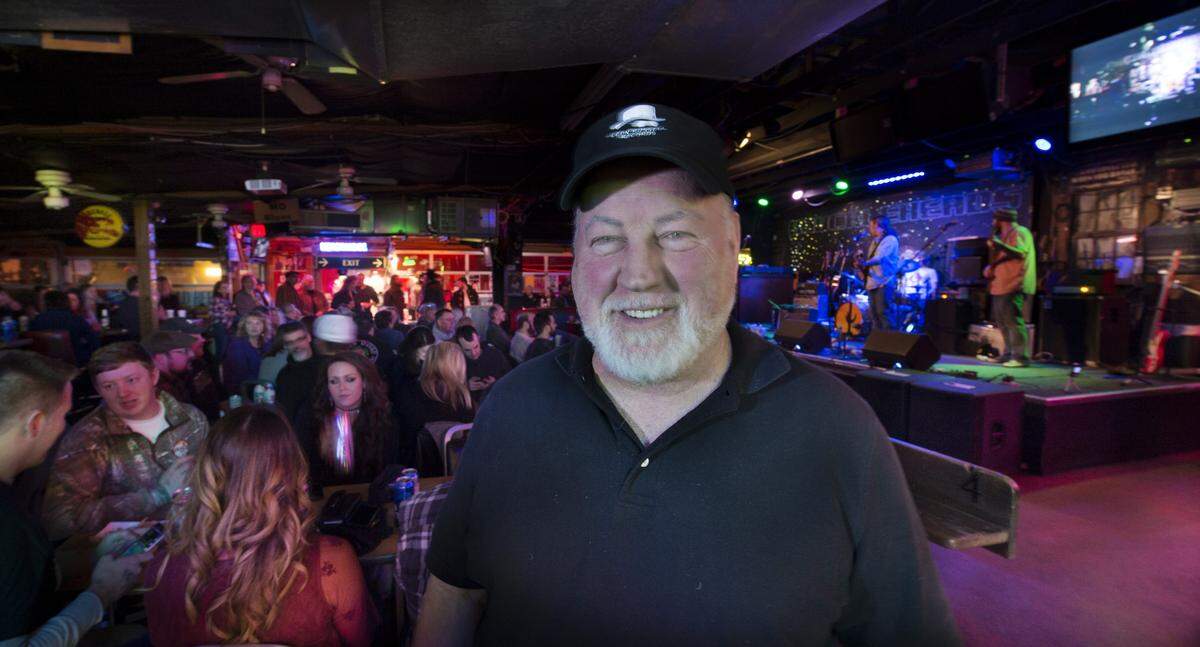
The idea now, Hicks said, is just to make enough to pay the bands, staff and utilities, hopefully just to break even.
On Wednesday night, a trickle of people came to the two 7:30 shows. The Rev. Carl Butler, a Wednesday regular, was booked in the tiny Gospel Lounge: normal capacity about 60 people. As the show started, zero were there. By 9 p.m., there would be nine.
Outdoors, at tables in front of the main stage, fewer than 40 people had gathered as the evening began. But across from the stage, Knuckleheads’ sound engineer Chris Bradley was elated. Married to popular musician Sara Morgan, Bradley also works as Knuckleheads’ general manager.
“This is a great crowd for a Wednesday right now,” he said, and by “right now,” he meant during the pandemic. Patrons, fearful of infection, are barely showing.
“Mostly, it’s that they just don’t feel comfortable,” Bradley said.
Advance ticket sales used to trounce walk-up sales, but now it’s the other way around. “Mostly,” Hicks said, “shows are canceling so fast, you’re afraid to buy a ticket. Why buy a ticket if it’s going to cancel tomorrow?”
Some shows are working. On June 20, they featured rock and blues musicians Danielle Nicole, of Kansas City, and Paul Thorn. Hicks said he’d typically pull in $5,000 at the door on a show like that.
“I made $1,200, not counting the bar, so that was a good show,” he said.
Then, on a regular Honky Tonk Monday Dance night, 47 people showed at $5 each, for $235. The band cost $400. Add doorman, sound man, bartender, kitchen help.
“I had to take money out of my pocket,” Hicks said.
‘Just having a good time’
On Wednesday, for example, the act originally scheduled sold only three advance tickets. Three people were going to show. So the performance was canceled.
Knuckleheads, at the last second, was able to book Jeff Norm Jimmy & Dave, a confederation of four noted locals — Jeff Porter from the band The Rainmakers, Norm Dahler from The Elders, and Dave and Jimmy Nace from The Nace Brothers — who regularly play together.
They pulled in a small but faithful audience. Free admission for those who called in advance. By night’s end, about 100 fans gathered at one time with a dozen or so up and dancing, all but a few without masks.
Hicks might break even on this night, but likely not. The band was glad to be there.
“You know, we’ve been kind of locked down until just recently,” drummer Dave Nace said, mask on, just before heading on stage. “Partly, being outside is a benefit here. But, man, we missed a few months. We want to play. It’s what we do.
“It’s partly financial, but not totally. It’s just that’s what we’re about.”
Nace said that, as with other bands, scheduled gigs for him and his brothers dried up when the coronavirus hit. A gig at the Indianapolis 500 on May 24: canceled, with the race rescheduled for August. County fairs, festivals, a Fourth of July gig, plus one in Arkansas and another on Memorial Day weekend down at the Lake of the Ozarks: All gone.
For bands that travel, anchor gigs at festivals and major events are often the key, Hicks said. They bring in big money. In between, bands will book smaller gigs to help pay expenses. But if the anchor gigs disappear, playing the smaller, connecting gigs can often become a wash. Bands can even lose money.
Some bands are still willing to travel, just for the exposure. Hicks has been getting calls from musicians out of Nashville and Texas, as coronavirus shuts them down. Other artists, either fearful of the virus or calculating it makes little financial sense, are staying home. Or feel forced to.
“We didn’t do any live gigs for two months,” said Nace, although livestreaming brought in some money. “It’s not the same as making a connection with an audience.”
Nace understands the health danger.
“I’m a 66-year-old cancer survivor. I don’t want to put myself at too much of a risk,” he said, but thinks that Knuckleheads’ open-air space, with 10 fans blowing and tables separated, helps. He would be less keen on playing inside and knows fans are, too.
“I don’t think people are quite ready to be in a small space,” he said. He’s right.
“I knew that this is a big space. There’s plenty of distance. And it’s outdoors, so I was OK with coming here,” said Ron Hostetter, 52, of Lake Waukomis, who sat with his buddies at a table 20 feet from the stage. He was adamant that he wouldn’t have shown if the band was playing indoors.
“No,” he said abruptly. “No.” Going inside to the bar, people placed their masks on. Outdoors, five of 100 people wore them. One couple wore them briefly on the dance floor, but soon took them off.
“I’m not going up there,” Hostetter said of the dance floor.
Vicki Brown, 61, a medical clinic worker from Kansas City, sat nearby with her feet up, enjoying the night.
“No, I have no concern over the COVID-19. Sometimes I think it’s all a political thing,” she said. “It’s serious. But so is the flu. No concerns. Just having a good time. We would have come whether it’s inside or out.”
Hicks said he’s doing all he can to make patrons comfortable. His staff wears masks. Patrons wear them inside. A sneeze guard shields the cash bar. Bottles of hand sanitizer can be found every few feet.
“I want them (customers) to come down,” Hicks said. “I only want them to come down if they feel safe. If they don’t feel safe, then wait till you do, or not. We don’t want anyone to come down who doesn’t feel safe.”
Hicks also knows there’s only so much he can do. Right now, bands, even big shows, are still scheduled, including 2020 Grammy winner Tanya Tucker in October, who had to cancel in May. Right now, against mounting medical odds — the Kansas City metro area last week surpassed 10,000 new cases — Hicks wants to be positive.
“I’m very optimistic,” he said. “I think the worst of it is going to be over. By the time we get into August, it’s going to be at least 75% like it was. A lot of people think there’s going to be a second wave of it. I don’t think there is. And I don’t want to say that like a dummy. I’m just being optimistic.”
Sitting in a lounge chair at the edge of his bar, he offered his philosophy.
“If you’re going to live your life in fear,” he said, “what the hell are you going to do? I’m 72 years old and I’m not afraid of coronavirus.”
Outside, his customers, masks off, danced into the night.
This story was originally published July 13, 2020 at 5:00 AM.