

With first-time pass rates as low as 58% for the FE exam and 46% for the PE exam, these aren’t tests you want to guess your way through.
The right prep course can make a big difference, but finding that prep course? It’s easier said than done.
School of PE is a popular choice among aspiring engineers, but is it actually worth the hype?
I spent time using School of PE for both exams to see how it actually holds up beyond what it claims.
Here’s what stood out, what didn’t, and whether SoPE is worth your time and money.
Will School of PE Fit Your Learning Style?
- Do you like getting into practice pretty quickly? School of PE moves you into practice questions fairly early instead of keeping you in lectures for too long.
- Do you prefer learning by doing rather than just watching? A lot of the learning comes from working through problems, not just sitting back and watching videos.
- Do you need very detailed explanations every time? Some explanations are a little lighter, so you may need to stop and think through certain steps on your own.
- Do you want a strict day-by-day plan? There’s some structure, but unless you’re taking a live class, you’ll mostly be setting your own pace.
- Do you like watching videos to learn? The video lectures explain topics clearly without feeling too long or drawn out.
School of PE: Two Exams, One Platform

School of PE keeps everything in one place, whether you’re studying for the FE or PE, so I wasn’t digging around trying to find what you need every time I opened the platform. Instead, I could get to work as soon as I logged in.
The questions really stood out to me. They’re not easy, but it never felt like they were trying to trick me, either. I realized pretty quickly that following the outlined setup was key; if I rushed or skipped steps, it showed immediately. I caught myself doing that more than once—which is kind of the point. It forces you to slow down, not to drag out the content, but to make sure you’re absorbing the information.
Honestly, the blunt simplicity of the lectures really appealed to me. They explain what you need, then move on. I wasn’t stuck sitting through long breakdowns just to get to the actual practice. It leans more toward learning by doing (kinesthetic learners rejoice), which kept it from getting repetitive.
Finally, I liked that there were live classes when I wanted more structure, but the on-demand version was much easier for me to keep up with on my own schedule. That said, it still expected me to stay consistent. Once I started recognizing the patterns in the questions, it became clear to me that School of PE is an option that actually works.
Package Options
- On-Demand: Full access to lectures, practice, notes, and study tools that you move through independently
➡️ Best for students who want to build their own study rhythm and revisit topics as needed without schedule pressure - Live Online: Instructor-led sessions with recordings plus full access to course materials
➡️ Best for students who want accountability and someone walking through harder topics in real time - Monthly Subscription: Short-term access to core materials without long-term commitment or guarantee
➡️ Best for students doing a final push or quick review before their exam
PE/FE Package Comparison Table
| Features | OnDemand | Live Online |
|---|---|---|
| Price Range | $349–$1,999 | $1,199+ |
| Access Length | 4–12 months | Class duration + extra access |
| Video Lessons |  Included | Included |
| Live Instruction |  | |
| Practice Questions | Full access | Full access |
| Practice Exams | Included | Included |
| Mock Exams (Timed) | | |
| Study Schedule | Self-paced | Structured |
| Instructor Access | (outside class) | (live + outside) |
| Pass Guarantee | | |
| Best For | Independent studying | Guided structure |
Package Perks
- Large banks of FE and PE-style questions
- Practice grouped by topic areas
- Full-length simulated exams
- Video lectures across all sections
- Digital workbooks for most disciplines
- Built-in flashcards
- Study hub with everything centralized
- Instructor Connect for questions
- Discussion forum
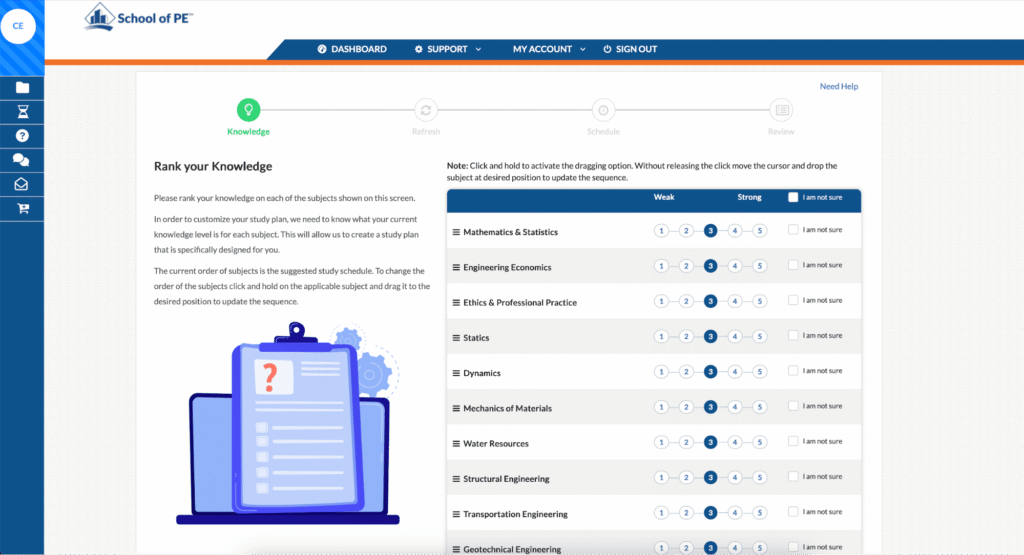
- Personalized study plan on select tracks
Pros
✅ Practice Feels Close To Exam Style: Questions weren’t overly easy or unrealistic
✅ Natural Study Flow: I didn’t waste time figuring out what to do next
✅ Flexible Enough To Adapt: I could shift focus based on weak spots
✅ Actually Builds Pattern Recognition: The repetition started paying off after a few sessions
✅ Good Volume Of Material: I never felt like I ran out of things to work on
Cons
❌ Explanations Can Feel Limited: Some answers don’t go very in-depth
❌ Best for Self-Driven Students: It doesn’t force structure if you avoid it
School of PE

School of PE Review
A Closer Look: Platform, Practice, And User Feedback
How the Question Bank Held Up
The question bank was honestly one of the stronger parts. The problems felt pretty close to what you’d expect on the actual exam, not overly simplified or random. Some questions did feel a bit harder, but it came across as intentional, as though it was designed to make sure the real test doesn’t catch me off guard. It pushed me to think through setups instead of just recognizing patterns too quickly.
- Large bank of FE and PE-style questions
- Organized by topic and difficulty
- Step-by-step solutions provided
What Happened When I Started Missing Questions
After a few sessions, the same types of problems kept coming up as weak spots. The platform showed me where I was struggling, but it doesn’t really force me to fix it. I had to go back, review, and retest on my own. That worked fine here, but if you need more direction, it can feel a little hands-off unless you’re using the live classes alongside it.
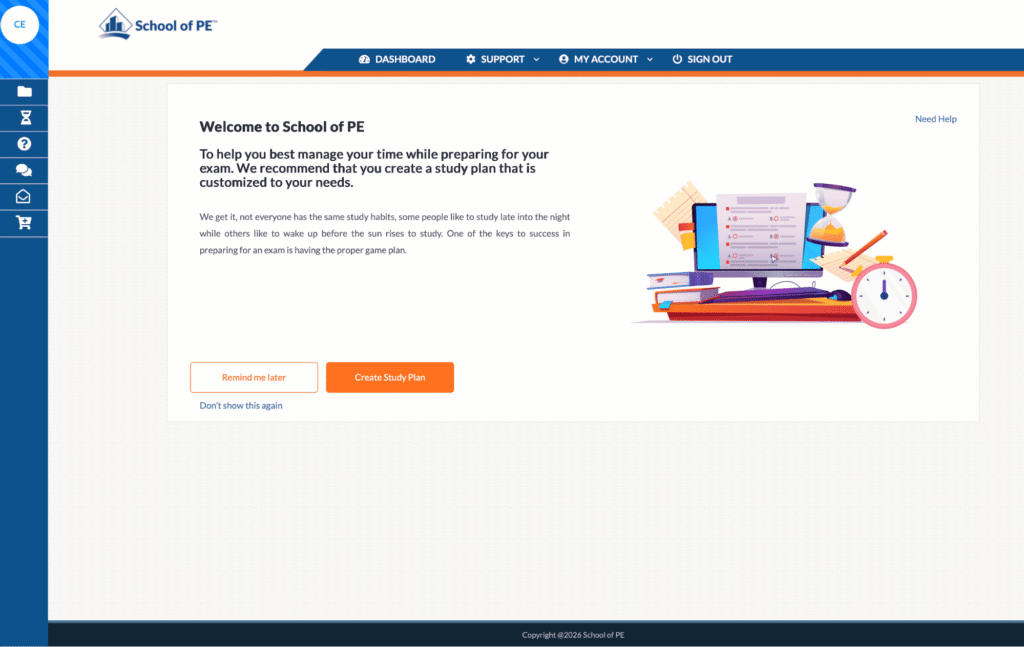
- Performance tracking by topic
- Score feedback after each set
- Study plan available but not enforced
Technology and Overall Usability
This was one of those things that just worked the whole time. Nothing froze, nothing reset, and I didn’t lose progress mid-session, which can make a big difference during long-haul study sessions. Moving between sections was quick, so going from reviewing something straight into questions felt seamless. It’s not overly styled or flashy, but that actually helped because it kept the focus on studying instead of distractions.
- Centralized study hub
- Smooth navigation between lessons and practice
- Works on desktop and mobile
Video Lectures, Notes, and Workbooks
As a visual learner, this part mattered the most to me. The lectures weren’t too long, and it never felt confusing to follow along. They explained just enough to get me moving without dragging things out. They don’t go super deep, so I still had to work through problems to really lock things in, but that’s a pretty typical study flow.
The workbooks helped a lot when slowing down and working things out step-by-step, especially for more involved problems. Finally, the notes really tied everything together.
- Video lectures across topics
- Instructor-prepared notes
- Digital workbooks for most disciplines
What You’re Actually Getting For The Price
You’re getting a lot of material and a system that actually gives you something to work with. There’s enough practice and structure that I could keep moving without feeling stuck, but I did have to show up and use it. It’s not cheap, but it makes more sense once you see how much is included. The pass guarantee also adds some peace of mind; money is stressful for everyone, and I can see a guarantee like this making the process a little more manageable.
- Full course access
- Instructor support available
- Pass guarantee on most plans
School of PE vs. Other Top PE/FE Providers
Note: For the sake of simplicity, I’m comparing just PE prep courses in the following table.
| PE Prep Course Comparison Table | ||
| PPI |
| GET STARTED |
| School of PE |
| GET STARTED |
| Civil Engineering Academy |
| GET STARTED |
| EET |
| GET STARTED |
School of PE vs. PPI2Pass
PPI2Pass centers on structured instruction, using detailed explanations, assigned homework, and a guided path through the material. The focus is on building understanding first, then reinforcing it through practice.
School of PE introduces practice earlier in the process, using repeated exposure to exam-style questions alongside shorter lessons. The approach leans on applying concepts while learning them.
→ Choose PPI2Pass if you want a structured, explanation-first approach
→ Choose the School of PE if you prefer learning through ongoing practice
School of PE vs. Engineering Education and Training (EET)
EET uses long-form instruction, often 80+ hours depending on the subject, with extended time spent working through problems during lessons before moving forward.
School of PE moves through topics in shorter segments, revisiting them through continued practice rather than staying on one area for long periods.
→ Choose EET if you want extended, in-depth coverage of each topic
→ Choose the School of PE if you prefer shorter lessons with repeated practice over time
School of PE vs. Testmasters
Testmasters is based on scheduled instruction with longer sessions, often totaling 70+ hours, where material is covered in a set timeframe leading up to the exam.
School of PE is organized around ongoing access, allowing study sessions to be spaced out over several months with the ability to revisit topics as needed.
→ Choose Testmasters if you want a fixed schedule with longer sessions
→ Choose the School of PE if you want to space out studying over a longer period
School of PE vs. Civil Engineering Academy (CEA)
CEA focuses only on civil PE and FE depth exams and aligns closely with the CBT format, including exam-style practice and simulation tools designed around that structure.
School of PE includes civil PE and FE, along with other disciplines, and combines lectures, notes, and practice throughout the study process rather than centering on simulation.
→ Choose CEA if you want civil-only prep aligned closely with the CBT format
→ Choose School of PE if you want a combined approach with instruction and practice
Final Verdict
This is one of those courses where it really starts to work once you’re actually using it, not just watching things. The more time spent in the question bank, the more patterns start to make sense, and that’s when things begin to click.
It’s not the best fit if you want everything broken down step-by-step or need constant guidance. But if you’re okay with figuring some things out through practice and staying consistent, School of PE does an excellent job.
FAQs
Access depends on the plan you choose, usually ranging from a few months to a year. Longer access is helpful if you want more time to review and practice.
It offers both options. You can choose live online classes or an on-demand version, depending on how you prefer to study.
It can work well for first-time test takers, especially if you stay consistent. Some may still need extra review for tougher topics.
They are generally similar in style. Some questions may feel slightly harder, which can help with preparation.
Yes, many people do. The structure makes it possible to study in smaller sessions around a busy schedule.


![PPI2Pass Review [FE and PE Exam Prep Courses]](https://www.kansascity.com/careers-education/wp-content/uploads/sites/7/2025/10/PPI2Pass-Review-feature-img.png)


