
Alcides Escobar’s ascent in lineup coincided with Royals’ ascent
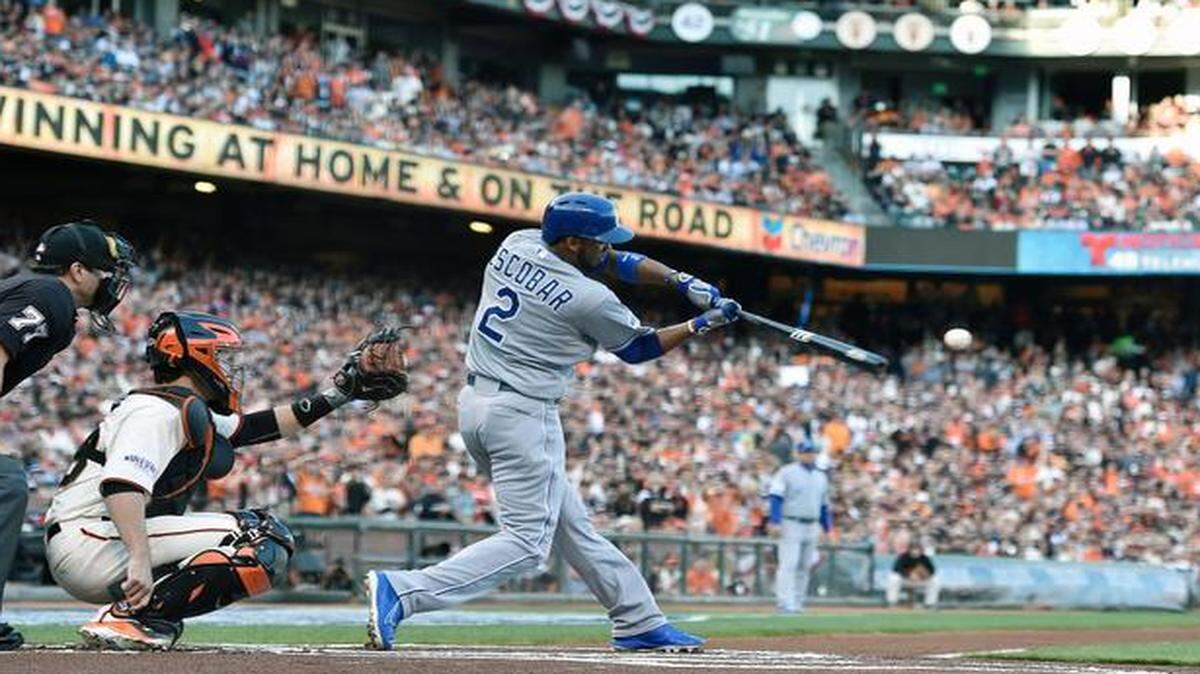
Right about 7:08 p.m. Friday, Alcides Escobar made his way to home plate at AT&T Park thinking not of an entire at-bat but of exactly one pitch.
“Right away when I’m walking to home plate, I’m saying, ‘Throw me a fastball down the middle, and I’ll swing at the ball,’” he said later.
A minute or so later to open game three of the World Series, that virtually scripted first pitch was served up by San Francisco’s Tim Hudson and Escobar lashed a double to left.
Fans still were still settling into their seats, and even No. 3 hitter Lorenzo Cain didn’t see it as he prepared to get in the on-deck circle.
It was one measly pitch in one instant, and maybe you’d like to see some discipline and discretion there. But Escobar takes the notion of being a leadoff man almost literally, so who’s to blame him for wanting to make sudden impact?
“I’m ready always, man,” he said.
Escobar would score on groundouts by Alex Gordon and Cain, a very Royals run that held up for five innings.
And then he’d be the catalyst again in the pivotal two-run sixth on the way to a 3-2 Royals victory that gave them a 2-1 series lead.
Suddenly, Escobar is as comfortable in his role at the top of the order as he is in the field, where he is a Gold Glove finalist. He’s now hitting .417 in the postseason.
“You can’t ask for a better leadoff hitter right now than him,” outfielder Jarrod Dyson said.
It’s a role Escobar had played before but not seized, a role he nonetheless sees as natural.
So when manager Ned Yost approached him in mid-September about moving from the bottom of the order to the tone-setting top, Escobar said, “Let’s do it! … Thank you.”
In the crafting of a decision so momentous, it might be supposed that it had the conviction of some science behind it.
You know, colorful charts and computer analyses and crunching advanced analytics and such.
But this one might as well have been concocted with the consultation of an Old Farmer’s Almanac, an Ouija board or Tarot cards. Or by flinging darts or tossing a coin.
Just ask Yost.
“When we made this change,” he said, “we were just kind of grasping at straws.”
Even so, that’s underselling it some.
A more generous but also more accurate way to frame it was under the category of necessity as the mother of invention.
When Yost moved Escobar to the top of the lineup, the Royals had lost nine of 15, including five of their last seven after a 4-2 loss to Boston.
They’d been prone to some radical swings all season, of course, but this was shaping up as their swan swoon as time was evaporating to earn a playoff berth.
And much of the reason was the ever-lurking issue of an offense that was less likely to emerge regularly than to submerge into a non-factor.
Whatever identity it had took routine trips into witness-protection.
During the 15 games leading to the move of Escobar to leadoff and Cain to No. 3 in the order, the Royals amassed all of 41 runs and scored as many as five just twice.
The very complexion and configuration of the offensive game changed almost instantly when Escobar was inserted atop the order on Sept. 13.
He doubled in his first at-bat and scored on Nori Aoki’s single as the Royals trampled the Red Sox 7-1.
There was no assurance he’d stay in that role, though.
“The first day we did it, Esky said, ‘I love hitting (leadoff); I hope this isn’t a one- or two-day deal,’” Yost recalled. “We said, ‘Esky, that’s all kind of depending on you if you can give us good at-bats.
“Because that’s where he struggled last year. He kind of lost his discipline a little bit, and he was swinging at pitches off the plate, where he could have been taking walks.”
Symbolized by the emphasis on the swift Escobar and fleet Cain and embodied in the deployment of September call-up Terrance Gore as a pinch-runner, the Royals’ offense at last took a shape it had only hinted at before.
It would an aggressive, attacking one that would put the ball in play and force the opposition to make plays … or get in its head trying.
As of the night of the change, the Royals would score 56 runs in the next 13 games, winning eight to clinch their first postseason berth since 1985 as Escobar closed out the regular season hitting .362 (25 for 69) in his new-found perch.
It was a long way to come for Escobar, whose average had dipped to .234 last season after hitting .293 in 2012.
“Last year, I don’t know what was going on,” he said. “I was swinging at a lot of bad pitches. I was swinging at everything.”
Now, he’s earned the chance to swing at his discretion, which was alert and spot-on before anyone else was ready on Friday.
“That’s how we’ve got to be out there,” Dyson said. “Stay on the attack.”
To reach Vahe Gregorian, call 816-234-4868 or send email to vgregorian@kcstar.com.
This story was originally published October 24, 2014 at 11:39 PM with the headline "Alcides Escobar’s ascent in lineup coincided with Royals’ ascent."