
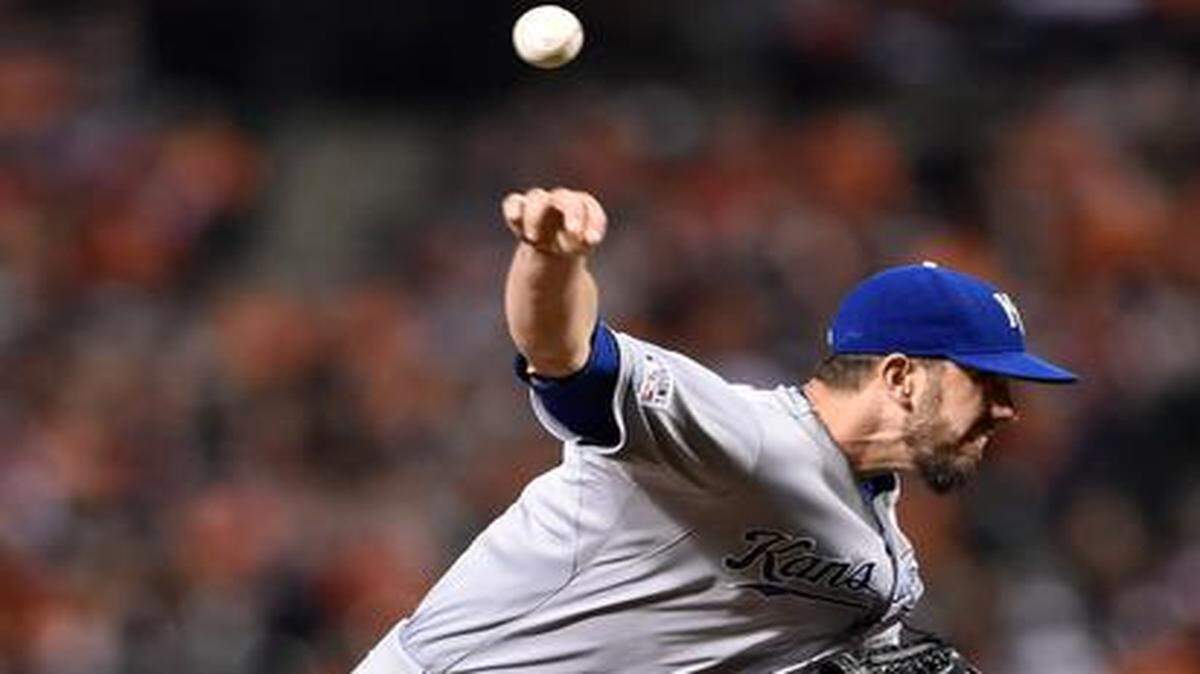
Wobbly James Shields remains a concern for the Royals as postseason progresses
From a certain detached distance, anyway, the Royals on Friday night at Camden Yards were creeping toward what passes for a safe haven in baseball.
They led Baltimore 5-1 in the fifth inning of game one of the American League Championship Series, and everything was aligned as if they’d scripted it themselves.
The Royals had won 71 of 85 games in which they’d scored four runs or more, after all, and 66 of 71 games they’d led after six innings.
But the main thing was that the bridge to that final third of the game that they’ve ruled all season was the very man seemingly made for the moment on the mound.
Then it all abruptly unraveled, and there was a time when that would have meant the Royals would come unhinged, too.
This collapse, though, proved only an afterthought after yet another giddy, goofy extra-inning win furnished by home runs.
The Royals won 8-6 after Alex Gordon and Mike Moustakas homered in the 10th to make them the first major-league team to hit go-ahead home runs in three extra-inning games in one postseason.
But that contortion in the identity of the Royals, who hit the fewest home runs (95) in Major League Baseball this season, merely furnished the win.
It was enabled by what’s been the spine of this team, the most unwavering and dynamic element of a team whose other strengths fluctuate.
The bullpen trio of Kelvin Herrera, Wade Davis and, ultimately, Greg Holland allowed it to happen … in large part because Herrera and Davis were expanded like accordions to pitch two innings apiece.
Neither allowed a base-runner, and Davis appeared utterly unhittable as he struck out four to get the game to extra innings after the Orioles had rallied to tie it off James Shields and Brandon Finnegan.
Holland was wobbly in the 10th, allowing a run on two hits and a walk, but it’s not the first time he’s created some static but gotten the result.
“We felt like we could hold them until we could put some runs on the board,” manager Ned Yost said, adding the Royals felt expanding their roles “was the best opportunity to give us a chance to win the ballgame.”
Their performance, which included Herrera shutting down a two-on, no-out jam in Finnegan’s wake, made secondary the decision to leave Shields in the game in a troubling fifth … but still left his performance a concern.
Yost didn’t fully explain his rationale, but whatever it was, there was a disconnect to that logic, though, so much so that it could only be seen as wishful thinking.
Shields could well be the most essential player in this Royals’ renaissance festival, their top starter and the catalyst and the hub and the rock and everybody’s brother and the tone-setter for so much of this.
But faith is one thing, gritting your teeth and guessing is another.
And that’s the most conviction Yost could have been feeling when he let a diminishing Shields linger with the bases loaded and two outs in the bottom of the fifth.
Maybe it was stubborn or reflexive textbook thinking.
Maybe it was a dash of sentimentality.
Maybe it even was an unconscious reaction to the backlash for removing Shields in a crucial situation in the Wild Card Game against Oakland that boomeranged when rookie Yordano Ventura faltered.
But what it couldn’t have been based on was the most relevant, compelling evidence of all: how Shields was pitching Friday and, in fact, has been most of the postseason.
To that point Friday, he’d allowed almost as many hits (nine) as outs induced (14), and by the time he was out of the inning, he’d allowed a two-run single to left-handed-hitting Ryan Flaherty that made his postseason numbers looked like this:
In 16 innings pitched, Shields has allowed 10 runs and 20 hits.
He’s had only four 1-2-3 innings while being inundated with eight multi-runner frames.
Yost stayed with the Shields he wants to have, not the one he has right now.
But the question for the Royals isn’t so much about whether it was right or wrong to stay with Shields on Friday, when the decision in some ways was vindicated by left-handed phenom Finnegan’s first postseason failure in the next inning since he was the man up in the bullpen.
It’s hard to know what’s happening with Shields right now.
It’s conceivable he’s wearing down after pitching more innings than anyone in baseball this season, and it’s also possible he’s in a funk he’ll come out of.
One way or another, he needs some fine-tuning, and the Royals may need to recalibrate where he stands.
But it was merely a back-story on Friday as the Royals found another way to defy all logic … and win.
“I guess,” Davis said, “we’re getting comfortable with it.”
To reach Vahe Gregorian, call 816-234-4868 or send email to vgregorian@kcstar.com. Follow him on Twitter: @vgregorian. For previous columns, go to KansasCity.com.
This story was originally published October 11, 2014 at 1:07 AM with the headline "Wobbly James Shields remains a concern for the Royals as postseason progresses."