
Three men with a singular goal: Bring the Chiefs a championship
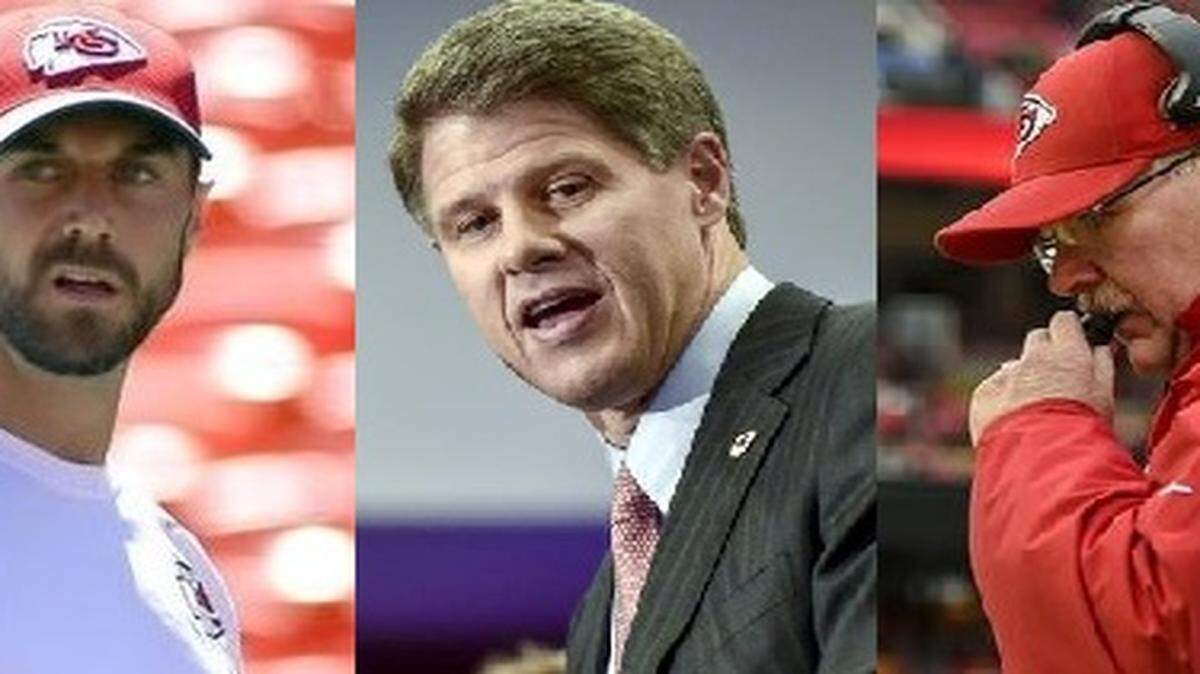
(Editor’s note: This story is part of The Star’s annual football preview, which will appear in three special sections in the Sunday, Aug. 28 print edition and also on KansasCity.com and The Star’s Red Zone Extra app.)
The Chiefs’ three most important leaders — owner Clark Hunt, coach Andy Reid and quarterback Alex Smith — are highly regarded around the league. But each is also aware they are lacking in the way football men are ultimately measured.
So often, perspective is what we take when we can’t get what we want. A defense mechanism. Get dumped, then maybe she wasn’t the right one anyway. Miss that promotion, then maybe you can have more time for yourself. Don’t make a lot of money? Then, well, money’s not what it’s about, right?
This is how it goes in sports, too. Winners don’t talk much about the value of losing. Those who don’t experience the ultimate thrill are left to make the best of what they have.
Marv Levy is a good example here. He is a kind, thoughtful and smart man. A terrific football coach whose place in life has too often been as sports’ most famous loser. He deserves better. This is how it goes. His Buffalo Bills made four consecutive Super Bowls in the 1990s, a record that may never be matched, and he’s in the Pro Football Hall of Fame. He is most remembered for losing all four.
People sometimes wonder how he deals with it. The heartbreak. The disappointment. The inadequacy. Levy usually smiles, and lets them in. It’s not like that, he’ll say. He’s lived a good life. He has so much to be proud of. Some of that comes from the fact that he survived prostate cancer, but not all of it.
“Look,” he once said, “it’s a game. Sure, we would have loved to have won ’em all, or one. But you only mourn for a little while. Then you recognize the good.”
We should all strive to think of our disappointments this way. Then again, if Scott Norwood had made that kick, we’d probably have had to find someone else to mention here.
An old football saying goes that the three most important people in any NFL franchise are the owner, head coach and quarterback. If that’s true, the essence of the Chiefs is appropriately represented by Clark Hunt, Andy Reid and Alex Smith.
All three are proud, committed, respected, focused, flawed and humble, at least by the standards of the NFL. Hunt is as flashy as a plain white shoelace but carries enough respect across the aisle to have been essential in the league and players agreeing on the current CBA.
Reid is addicted to work and allergic to arrogance, a brilliant game-planner with a well-earned reputation for clock-management errors. Smith is risk-averse, too often unwilling to throw downfield, but also a superior athlete and decision-maker. He was given no realistic chance to succeed by his first team, until the moment he lost his job after suffering a concussion, but even behind closed doors is so respectful his family gave him the suitably bland nickname of “Mr. High Road.”
Also — and this part is crucial — none have won a Super Bowl in their current positions.
Together, the three have 39 years at the front of an NFL franchise without achieving the goal that drives every team in every season. In the cold, bottom-line world of professional sports, they are often viewed as just good enough to watch the real winners.
And, together, they are now at the front of a franchise working on a 47-year Super Bowl drought. Only the Jets and Lions have longer ones.
“I think about it definitely more as I’ve gotten older,” Smith said. “More and more … It’s a constant for me. When I work, it’s in the back of my brain. It’s there.”
Winning a championship in any sport requires at least some luck, but fair or not, sports are seen as the ultimate meritocracy. If you’re good enough, you win, and if you’re not, you don’t. There is little time for nuance, and no patience for excuses.
Reid was the offensive line coach for the Super Bowl XXXI-champion Packers, but that’s a very different thing than winning as a head coach. There is actually a case to be made for him as one of the best five or so coaches of all-time to have never won a championship — he has more wins than Joe Gibbs and Bill Cowher, and a better winning percentage than Chuck Noll and Bill Parcells.
Reid’s best team in Philly lost by three lousy points to a Patriots squad that went 17-2 and led the league in point differential, but what people remember most about those Eagles teams is the rumor that Donovan McNabb threw up in the huddle during the fourth quarter.
“I love every minute that I have a chance to do this job,” Reid said. “There’s only 32 of us in the whole world, and that’s a pretty amazing number. So, to have this opportunity to do this, man, I’m loving every minute of it.”
Hunt, Reid and Smith will ask for and receive no sympathy. They range from rich to wealthy, and each has made influential friends and earned a good reputation in America’s most popular sport.
But there is something reductive about the way we tend to put these men in categories, particularly the quarterbacks and coaches. By definition, they are the best in the world at what they do. Only one can win each Super Bowl, and they all need luck and support and health and so much else along the way.
Smith has made more than $75 million in his career. He is smart, with a beautiful wife and two sons. He is a model philanthropist, helping many foster children transition into adulthood. In the last five years, only Tom Brady, Aaron Rodgers and Andy Dalton have won more games as quarterbacks.
Reid is one of the most successful coaches of his generation. His career record (161-110-1) is virtually identical to that of his mentor, Mike Holmgren (161-111). He has more wins and a better winning percentage than a half-dozen coaches in the Hall of Fame, including Hank Stram.
All three are objectively successful, in other words, but in the sports world we’ve created they’re viewed as something like the Applebee’s of their professions — functionally good enough, but nothing you’ll brag about.
“There are so many good coaches in this league,” Reid says. “There’s some good ones that haven’t won it, and they’re some pretty good ones that have won it. So, I surely respect those that have gone all the way and done that.”
Reid kept to the script and denied his Super Bowl dreams are at all driven by personal ambition. Football coaches have to compartmentalize, and Reid tells himself he is working for the city, for his players, for his assistants. We all have mechanisms to keep our priorities straight, and maybe this is Reid’s.
Smith answers a little differently. Oh, yes, absolutely, he is a football man and a leader, so first he talks about being accountable to his teammates. This sport’s highest level requires so much time, and so much work, the only way to truly pay it all back is by having the season’s last celebration.
But Smith has also taken more arrows than most, first in San Francisco, and then here in Kansas City. He’s a human being, and what human being doesn’t enjoy answering criticism with a middle finger?
“We all play for that, for sure,” Smith says. “You want to show everybody. From your fans, the naysayers, all of them. Yeah. Certainly.”
Dick Vermeil has lived both sides of the divide. He became a head coach at 40, full of fire and vinegar and a head of black hair. He bragged about sleeping in his office and was once furious that July 4 fireworks interrupted his concentration.
For a while it worked, too. He took the Eagles to the playoffs for the first time 18 years. His best team went 12-4 and lost the Super Bowl to Jim Plunkett and the Raiders. He burned out two years later and quit after a losing season.
That’s how he was remembered, too. The fiery guy who lost a Super Bowl and coached too hard to last. Then, 23 years after he coached his first game, he won the Super Bowl with the Rams, full of compassion and teary speeches and a head full of gray.
And he was seen as a completely different man.
“It doesn’t change you as the person who experiences it, but it changes people as they look at you,” Vermeil said. “There’s no question about that. All of a sudden, I was, ‘Dick Vermeil, head coach of a Super Bowl-winning team.’ I was never again, ‘Dick Vermeil, head coach of a losing Super Bowl team.’ ”
This is a personal point for Vermeil, partly because of his relationship with Hunt, but mostly because of his love for Reid. Vermeil had enough time as A Guy Who Didn’t Win to say the best coaches don’t always win Super Bowls. He thinks Reid is a better coach than many who’ve won Super Bowls.
But until or unless Reid does win a Super Bowl, Vermeil’s words will sound more like a noble defense of a friend.
This is what the rest of Reid’s and Smith’s time with the Chiefs will be about. Hunt’s, too, though he presumably has decades ahead of him as an owner. For the coach and quarterback, the timeline is much more finite.
Both have been close. Smith missed one Super Bowl because of two bizarre special-teams turnovers. He missed another because of a concussion. Reid made one, and came within one win of four others. This is the best chance they’ve had together in Kansas City, and considering the turbulence of the NFL, it might be the best chance they have left.
They have been successful, no matter what. The rest of their time in the league is about being able to retire without regret, and without the perspective forced upon those who never win it all.
Sam Mellinger: 816-234-4365, @mellinger
This story was originally published August 27, 2016 at 9:55 AM with the headline "Three men with a singular goal: Bring the Chiefs a championship."