
K-State miracle architect Bill Snyder gets the call from college football’s hall
On Sept. 30, 1989, Kansas State trailed North Texas, then classified as a Division I-AA program, by four points with 95 seconds remaining. The Wildcats had the ball 85 yards from the end zone.
At that moment, the K-State football program’s record stood at 299-510-40 and the Wildcats were lugging a 30-game winless streak.
In 93 years of football, they had captured one conference championship, in 1934. Thirty of the previous 33 seasons had produced a losing record. Kansas State was college football’s hopeless cause, a program so downtrodden that the Kansas Board of Regents had discussed a future in a lower NCAA classification.
But the strangest thing happened in the next 85 seconds that night in Manhattan, Kan. The Wildcats drove, reached the 12 and — on the final play — quarterback Carl Straw found Frank Hernandez in the end zone for a game-winning touchdown.
K-State players said they felt like they had won the Super Bowl. Fans spilled onto the field. The school’s athletic director said he thought he would pass out from the excitement.
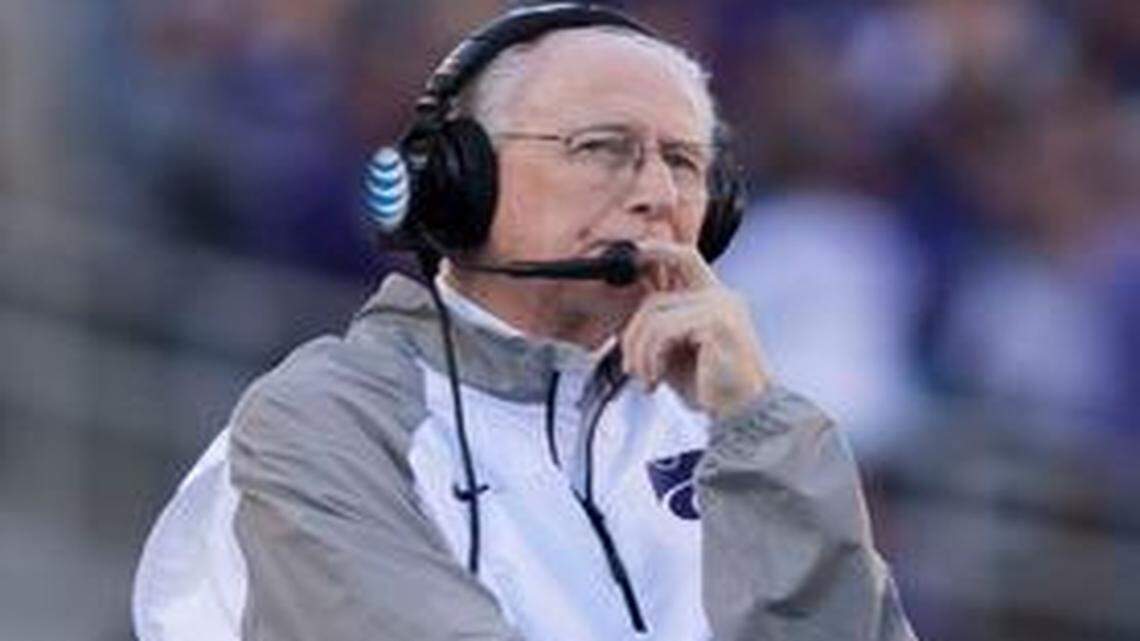
The only person in the place whose heart wasn’t racing at that moment was Bill Snyder, the first-year K-State coach. Snyder said he expected to win every game, a preposterous notion to anybody who knew anything about Kansas State football in 1989.
To anybody but Snyder, who on Friday in Dallas will be introduced as part of the next College Football Hall of Fame class.
Snyder, 75, has been elected in his first year of eligibility. He’ll become the fourth coach to be inducted while still coaching, following Bobby Bowden of Florida State, Penn State’s Joe Paterno and John Gagliardi of Division III St. John’s in Minnesota.
Discussion by the selection committee had to have been brief. Or perhaps the group simply consulted Barry Switzer, the former Oklahoma coach who missed coaching against Snyder by one year. Switzer’s Sooners usually had, as he liked to say, “hung half-a-hundred” on K-State by halftime. Starters had their shoulder pads off in the second half.
As Kansas State started to climb under Snyder — from that lone victory in 1989, to a bowl team in his fifth season, to a No. 1-ranked team in his 10th and the Miracle in Manhattan in full glory — Switzer noted that a single-season coaching award did not adequately express Snyder’s value.
“He’s not the coach of the year,” Switzer said. “He’s not the coach of the decade. He’s the coach of the century.”
Maybe two centuries now.
The numbers alone are Hall worthy. In 23 seasons split between two tenures, Snyder is 187-94-1, including a 9-4 record this season. His teams have appeared in 16 bowl games. The program had played in one postseason game before Snyder. Kansas State won Big 12 championships in 2003 and 2012 and finished atop the Big 12 North four times.
But Snyder’s meaning to Kansas State runs much deeper than the victories. The university’s enrollment in the mid-1980s was dropping. Fundraising was flat. Football wasn’t making money. Even the school’s library was, by then-president Jon Wefald’s admission, the worst in the Big Eight.
The football team played Oklahoma in Norman for five straight years, selling home games for a bigger payday.
Not even a winning men’s basketball program could alter Kansas State’s depressed image.
But by 1993, the Wildcats’ first bowl season under Snyder, Kansas State was a different place. So was Manhattan. A first stadium renovation was underway. New hotels went up. Football weekends became happenings.
Kansas State had developed a culture of success, not by recruiting the nation’s highest profile athletes, but by identifying talented players who would fit Snyder’s ideals. Some came from junior colleges, some transferred.
Some, like Darren Sproles, were deemed too small at other schools to play running back. Others, like Jordy Nelson, had no other major offers and decided to walk-on.
None of Snyder’s recruiting classes have been rated in the top 10 nationally. But he’s twice turned Kansas State into national contenders. His first tenure ended in 2005, but Snyder quickly regretted retiring and three years later was back on the sideline.
The Wildcats were down again, not to the extent of the late 1980s, but they were coming off successive losing seasons. Surely, Snyder couldn’t work his magic twice.
But in 2009, his first year back, Snyder took K-State into the regular-season finale with a chance to win the division. The Wildcats returned to a bowl game the next season and won a Big 12 title in his fourth year back.
Many people are responsible for what’s occurred at Kansas State over the past quarter-century, starting with an administration that hired the Iowa offensive coordinator without college head coaching experience, to a lengthy list of support personnel and fan base that ranks among the nation’s most loyal and enthusiastic.
And the funny thing is, as he did in that game in 1989 when Hernandez caught the touchdown pass, Bill Snyder expected it all along.
To reach Blair Kerkhoff, call 816-234-4730 or send email to bkerkhoff@kcstar.com. Follow him on Twitter: @BlairKerkhoff.
This story was originally published January 8, 2015 at 6:15 PM with the headline "K-State miracle architect Bill Snyder gets the call from college football’s hall."