
Even an inclusive College Football Playoff is going to exclude a conference champ
One of the unknowns heading into the inaugural College Football Playoff was its impact on the regular season.
The dozen games per school that stretch from late August to early December are worth billions in television contracts. Their importance remains paramount to the sport, and as the playoff was being created, there was talk and concern of diminishing the autumn games.
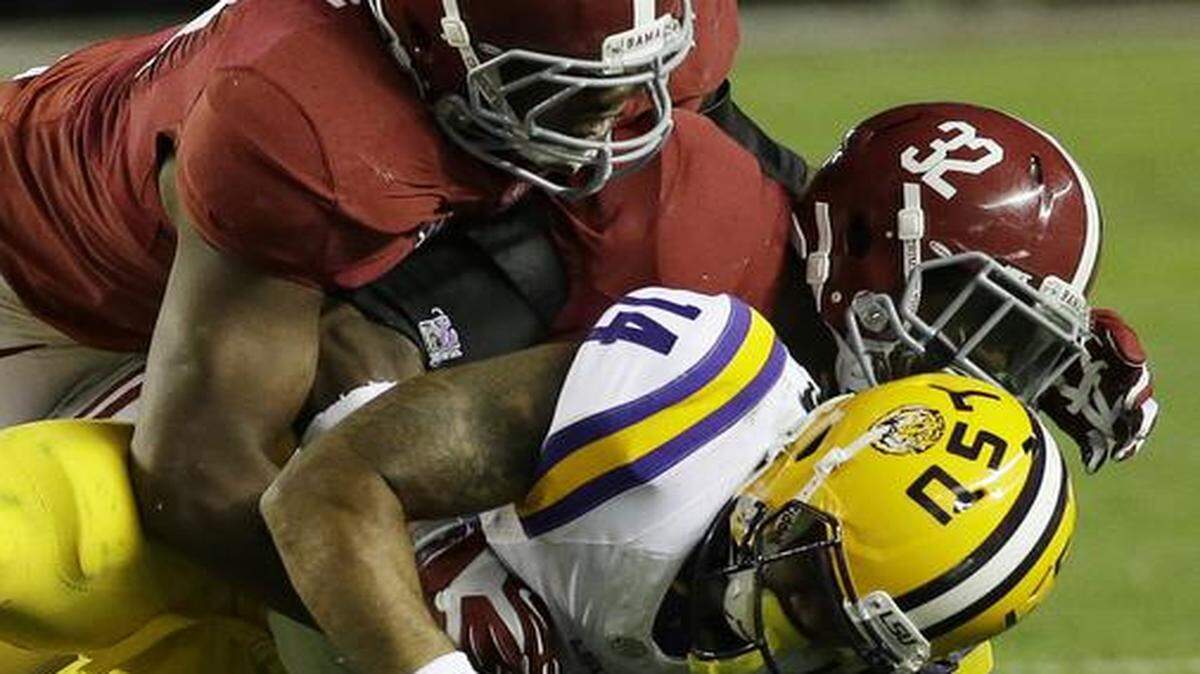
To this point, any worry was groundless. We’re consuming college football voraciously, and Saturday night’s buffet will make gluttons of us all: Kansas State-TCU on Fox, Alabama-LSU on CBS and Ohio State-Michigan State on ABC.
But Saturday’s blockbuster schedule, which also includes Notre Dame-Arizona State in the afternoon and Oregon-Utah later in the evening, serves as a reminder of what could become the loudest gripe as the playoff selection approaches.
By early Sunday morning we’ll have projected another foursome while awaiting the playoff committee’s ranking on Tuesday.
But the math won’t change: Four spots won’t accommodate five power conference teams.
Some league champion or highly rated team will be omitted from the group, and where in previous years the complaints were confined to a program (Oklahoma State in 2011, for instance), this and every year of a four-team playoff, a conference is going to be livid.
Or two conferences, if one league occupies more than one line on the bracket.
Let’s play out a scenario.
Undefeated Florida State wins out to capture the Atlantic Coast Conference.
Alabama powers through its remaining schedule to take the Southeastern Conference.
Oregon, TCU and Michigan State win out.
All but the Seminoles have one loss. So does, for the sake of this scenario, Mississippi State and Notre Dame.
Who doesn’t make the bracket?
The winnowing might start with the Big Ten champion. The league simply had such a lousy September in nonconference games that its champion could be left behind.
Or the Big 12’s. TCU coughed up a three-touchdown lead in the fourth quarter of its loss to Baylor.
Or the Pac-12’s. Oregon’s loss came at home to Arizona.
Would the committee considering drop-kicking undefeated Florida State if the Seminoles play what is perceived to have been the weakest schedule?
Mississippi State, if it didn’t represent the SEC West, but would have defeated as many as four top teams? The Irish, who would only have lost at Florida State in the end?
These are the potential complications facing the committee and already have me wondering how difficult it would be for a bracket twice the size, one that has room for five power conference champions, two at-large teams, including Notre Dame and the best team from a nonpower conference if it meets certain criteria.
It’s early. Many regular-season clashes remain. The conference championships could produce clear-cut contenders. College football has provided such clarity before. Last year, nobody quibbled with a Florida State-Auburn title game.
And the committee has this going for it: Although it’s only been two weeks of rankings announcements, the response has been generally positive. The ratings have varied from the major wire service polls, and instead of questioning the committee rankings, I’ve heard more wondering about the accuracy of the polls.
Perhaps the bracket decision of the committee will be widely accepted, and maybe they’ll get lucky in this first year and four obvious playoff teams will emerge.
Then again, this is college football, and getting it right in the end is rarely packaged in a neatly tied bow.
To reach Blair Kerkhoff, call 816-234-4730 or send email to bkerkhoff@kcstar.com. Follow him on Twitter: @BlairKerkhoff.
This story was originally published November 6, 2014 at 4:20 PM with the headline "Even an inclusive College Football Playoff is going to exclude a conference champ."