
KC baseball park designer branches into college football
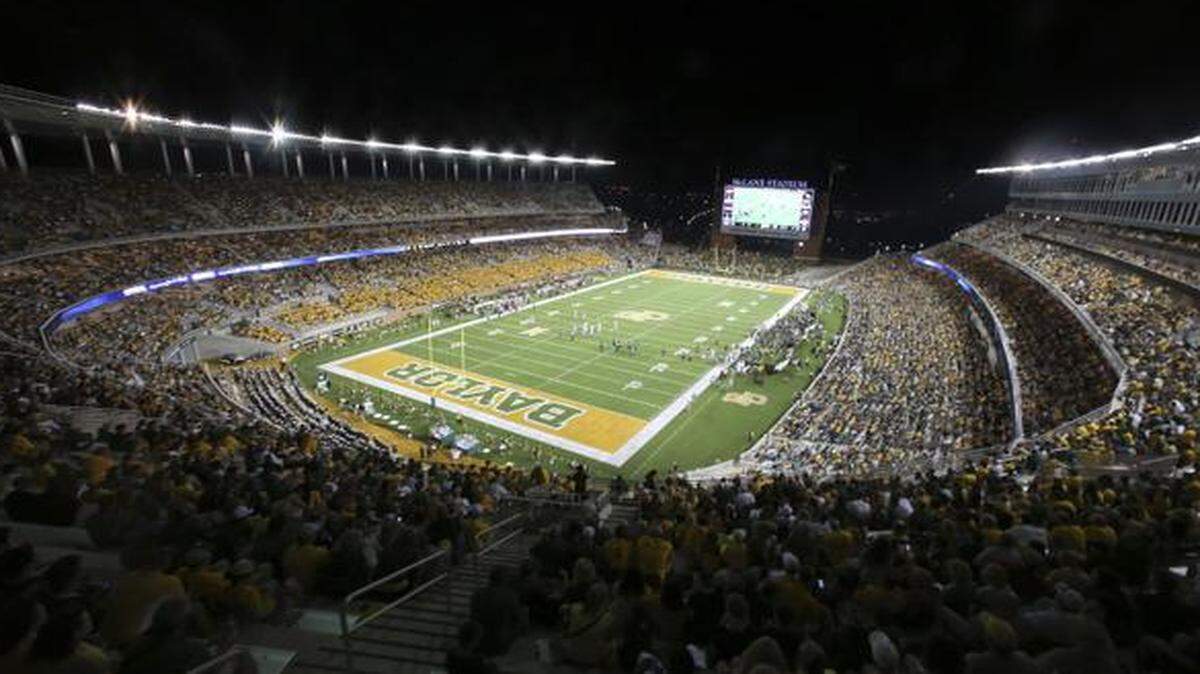
For the first time this season, Baylor is away from home. The Bears play at Buffalo on Friday night, and although any road game presents challenges, this one will feel especially different.
They’ve spent the first two weekends competing in their fabulous new home, McLane Stadium, which opened to rave reviews.
Innovative … work of art … blueprint for future projects, the $266 million structure that sits on the Brazos River in Waco, Texas, seems about as perfect as a college football stadium can be.
Which was precisely the idea stadium designer Earl Santee of Kansas City sports architecture firm Populous had to convey when the group from Baylor flew to Kansas City in August 2011 to meet at the River Market office.
Doubt filled the room. Baylor’s football success had turned under coach Art Briles. The previous season, the Bears had appeared in their first bowl game as a Big 12 member. But should one winning season provide an impetus for a new stadium?
“It’s funny how a lot of projects happen,” Santee said. “You have to have the right idea, the right leadership, the right financing, the right politics. And all these moments have to happen concurrently.”
For Baylor, those multiple paths intersected at the Populous office that day, with the help of a model.
Santee had studied a Baylor map and created a vision for a beautiful stadium on the river that connected athletics to campus and campus to Waco.
Baylor president Ken Starr was there with athletic director Ian McCaw and representatives of the school’s board of regents and finance. Santee talked about the stadium as a gateway to the university and central Texas. He answered questions, and then came the critical moment.
“One I’ll remember forever,” Santee said.
Silence.
The group from Baylor marveled at the model and the mood changed from wondering if a new stadium should be constructed to how Baylor could make it happen.
“Collectively, they got it,” Santee said.
If the project needed momentum, the football team supplied it immediately. Quarterback Robert Griffin III won the Heisman Trophy in 2011. The Bears won their bowl game that season and the next, and in 2013 captured their first Big 12 championship.
But just by deciding to build a new structure, Baylor had taken a bold step. Mostly for financial reasons, college football stadiums haven’t sprouted up across the landscape like baseball ballparks. Some 31 were constructed in the 1920s, including Kansas’ and Missouri’s Memorial stadiums.
Baylor’s is the ninth in the past decade, and none of them have a capacity larger than 51,000.
For Santee, a Kansas graduate and among the world’s foremost sports architects, with 18 major-league ballparks on his resume and the blueprint for the Atlanta Braves’ new ballpark on his desk — designing a major college football stadium became a new and refreshing challenge.
“There is a purity to the experience that’s different in college sports,” Santee said. “College sports lives for tradition. There’s a clear and clean sense of how a legacy lives on from generation to generation.”
McLane Stadium wasn’t Santee’s first college stadium. A couple of years earlier he designed 7,700-seat Crusader Stadium at Mary Hardin-Baylor in Belton, Texas.
Drayton McLane was the connection. The former Houston Astros owner is a major benefactor at both universities, and Santee had designed the Astros’ Minute Maid Park.
Santee’s visits to Texas won’t end anytime soon. He’s also the senior principal on Texas A&M’s Kyle Field renovation. He attended the Aggies’ opener last weekend against Lamar, one of 104,728 who sat through a two-hour rain delay to see a stadium that’s a year away from completion of a $450 million refurbishing.
For this project Santee, cast a wide net for feedback: administrators, coaches, athletes, donors, former and current students.
“I wanted to know about their traditions and the value of those traditions and come with a design that embraces and honors them,” Santee said. “It runs very deep there.”
With the latest projects, Santee may be starting a new tradition for college sports, investing in structures in a way that hasn’t happened in nearly a century.
To reach Blair Kerkhoff, call 816-234-4730 or send email to bkerkhoff@kcstar.com. Follow him on Twitter: @BlairKerkhoff.
This story was originally published September 11, 2014 at 4:03 PM with the headline "KC baseball park designer branches into college football."