
To fix college football’s scheduling imbalance, consult the NFL
University presidents used to describe the evils of a playoff as the “NFL-ization” of college football.
They got past it. “College Football Playoff” is even the title of the postseason system.
Now, college football would be wise to borrow another concept from the pro ranks — standard nonconference scheduling.
The NFL system presents a perfect balance. Six games against three division opponents, four against one of the other three divisions in the conference, four against a division from the other conference, and two against teams with similar records from the other two divisions in the conference.
The Chiefs, for instance, open Sunday against the Titans because both teams finished in second place in their division. It’s also why the Steelers are on the slate. The Chiefs and their AFC West opponents meet all of the teams in the AFC East and the NFC West.
In the NFL, scheduling is removed as an advantage. That doesn’t mean all schedules are created equal, but like the draft and salary cap, it’s a measure taken by the league to provide fairness and opportunity.
College football does no such thing. Conference games are set by the leagues, but the schools get fill out the rest of the card, and, well, you might desire a day of matchups like the one in Eugene, Ore., on Saturday between Oregon and Michigan State, but this not how most college football programs are wired.
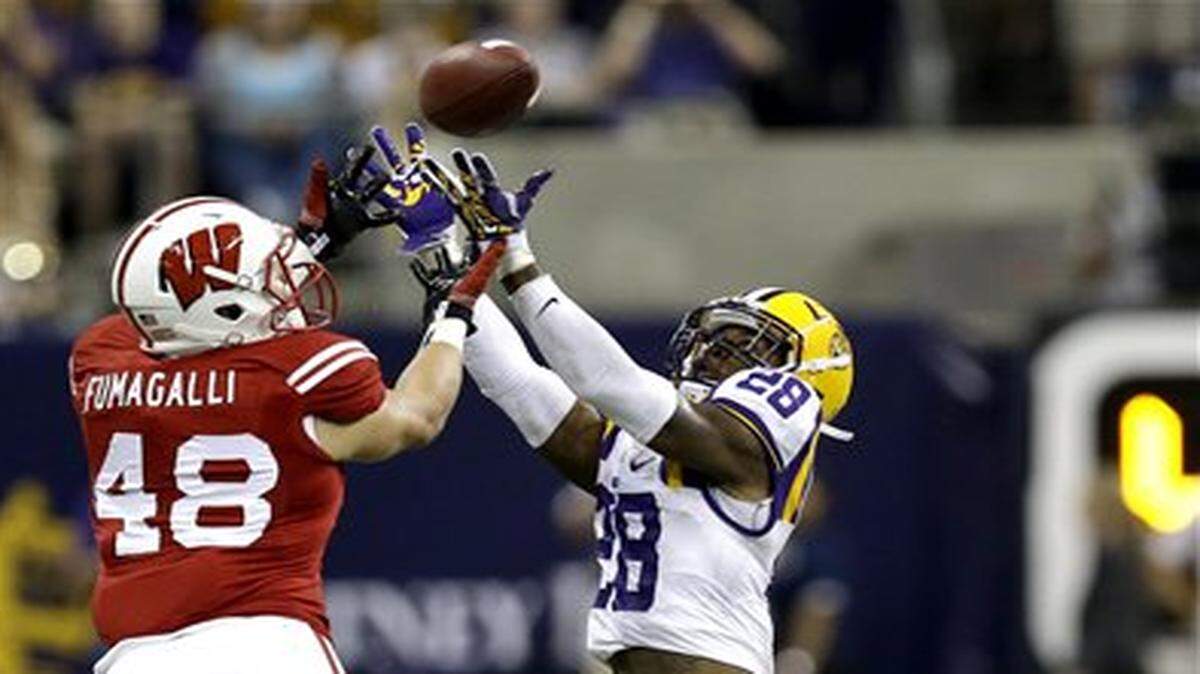
If the first weekend of college football presented neutral-field drama with the likes of Florida State-Oklahoma State, LSU-Wisconsin and Alabama-West Virginia, the second week’s theme looms as mismatch dreck. The Big 12 and Southeastern Conference schedules this week are loaded with them.
College football will continue to do business this way unless the power conferences are persuaded otherwise and agree to a bit of cooperation.
The SEC has mandated that starting in 2016 each of its schools schedule at least one fellow power-five conference opponent. That’s a start, but it’s not enough.
Make it three for the SEC and others that play eight conference games and two for the leagues that play nine. Hold one spot for the possible mismatch (and if you’re a Big 12 school, don’t think of North Dakota State that way).
Here’s where the NFL style comes in. Rotate the opponents roughly by power conference standing. Missouri won the SEC last season, and the SEC has an eight-game conference slate, so the Tigers go into a scheduling pool with last year’s division and conference winners Florida State, Duke, Ohio State, Michigan State, Baylor, Stanford and Arizona State.
Kansas State finished third in the Big 12 and has one of the nation’s most attractive nonleague games, against Auburn on Sept. 18. In this system, the Wildcats would have selected from among Nebraska, Penn State, Syracuse, Miami, Fla., Georgia and LSU.
Kansas, last in the Big 12, could meet Arkansas, Kentucky, Colorado, California, Purdue or Northwestern.
Make the games two-year deals, home and away. If the system started in 2015 based on the 2014 final standing, the next round would begin in 2017 based on the previous year’s standing.
Leave flexibility for rivalries that cross conferences, like Iowa State-Iowa, Clemson-South Carolina and Florida-Florida State.
No more scheduling out years in advance. Spots would be reserved based on standings. Season-ticket holders would favor it. TV programmers would love it.
Coaches, naturally, would loathe the idea because scheduling would largely leave their control. But you know who else would want this? The College Football Playoff selection committee.
Because here’s what the committee doesn’t want to do at its meeting to select the national semifinals: Weigh an 11-1 team that played a weaker slate than a 10-2 team for the fourth and final spot. If the schedules were deemed equal, the decision is made easier.
The message will grow louder throughout the season, but it will take a playoff bracket snub to get anybody’s attention.
To reach Blair Kerkhoff, call 816-234-4730 or send email to bkerkhoff@kcstar.com. Follow him on Twitter: @BlairKerkhoff.
This story was originally published September 4, 2014 at 5:10 PM with the headline "To fix college football’s scheduling imbalance, consult the NFL."