
Chiefs took challenge of stopping Seattle’s running game personally
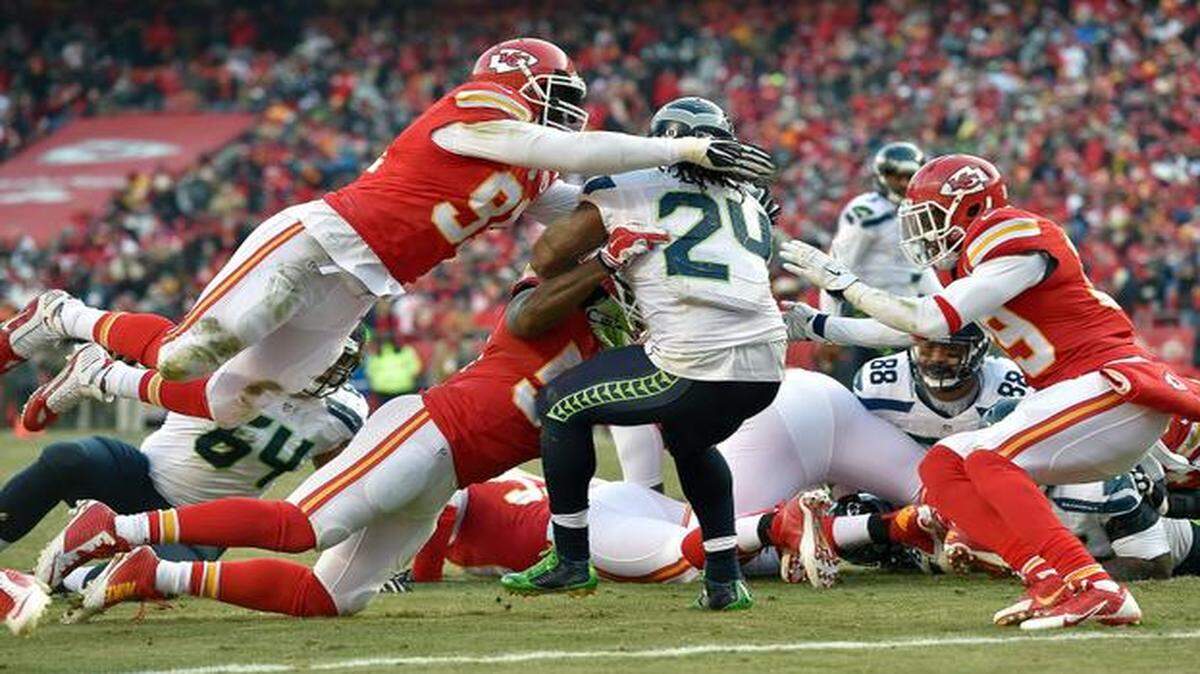
Kevin Vickerson finally allowed himself to smile following the Chiefs’ 24-20 win over the Seahawks on Sunday.
Understand, the process of getting his mind right — i.e., drawing the internal fuel necessary to play angry and aggressively — for Sunday’s showdown against the defending Super Bowl champion Seattle Seahawks had begun days earlier.
The Seahawks like to run the ball, sometimes with six linemen, and Vickerson, a 6-foot-5, 328-pound defensive end and noted run stopper, knew this. So while he said all the right things when asked about how they planned on stopping star running back Marshawn Lynch during the week, he silently bristled at each question.
The Chiefs were 6-3, just like the Seahawks, he thought. And they remained the only team that hadn’t allowed a rushing touchdown all season. So why was everybody so concerned about Lynch?
“It’s been said all week,” Vickerson said after the game. “It’s respect thing. We want respect, too. We respect all, but we’re not going to back down to anybody.”
In the aftermath of the win, it was clear Vickerson — a member of the Denver team that lost to Seattle in last season’s Super Bowl — wasn’t the only Chief who felt this way.
“We embraced this challenge,” linebacker Tamba Hali said. “If you can’t stop the run in this league, it’s dangerous.”
Despite facing a steady stream of stacked boxes — the Chiefs always tried to keep one more man around the box than the Seahawks had blockers — Lynch still got his, somewhat, rushing 24 times for 124 yards.
But the Chiefs managed to keep him out of the end zone and stop him on a handful of big occasions, including a crucial fourth-and-1 late in the game, and those are the occasions the Chiefs — who still haven’t surrendered a rushing touchdown this season — will hang their hats on, even though the Seahawks rushed for 204 yards on 37 carries, a fairly-robust 5.5 average.
“Sure, they rushed for a lot of yards,” Hali said. “But keeping the points off the board is more important.”
So is clamping down when you really need to, as the Chiefs kept the Seahawks out of the end zone three of the five times their reached the red zone. In 15 red zone plays, the Seahawks only rushed six times for 16 yards, despite the fact they had a sledgehammer like the 5-foot-11, 215-pound Lynch at its disposal.
“Marshawn Lynch, he’s a beast,” linebacker Justin Houston said. “It’s hard to stop that guy ... we gave up some big plays, but we knew when we had to ’bow up, that’s what we did.”
The Seahawks — who ran the ball eight straight times for 45 yards at one point in the first quarter — certainly weren’t shy about turning to their vaunted read-option running game with Lynch and speedy quarterback Russell Wilson, which demands a combination of discipline and physicality to defend properly.
“You’re running (against) a college-style offense,” Hali said. “If you’re sound but one player — one player — doesn’t do their job, he’s (running) for 40 or 50 yards. It’s a scheme where we all have to be on the same page, rally and keep tackling and eventually things would start bouncing our way a little bit.”
Houston said the Chiefs did OK against the zone stuff, though he admitted he’s grown tired of seeing it. The 49ers and Dolphins — who both feature mobile quarterbacks — used it against the Chiefs, too.
“I definitely don’t like the way they’re running the ball now with the zone read,” Houston said with a laugh. “I hate that. I wish they’d just hand it off. I definitely thought I left that (offense) back in college.”
But for all the emphasis they placed on stopping the Seahawks’ zone read, the Chiefs took it as a personal challenge whenever Seattle brought in an additional offensive lineman, which the Seahawks often do for the explicit purpose of running the ball down the opponent’s throat.
To counter that look, the Chiefs went to a rare 4-4-ish look, which featured four interior linemen — a combination of Dontari Poe, Allen Bailey, Kevin Vickerson, Jaye Howard and Vance Walker — and four linebackers in Hali, Houston, Josh Mauga and James-Michael Johnson in the box, trying to take way the running lanes.
“That was one of the keys,” Howard said. “We had to put the best people to play the run on the field.”
That proved to be a key on a crucial fourth-and-1 late in the fourth quarter, when the Chiefs’ 4-4 front — led by Allen Bailey and Jaye Howard — stuffed Lynch short of the first down marker at he Chiefs’ 35-yard line.
“I don’t know if you want to call it lucky for them or if we didn’t execute,” Seattle tight end Luke Willson said, “but that doesn’t happen to us very often.”
The Chiefs, obviously, don’t think their ability to keep the Seahawks from scoring a rushing touchdown was lucky. After all, they’ve done the same to nine other teams this year.
“It’s our mindset, our focus, it really is,” Hali said. “We keep building on it each week. We know they’re going to rush the ball. When it gets in that red area, it feels a little condensed.”
Vickerson, meanwhile, used the same term Houston did to describe their mentality.
“We had to ’bow up, period,” said Vickerson, who finished with three tackles. “We weren’t hiding. We weren’t running from it.”
And in the end, he hopes the Chiefs earned some respect for coming up big against Lynch when it mattered, too.
“It was a statement game, most definitely,” Vickerson said. “We’re good. It is what it is. We know what we can do.”
To reach Terez A. Paylor, call 816-234-4489 or send email to tpaylor@kcstar.com. Follow him on Twitter: @TerezPaylor.
This story was originally published November 16, 2014 at 7:51 PM with the headline "Chiefs took challenge of stopping Seattle’s running game personally."