
Chiefs’ ‘Pass Rush City’ started more than 50 years ago
Tom Pratt reaches into his desk and pops in a DVD from almost 22 years ago.
It’s a play from the 1992 season finale between the Chiefs and Denver at Arrowhead Stadium, a winner-take-all showdown for a wild-card playoff berth.
Broncos quarterback John Elway, backed up at his 5, takes the shotgun snap and backpedals on the bright green Arrowhead artificial turf. Chiefs outside linebacker Derrick Thomas races around the protection and sacks Elway, and with his signature move rips the ball loose for a fumble and recovers it for a touchdown, sparking a Chiefs victory.
That, says Pratt, is the way they sack the quarterback in Kansas City. And have done so for more than 50 years.
Pratt now holds the distinctive assistant coaching title of pass-rush specialist for the Cardinals, and he uses Thomas’ sack, strip and fumble return as Exhibit A when he wants to show his players the art of sacking the quarterback.
Pratt, 79, is the only active NFL coach who also worked in the American Football League, starting with the Chiefs in 1963, their first year in Kansas City.
He helped build Pass Rush City — the term coined this summer by new Chiefs edge rusher Dee Ford.
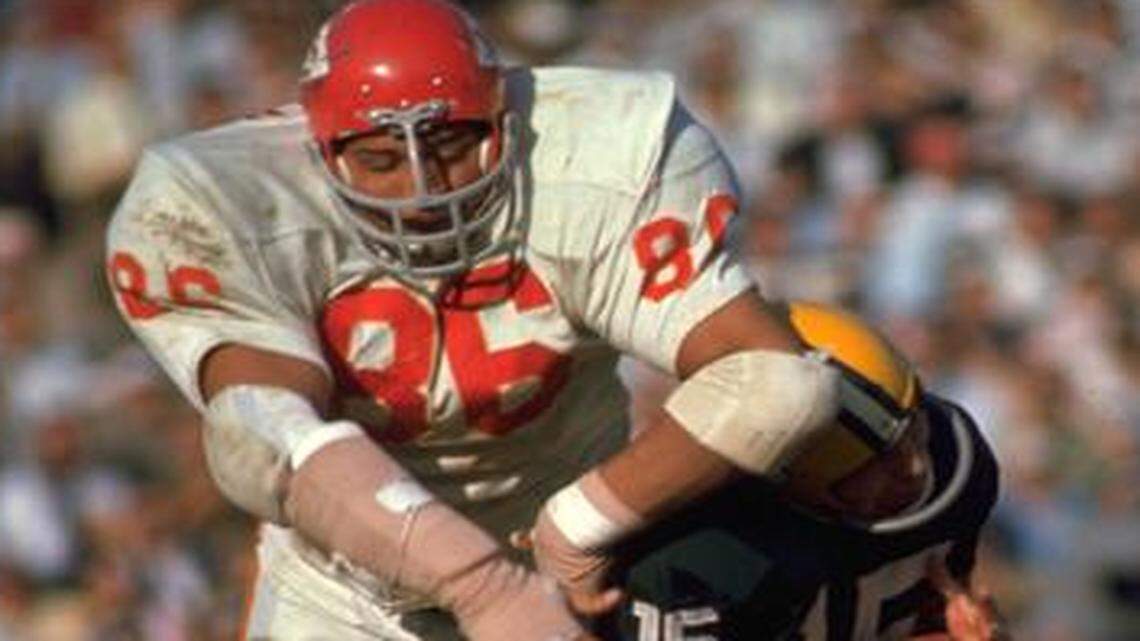
In three stints with the club, Pratt tutored a lineage of pass rushers few franchises can match, starting with the unit in the late 1960s that went to two Super Bowls and capped by Thomas’ pillaging of quarterbacks that led to his joining the previous generation of Buck Buchanan, Curley Culp, Bobby Bell and Willie Lanier in the Pro Football Hall of Fame.
“Go all the way back to the Buck Buchanan and Jerry Mays and Aaron Brown years,” Pratt said of the Super Bowl Chiefs, “and we realized the value of the rushers and tried to incorporate the whole package with those players.
“Once you get them, and you say, ‘Hey, wait a minute, we want to maintain this pattern, this profile that we’ve got for rushers.’ That was part of it. Teams that never really had great rushers or a combination of rushers didn’t realize how important they were and sometimes drafted someone for his ability to stop the run instead of a big-time rusher.”
The Chiefs won Super Bowl IV with Mays and Brown crashing from the ends and Buchanan pushing the middle. When coach Hank Stram wanted to add a little more pressure on the quarterback, he’d send linebackers Lanier and Bell after the passer.
Because of the wide-open play in the pass-happy AFL, the Chiefs of the 1960s had to put pressure on quarterbacks such as Daryle Lamonica, Jack Kemp and Joe Namath in order to be the young league’s most successful franchise.
“It was almost unfair to have Culp and Buchanan and Lanier and all those guys,” Namath said. “How did they find all of those guys in Kansas City?”
The Chiefs continued to emphasize the pass rush when they took Art Still with the second overall pick of the 1978 draft and Mike Bell with the second pick in 1979.
In 1977, the club began keeping track of sacks, which were finally made an official NFL statistic in 1982. Still rolled up 73 career sacks and Bell had 51 before Thomas (126 1/2) and Neil Smith, (86 1/2) revived the franchise in the 1990s and became one of the NFL’s most prolific sack tandems of the 1990s.
“Neil and Derrick … that was the best combination of rushers I’ve been around,” Pratt said. “Those two guys literally lived up to the saying, ‘I’ll meet you at the quarterback.’ They were both special edge rushers.”
The tradition was passed on in the next two decades to Jared Allen, who led the NFL with 15 1/2 sacks in 2007, and it continues to this day with Tamba Hali (73 1/2 career sacks), who led the AFC with 14 1/2 in 2010, Justin Houston (26 1/2 in three years) and the selection of Dee Ford with the first pick of the 2014 draft.
“I’m starting to take pride in what the Chiefs organization has done with drafting guys who can get after the passer,” said Hali, who trails only Thomas and Smith on the club’s career sack list. “Each year we’re bringing in better guys.
“…We know the history and the guys who have been here. It would be nice to continue to live up to that hype … Neil Smith and those guys. They’re always going to be proud of us if we’re doing what they did.”
The Chiefs’ defensive front battered Minnesota quarterback Joe Kapp in their signature 23-7 victory in Super Bowl IV and eventually forced him off the field because of a separated shoulder.
Mays threw Kapp for a 6-yard loss in the first quarter. Buchanan dropped him for an 8-yard loss in the second quarter. And Brown finished Kapp off in the fourth quarter, sending him to the sidelines after making him fumble and lose 13 yards.
Such plays weren’t called sacks in 1970, but that didn’t matter to the first citizens of Pass Rush City.
“We didn’t count the sacks,” Bell said. “We didn’t care which guy made the sack, as long as one of us got to the guy. Sometimes I told Jerry Mays, ‘You take the inside, I’ll take the outside, and I’ll get to him.’ We would joke about it, and say, ‘If you don’t get to him, then you’re in trouble.’ So they make you be accountable for that.
“One guy would get there this time; the next time someone else would get there.”
Bell was originally a defensive end before he was moved to outside linebacker and made room for Brown, the club’s first-round pick in 1966 from Bell’s alma mater, Minnesota.
“They were all excellent athletes with excellent work ethic,” Pratt said. “Jerry Mays might have set the standard for a lot of players during that time. He was a totally dedicated guy.
“As we developed our defensive fronts, we wanted to get Buck Buchanan on (Oakland guard Gene) Upshaw. That turned into war every Sunday we played the Raiders. Buck gave us that big power guy up inside. Jerry gave us that steady rush on the left side, and Aaron was the best athlete of all the (linemen). He was unbelievable. He was like 300 pounds and could run 4.7. It was incredible how fast he was.
“Bobby Bell was probably the best athlete I’ve ever been around.”
One of Bell’s most memorable sacks came when he tackled the legendary Johnny Unitas in Baltimore in 1970 on the second “Monday Night Football” game ever played.
“We liked to challenge every guy on their offense,” Bell recalled. “We could outplay you, we could outquick you, we could outmanhandle you. That’s what we did.
“The most important characteristic of a good pass rusher is when he gets to the line of scrimmage, he has to know exactly what that guy across from him does to get around him. In his mind, he has to have the determination, ‘This guy is not going to block me.’
“Derrick Thomas had it, Art Still had it … Jerry Mays had that. Aaron Brown had it. Buck had it. They had the determination, ‘I don’t care what you do across there, I’m going to beat you anyway.’ That’s the name of the game.”
Any conversation about the best athlete in Chiefs history has to include Still, taken second in the 1978 draft behind Hall of Fame running back Earl Campbell.
Still, a finely chiseled 6-foot-7, 255-pounder with hardly an ounce of fat, not only ranks fourth in club history with his 73 sacks but ranks second in tackles with 992 during 1978-87.
Unlike most decorated pass rushers, Still played left end because he was just as good against the run as he was the pass.
“Maybe they saw something I didn’t think I had,” Still said. “I wasn’t much of a pass rusher when I was at Kentucky. That’s something about coaches and scouts and all, they can see something and predict, ‘This is the potential the ballplayer has.’
“For me, it was a combination of being around other good ballplayers … Bill Maas, Mike Bell, Gary Spani, Gary Green, Gary Barbaro, Kevin Ross, Albert Lewis, Deron Cherry … Yeah, I had quickness, and you have to anticipate where the quarterback is going to be, too, but the combination of the players … and coaching. Walt Corey was my defensive line coach for the majority of my career, and there were certain things I could do that were contrary to how you usually played the position.”
Corey, who played linebacker for the Texans and Chiefs during 1960-66 — and was on the team’s defensive staff, including as coordinator during Still’s career in Kansas City — said Still’s skill-set was unique.
“I coached Bruce Smith, who was exceptional on the right side, but on the left side, I don’t think I’ve ever had a better one or played with a better one than Art Still,” said Corey, who was Buffalo’s defensive coordinator for the Bills’ four Super Bowl teams.
“He was able to see things faster than anybody else, and it gave him the jump on the play. We used to always say, ‘How the heck did he do that?’ Art Still was one of a kind.”
Lining up on the left side put Still on the blind side of Oakland’s lefty QB Ken Stabler, and he sacked the Snake four times in a Chiefs win at Oakland in 1980.
“I had admiration for him — he was calm, cool, collected, …” Still said of Stabler. “That’s why they called him the Snake. I was coming from his backside. He never looked around, he’d look down the field, he could step up and step back … I didn’t like lying on top of players, but I liked lying on top of him. …
“When we played the Raiders at home, you’d come around to the tunnel past their locker room, and he was sitting in his chair. He had a little cup, if I’m not mistaken, smoking a cigarette, just chilling, and I said, ‘I wish I knew what he had in that cup.’”
Still and Bell gave the Chiefs a potent 1-2 pass rush, but the Chiefs made the playoffs just once in Still’s 10 seasons in Kansas City — in 1986, when they went 10-6 and lost to the Jets in the first round.
Still, a four-time Pro Bowler and two-time Chiefs MVP, may have had his best season that year, leading the club with 10 1/2 sacks. He was third on the team with 95 tackles and was AFC defensive player of the week twice and player of the month for December, when the Chiefs secured the playoff spot by winning their last three games.
Most impressively, Still played every snap that year — 1,098 plays — more than any defensive player in the NFL.
Bell missed the 1986 season but was part of Chiefs playoff teams under Marty Schottenheimer in 1990 and 1991.
“Mike Bell would blur the film … with his speed … literally,” former Chiefs nose tackle Bill Maas said. “You would put on the film, and his speed with his hands and feet would blur the film.”
Bell gave fits to Cincinnati Hall of Fame offensive tackle Anthony Muñoz, considered one of the best ever at his position, and twice recorded three sacks against the Bengals in games in 1983 and 1984.
“He was probably the toughest to figure out,” Muñoz said. “I had Bruce Smith … Sean Jones … but I don’t know what it was about Mike Bell. He wasn’t super fast or super quick, but his knowledge on how to use his body made it tough to pinpoint and say, ‘This is what you have to do (to stop him).’ He was one of the best I faced.”
Rushing the quarterback is a whole different ballgame than it was in Bobby Bell’s day. The rules are skewed to the offense and tilt in the interest of player safety.
The head slap made famous by Deacon Jones — who is credited with coining the term “sack” — has long been outlawed. The use of hands by offensive linemen is more liberal than it was in the 1960s and 1970s, and receivers can’t be touched after 5 yards downfield, making it easier to get open before the pass rusher can get to the quarterback.
“I used my hands a lot,” Bell said. “If I could get my hands on you, you could weigh 300 pounds, 400 pounds, I can beat you. You give a guy a limp leg (fake), and you’re gone. … I was doing stuff like Lawrence Taylor way before he was doing it.”
Those plays might not have been called sacks in the 1960s, but they were big plays just the same.
“I believe in making big plays,” Bell said. “That’s what I told the coaches when I negotiated contracts: ‘I’m going to make some big plays. If I average, two, three big plays a game … that’s what I look for … the big play.’ Outstanding players have to be able to do that every game.
“That’s the turning point … getting the quarterback was one of those plays.”
To reach Randy Covitz, call 816-234-4796 or send email to rcovitz@kcstar.com. Follow him on Twitter at @randycovitz.
This story was originally published August 23, 2014 at 1:00 PM with the headline "Chiefs’ ‘Pass Rush City’ started more than 50 years ago."