
You can buy Royals’ champagne corks plus used dirt and more at the K
At Kauffman Stadium, a pair of party goggles worn by Royals closer Greg Holland is still available for $500.
For less than that, let’s hope, you can go online and bid on a ball in the dirt, swung at by Alex Gordon in a scoreless fourth inning of Tuesday’s Wild Card victory.
Used balls, scuffed bases and broken bats from Major League Baseball’s biggest games are not cheap. But at least a tiny silver sticker that the league affixes to each attests to the authenticity.
At the Royals Authentics store in the stadium, Justin Villarreal heaved a sealed, 5-gallon bucket of dirt onto the counter. One of those little stickers, about the size of a fingernail, was folded from the edge of the lid to the lip of the pail.
“Here’s the infield dirt from Tuesday’s game,” said Villarreal, the Royals director of authentic merchandise sales. If the lid were to open and tear that sticker on its way to a factory, “there would be no way to authenticate this dirt.
“It would be worthless.”
Isn’t dirt worthless, anyway?
“Dirt sells like crazy,” he said.
Everything Royal has spiked in value as the team returns Sunday to The K to continue its first postseason play since 1985.
But beware the fakes in a growing “game-used” marketplace of baseball memorabilia. Anyone can peddle a grimy No. 6 jersey and claim it came off Lorenzo Cain’s back.
As for infield dirt, which often is worked into commemorative game collages suitable for hanging in your den, you want the real shavings from base paths of a major-league field where something important happened. (Not dirt scooped from a shyster’s sandbox.)
That’s where the cops and those tamper-proof stickers come in.
In the minutes of mayhem that followed the Royals’ 12-inning Wild Card win earlier this week, a serious operation unfolded amid the hopping around on the field.
The K had gone wild after catcher Salvador Perez blazed a ball down the left-field line for a walk-off victory. But it was all business for Kansas City police officer Jim Pruetting, off-duty and emerging from the Royals dugout in civilian clothes.
His eyes went back and forth between two spots: the bat that Perez had used and the ball he hit. The Royals’ batboy rushed to pick up the lumber and hand it to Preutting. The ball boy in left field darted straight to the Oakland A’s fielder to retrieve the winning ball.
Pruetting returned to the dugout to document the bat and the ball, as Major League Baseball requires him to do.
He peeled two hologram stickers from a roll. He applied them to the prized artifacts and, using a hand-held device, he scanned each sticker.
Drop-down menus appeared in Pruetting’s hand, allowing him to input the details: Batter. Pitcher. Inning. Type of hit: game-winning.
Earlier in the Wild Card game Pruetting had done the same with 73 thrown balls — duly authenticated and flying off the shelves at Royals Authentics by the seventh inning.
He also would tag and scan more than two dozen bases used in the game. They were pulled from the field and replaced every inning.
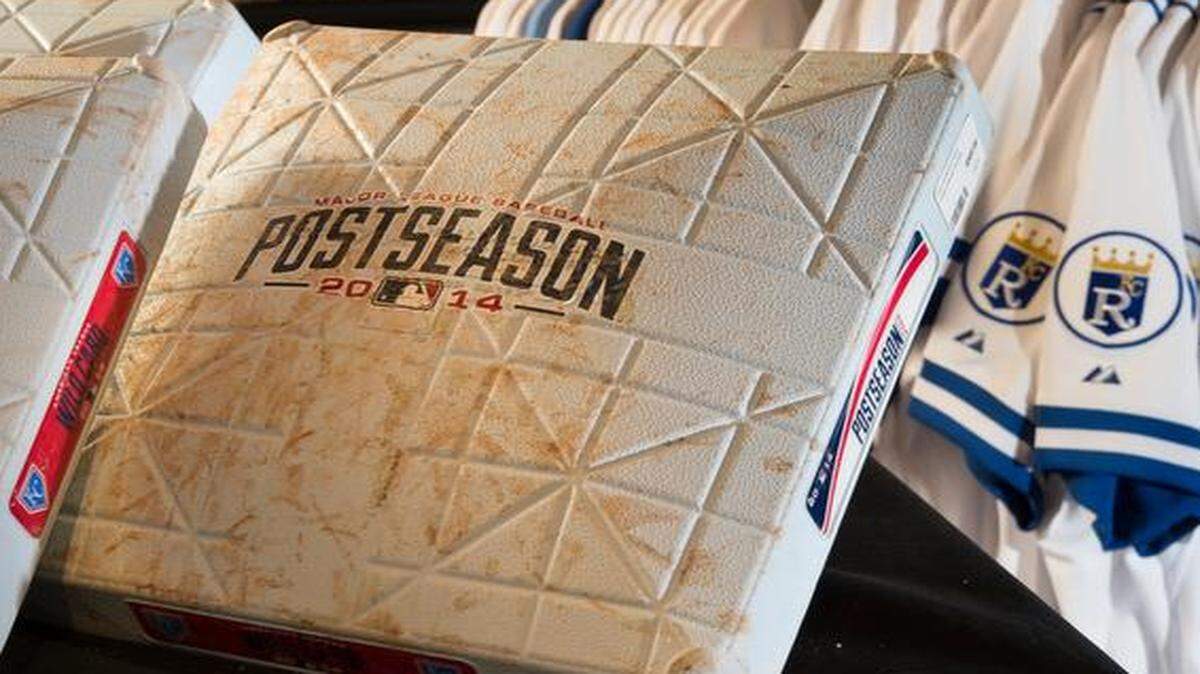
Each base had “POSTSEASON” etched on the top. Fans had pre-ordered them for $500 a piece.
Thwarting fakes
True, the Royals and Major League Baseball rake in piles of money selling game-used collectibles.
But they’re also fighting crime.
In the mid-1990s the FBI’s “Operation Bullpen” derailed 18 lucrative counterfeiting rings peddling autographed memorabilia no more valuable than the jerseys and baseballs on which signatures were forged.
The late San Diego Padres great Tony Gwynn, among other players, helped trigger the investigation after alerting league officials to items bearing phony autographs at stadium gift shops.
Authorities determined that “75 percent of all autographs commercially sold were fake,” said Michael Posner, who manages MLB’s authentication program. “That was a huge punch in the gut to the industry.”
The investigation compelled MLB to utilize the latest technology and professional methods to thwart forgers. An authentication program launched in 2001 was eventually stiffened when a third party, Authenticators Inc., entered into contracts with off-duty or retired law enforcement officers to keep their eyes trained on the games.
Pruetting and two other Kansas City officers take turns attending Royals games, where they sit in the dugout with the home team. Every ball and cracked bat taken out of play is delivered to them to be tagged and recorded.
“We understand how to collect evidence and maintain a visual chain of custody,” Pruetting said.
By “visual chain of custody,” he means never losing sight of, for example, a foul-tip ball — from the time it squirts off the bat to the moment it’s in his hands.
For this reason, used baseballs that wind up in an umpire’s hip pouch can’t be authenticated. Nor can home-run balls caught by fans, including those thrown back onto the field. In such cases, Pruetting said he can’t be certain that authentic game balls weren’t switched for fakes.
“Everyone on the force wants my job,” he said, because it entitles Preutting and his fellow authenticators the best possible view of Royals games.
In historic games such as the Wild Card and later playoff pairings, the off-duty officers may be stationed in locker rooms to observe players remove their uniforms. Game-used jerseys, when not kept by the players, command top dollar in online auctions at MLB.com.
The authenticators stayed until 4 a.m. after Tuesday’s game to collect and wash champagne bottles emptied by Royals celebrating in the clubhouse. The bottles and even the corks were marked with the hologram stickers, which break apart if peeled off.
Fans attending Sunday’s playoff game can buy a cork for $25. The club gathered up more than 200 of them.
Twenty percent of the profits of the Royals Authentics store go to charities, Villarreal said. Many game-used items are donated to schools and nonprofit groups holding fundraisers.
Baseballs and more
The database of MLB’s authentication program today includes more than 4 million items archived in the Baseball Hall of Fame or sold individually at stadiums.
The Royals Hall of Fame most likely will make room for Perez’s game-winning bat and the ball he stroked, said Villarreal.
As for less significant baseballs retrieved for authentication, prices at Royals Authentics start at $100. During the regular season the balls’ starting price was $25.
Villarreal sets the prices depending on whether the ball was merely fouled off, whiffed at for a strikeout or hit into play.
Used baseballs are just the beginning when it comes to game collectibles online or in the store, which opened in 2013 on the third base side of the Plaza/Field Level.
Items range from lineup cards to name plates on lockers to Alcides Escobar’s broken bat from the Sept. 26 game in Chicago that clinched a Royals playoff berth.
On MLB’s authentication website, there are bottle openers made from chunks of broken bats, wallets with linings stitched from scraps of players’ uniforms, and jewelry featuring a small piece of a used baseball.
The hologram sticker on each product includes a code number that allows buyers to check online for information on when and how a collectible was used in a game.
Villarreal came up with idea of bottling water from The K’s fountains and selling it for $10.
“Since bottled dirt sells,” he said, “I thought, let’s give water a shot.”
Quite inventive for a man not into collecting baseball memorabilia for himself.
The only game-used item that Villarreal said he purchased was a lineup card for a game played in July, on the day his twin daughters were born.
“Just isn’t me,” he said of collecting. “The most satisfaction I get doing this is when a customer says, ‘Hey, it’s my son’s first major-league game. I’ll take anything.’ ”
To reach Rick Montgomery, call 816-234-4410 or send email to rmontgomery@kcstar.com.
This story was originally published October 3, 2014 at 10:44 PM with the headline "You can buy Royals’ champagne corks plus used dirt and more at the K."