
Before he became a playoff star, Lorenzo Cain had to learn how to run
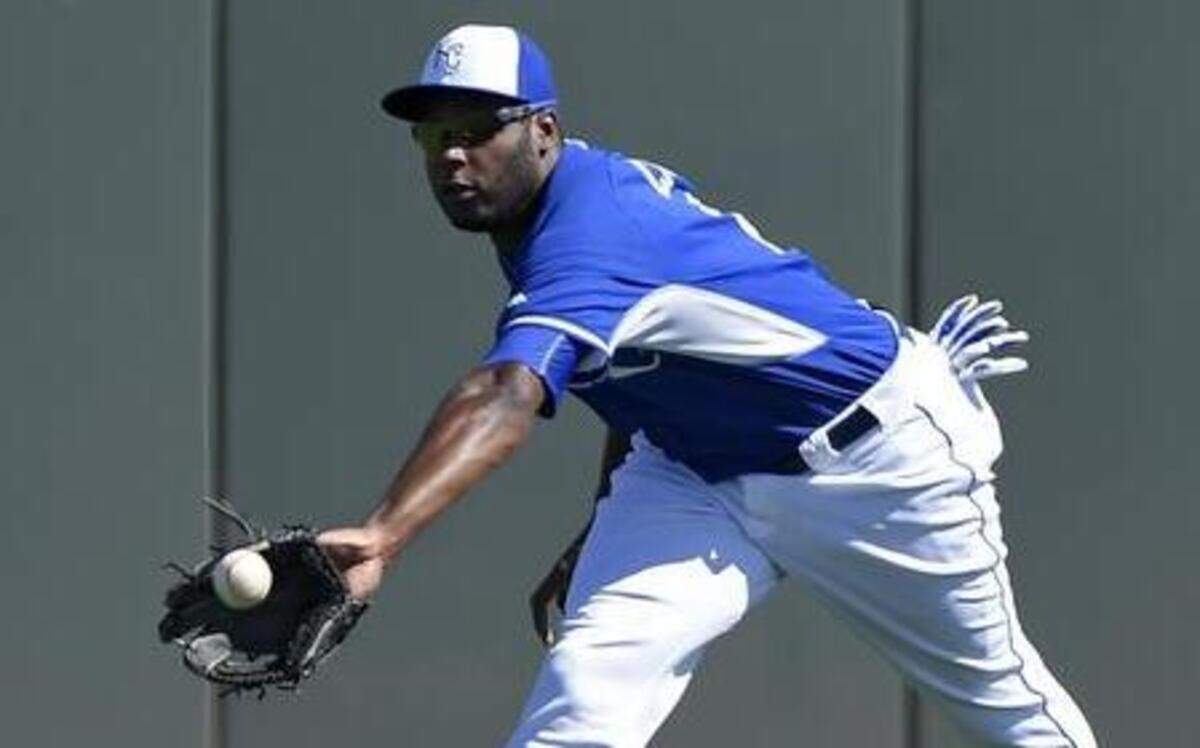
Three winters ago, a man Lorenzo Cain barely knew presented him with a choice. Tim Overman sat Cain down before their first workout inside the Barry Switzer Center at the University of Oklahoma. Overman coached strength and conditioning there and, as he saw it, had been outsourced by the Royals to salvage Cain’s career.
“You can either invest in yourself,” Overman told Cain, “or you can be selling cars next year.”
Cain had forged an improbable path as a baseball player when he met Overman after the 2012 season. But Cain had reached a crossroads.
The Royals acquired him hoping he could anchor their outfield. Through two seasons in Kansas City, all he anchored was the disabled list. His salary would begin to escalate in the coming years, and Cain suspected the team’s patience was growing thin.
Cain did not begin playing the game until he was 15, and his unorthodox baseball upbringing wrought a playing style that strained his body. He took unnecessary risks on the field. He ran in a fashion that placed undue stress on his legs. A series of muscle tears sidelined him.
After playing just 61 games in 2012, Cain asked trainer Nick Kenney for help.
“I’m willing to do whatever I have to do,” he told Kenney.
Kenney placed Cain in contact with Overman. Before he became a breakout face of the 2014 playoffs, before ESPN celebrated his astounding athleticism in a “Sports Science” segment, before his jersey flew off the racks as Kansas City’s best-selling garment, Cain needed to master an athlete’s most basic act.
“I distinctly remember his first day,” Overman said. “He was like, ‘Nobody ever taught me how to run.’”
The alterations Cain made that winter, and the work he continued in the subsequent two winters, led to his place of prominence in 2015. As the No. 3 hitter on the undefeated Royals, he boasts a gaudy 1.130 on-base-plus-slugging percentage. He was worth 5.0 wins above replacement in 2014, the second highest total on the club, according to Baseball-Reference.com. Some scouts consider him the game’s most talented outfielder.
The Royals rewarded Cain with a $2.725 million contract for 2015 to avoid arbitration. The organization could pursue an extension to keep him under team control before he hits the open market in 2018.
General manager Dayton Moore declined to comment about the team’s plans with Cain. The organization does not discuss contract negotiations in public. But Moore pointed to his organization’s track record of retaining homegrown assets, such as the $23 million deal just struck with opening day starting pitcher Yordano Ventura.
“We’ll always work very hard to keep our young players here in Kansas City long-term,” Moore said. “We’ve had some success doing that. We’ll continue to work towards that.”
The concept of a long-term contract with Cain appeared farfetched in 2012. Cain tore his groin that April and missed three months. He lost another three weeks because of hamstring strain. Kenney understood it was nearly impossible to alter a player’s running style during the season. So he set Cain up with Overman, who worked in the home state of Cain’s future wife, Jenny, for offseason tutorials.
“The talent was always there,” Kenney said. “It’s just that he was actually working against himself.”
Overman diagnosed Cain as an “over-strider,” meaning with each stride he reached forward with his toes and pulled his hip forward. When his foot struck the ground, his vulnerable hamstrings absorbed the force. Cain needed to correct his technique and transfer the force to more stable muscle groups in his glutes and thighs. As Cain phrased it, he needed to stop clawing and start driving.
Overman subscribes to the theory a person must complete 10,000 repetitions of an action “to change involuntary behavior,” he said. Cain completed dorsiflexion exercises, which practice lifting the foot upward, rather than his original downward motion. Overman hooked him up to a running sled to help Cain pinpoint his issues.
“He marched at first,” Overman said. “We slowly decreased the weight and increased the speed. What that does is if you are out in front of your hip, you really feel that pull. So now he knows what it’s not supposed to feel like.”
Cain embraced the challenge. He moved from Florida to Norman, Okla., for these sessions. He attended workouts five days a week. He still does, two years later, to reinforce the good habits he learned that first winter.
Cain experienced modest improvements in 2013. He played a career-best 113 games and his only stint on the disabled list stemmed from an oblique strain. After a minor groin strain last April, Cain blossomed into a budding star for the pennant-winning Royals. He posted a career-high .751 OPS during the season and an .805 OPS in October.
Members of the coaching staff point to various signs of his development. Cain developed more sophisticated plans for at-bats. He studied video more often. He possessed better spatial awareness in the outfield and physical awareness inside the training room.
“He’s learned his body,” manager Ned Yost said. “He understands what he can deal with and how he deals with it.”
From his perch coaching at first base, Rusty Kuntz thought Cain required four steps to reach his top speed when trying to steal a base. By last season, Kuntz estimated, Cain could accelerate after only two steps. He swiped a career-best 28 bags.
“Last year was the first time I noticed ‘Oh man, he got up to speed a lot quicker,’” Kuntz said.
Kuntz also has a front-row seat for the sight of Cain’s one, ongoing running issue. Cain continues to lunge at the bag when trying to beat out infield hits or break up double plays. He injured himself doing this last year. The training staff begged him to stop, but Cain did not listen. He knows he must, and still he cannot stop himself.
“I did a great job in spring training,” Cain said. “I didn’t lunge one time in spring. And the first game here, I frigging lunged.”
The scene from opening day was comical — once Cain rose to his feet. He threw his right leg out as he approached the bag. His left leg slipped on the slick dirt. His feet flew into the air and he landed on his back. He executed a sideways roll, steadied himself with his right hand, then his left, rotated his hips 180 degrees and jogged off the field with his backside aching and his pride slightly damaged.
Inside the dugout, Cain absorbed disapproving looks from Kenney, assistant trainer Kyle Turner and rehab coordinator Jeff Blum. Kuntz found Cain for their usual conversation after these moments.
“OK,” Kuntz asked. “How did that feel?
Cain replied, “Not real good.”
In the minors, a team could bench a player who refuses instruction. The Royals lack such recourse. Cain is too vital to their everyday success. And he knows he must change. He insists he is trying.
“It’s tough,” he said. “I know it’s going to be tough. I feel like I can do it, because I’ve changed a lot of things with my running style and other stuff that I need to work on. But it’s just something else I need to master.”
Cain turned 29 on Monday. He celebrated with a hit, a walk, two RBIs and a run scored against the Twins. He caught the final out of the team’s latest victory.
He has invested in himself. He did not become a car salesman.
“Lorenzo’s never missed a workout,” Overman said. “He’s never been late. He just gives effort. And that’s all a credit to him and how he was raised. He knew what he needed to do. He just needed some direction to do it.”
To reach Andy McCullough, call 816-234-4730 or send email to rmccullough@kcstar.com. Follow him on Twitter: @McCulloughStar.
This story was originally published April 14, 2015 at 2:10 PM with the headline "Before he became a playoff star, Lorenzo Cain had to learn how to run."