
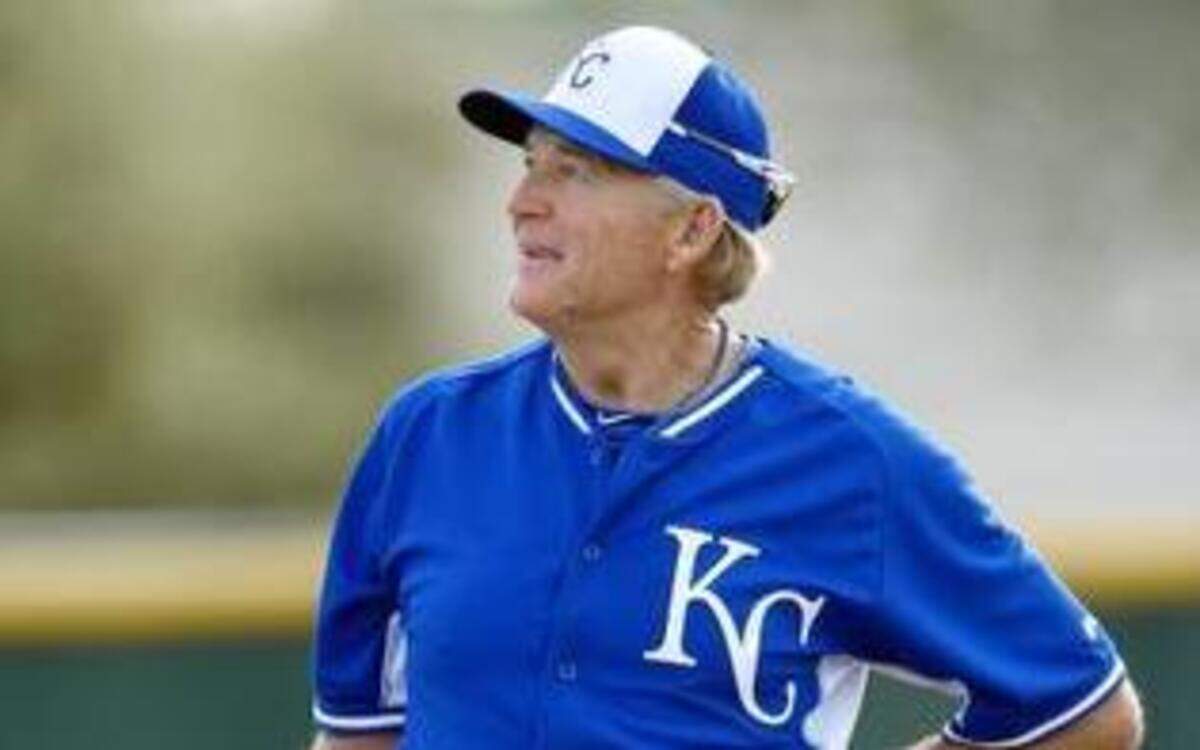
Rusty Kuntz still pointing Royals in the right direction
On June 15, 1977, the day the Chicago White Sox signed his eldest son, Chet Kuntz grabbed an oil rag and a black marker. He inscribed the date and an arrow pointing in two directions. These are your choices, he told his son, Rusty.
In one direction was the “big leagues,” a phrase Chet underlined and capitalized. The other was the San Ardo Oil Field, a slick in California’s Salinas Valley where Rusty spent his summers as a roustabout, earning $6 an hour chipping tar off the pipelines with a sledgehammer. He could be like his father, a bricklayer and an auto mechanic who juggled three jobs to make ends meet. Or he could make a life in baseball.
(Editor’s note: This story will appear in a special 26-page Royals preview section in the Sunday, April 5 print editions of The Kansas City Star)
One day in late March, Rusty Kuntz reached into his locker and fetched the rag. It has yellowed over the last four decades. He says he has brought it with him along every stop on his professional career, from seven years with the White Sox, Twins and Tigers to coaching stints with Houston, Seattle, Florida, Atlanta and Pittsburgh. He stowed it at the Royals complex, where he serves as the first-base coach and base-running coordinator, a member of the staff considered invaluable by his peers.
“I don’t know why I carry it with me,” Kuntz said, before gazing at the rag. “Well, I do. I do.”
Chet Kuntz passed away last spring, but the sentiment stuck with his son. Rusty thinks about it when the losses mount. He thinks about it when players disregard his advice. He thinks about it when his 60-year-old body aches and his eyes fail him. He thinks about it during the four or five hours he spends each day poring over iPads and binders and spray charts to prepare Alex Gordon, Lorenzo Cain, Jarrod Dyson and newcomer Alex Rios to retain their crown as the game’s elite outfield defense.
It is a voice the Royals felt they could not afford to lose, even if Kuntz would prefer a role as an instructor in the minor leagues. Manager Ned Yost refers to Kuntz as “the best first-base coach in baseball.” The Royals blazed into October on a path partially paved by Kuntz’s tutelage.
He oversees two of the club’s greatest strengths. When a runner steals a base, he can point to the voice in his ear before the pitch. When an outfielder flags down another fly ball, he can thank Kuntz for shifting him into position like a maestro inside the dugout. When the coaching staff debated braking their running as they trailed Oakland’s Jon Lester in the American League Wild Card Game, it was Kuntz who hollered “Heck no!” and watched as they tied an MLB postseason record with seven stolen bases and galloped to victory.
The statistics affirm Kuntz’s influence. The team led the majors in stolen bases in 2013 and 2014. The outfield at Kauffman Stadium encompasses more square footage than the 29 other parks, and the Royals’ outfielders ranked first last season in advanced metrics like Ultimate Zone Rating and Defensive Runs Saved.
“Rusty’s our guy,” Cain said. “He finds everything. You need work in the outfield, you need anything done, anything corrected, Rusty’s the guy to go to.”
“Every time he speaks, everyone listens,” Gordon said. “Because they know who he is, and what he’s about.”
“I credit that guy for everything we do successfully around here, man,” Dyson said.
Kuntz gulps Advil to ease his creaking frame, but his father’s message infuses the spirit that infuses the American League champions. Kuntz surveys the agita of his profession and stows those feelings away. Then he notices a familiar face and unleashes his customary greeting.
“Oh, player!”
His catchphrase is ubiquitous. His players sample his accent, the blend of a boy raised in Wichita and California’s Central Coast. This spring Dyson bought Kuntz a T-shirt that read “WHAT UP PLAYER.” Kuntz squeezed into the medium-sized garment and strutted around his pupils.
His ability to communicate with his players is unparalleled, his superiors say. And his optimism acts as a contagion, his players say. They can sense his investment in them, how “he doesn’t want to see anyone fail,” Dyson said. His enthusiasm for extra work never lags. He never looks downtrodden. “I’ve never seen him have a bad day,” Cain said. “Ever.”
His voice resounds through the complex, when he ignores the bone chips in his right elbow to throw batting practice, when he saunters through the clubhouse on a right ankle with a bone spur and a left knee without cartilage, when he swats sky-high fungoes with a surgically-repaired left arm. In Surprise, this is the sound of spring.
“Oh, player!” he cried as he walked onto the mound at George Brett Field two days before the first full-squad workout, providing a soundtrack as a few early arrivals assembled to hit. A group of pitchers in right field began to vacate the premises. Kuntz told them not to worry. “No, it’s just Dyson!” he said. “Relax!”
The Royals convinced Kuntz to return in 2015, in part so he could groom former outfielder Mitch Maier as a coach. General manager Dayton Moore stressed the club did not view Maier as an immediate successor to Kuntz. But when asked why he came back for this season, Kuntz answered, “Mitch Maier.”
Maier will aid the big-league club during home games and rove through the minor-league affiliates. It is the sort of role Kuntz desires — except the organization deems him too valuable at the big-league level, and “Rusty has been one of those staff members that will do whatever we ask him to do,” Moore said. Yost stumped for his return.
“He wanted me to be on the staff,” Kuntz said. “It’s always nice to hear a manager say that. And a lot of times they’ll tell you, ‘Sometimes you get to do what you want to do. Sometimes you do what you have to do. And right now, you have to be on the staff and show Mitch what he needs to do.’”
So he added an apprentice to his stable of pupils this spring. Kuntz identified Maier as “the perfect guy,” a mature, motivated 32-year-old with substantial big-league experience, lingering relationships with his old teammates and an attention to detail that Kuntz says rivals Gordon’s diligence in the outfield.
Kuntz underwent surgery to repair cataracts in his right eye this spring. He considered the ailment serendipitous. It prevented him from coaching first base, and allowed Maier the opportunity to experience live action.
“Once the ball’s put into play, I find myself as soon I look at the outfielder making a read and a route, I look right over at Mitch and see what he’s doing,” Kuntz said. “When the baserunners are on the bases, I see how he’s coaching first.”
The training adds to Kuntz’s already sizable workload. Kuntz operates as a conduit between the front office and the players. He sifts through insight offered by Mike Groopman’s analytics department. He relays the reports of the club’s scouts that are distilled into packets by advance scouting coordinator Bill Duplissea.
The amount of data resembles phone books, Kuntz explained. He seeks pertinent information he can relay without overloading his players. For running the bases, Kuntz wants to know when pitchers like to spin breaking balls and in what counts they throw to first base. As he ponders outfield alignments, he cross-references the heat maps provided to him with his own charts he has recorded over the last three seasons.
He also spends hours scouting opponents on his iPad. Before each series, Kuntz receives an edited package from video coordinator Mark Topping of the 13 to 17 pitchers on their opponent. Kuntz spends about 15 to 20 minutes searching for tells, the hints that betray the pitcher’s intentions, for each man. Sometimes he will watch the same pitcher for two or three hours until he discovers something. “That’s what you have to dig for,” Kuntz said.
“He finds every little thing,” Cain said. “Every head turn. Every shoulder drop. Every twitch. If the pitcher does it consistently, he points it out to us.”
Or, as Dyson put it last October, “I don’t have to watch any video. Rusty Kuntz is my video.”
Kuntz relays these tips to his players. Then he watches them utilize the sort of athleticism he never possessed. Kuntz debuted in the big leagues two years after the White Sox drafted him, but never played 85 games in a single season. He provided the game-deciding sacrifice fly for Detroit in the fifth game of the 1984 World Series, but he only appeared in five more major-league games. When he realized he had little chance to make Oakland’s roster in 1986, he asked for his release and prepared to start a new life.
Kuntz drove a truck for UPS for six months and found himself miserable. Houston hired him as a roving instructor in 1987. Kuntz estimates he made $16,000. He received a raise for the next season: $17,000. He was a novice, so unsure of his swings with a fungo bat that he rolled grounders to his players with his hands.
But he studied, and he improved, and he developed a fondness for instruction. He learned that a coach capable of communicating with the modern player and unceasing in his enthusiasm would never want for work. In 2002, during a brief spell as a roving instructor for Atlanta, he met an indefatigable executive named Dayton Moore.
Four years later, Royals owner David Glass hired Moore to rebuild his franchise. Moore inspected the spacious confines of Kauffman Stadium and understood the need for a fleet-footed outfield. When the team renovated the park, the front office explored moving in the fences to ease the burden on hitters. Glass resisted the changes.
“That’s how Mr. Glass wanted to build the team: Pitching, defense and speed,” Moore said. “He’s my boss. And I do what my boss says.”
Moore hired Kuntz for the big-league staff in 2007. Kuntz moved into the front office in 2009. The organization made a breakthrough in talent acquisition in 2010 when it dealt Zack Greinke for a package that included Cain and Alcides Escobar. When the team fired Doug Sission in 2012, Kuntz stepped into his old role. He has never left. When Cain accepted his trophy as the MVP of the American League Championship Series, Kuntz felt his eyes fill with tears.
He serves as a font of positivity in a game marked by failure. He works “with the best athletes in the world.” His boss is “the best general manager in the world.” He can remember this, even during all those hours staring at iPad screens, searching for clues on cross-country flights or in the quiet hours before the players even arrive at the park. He remembers what his father told him.
His own son, Kevin, a minor-league infielder with the Royals, wonders how he does it. When you find something you love to do, Rusty told his son, you’ll be just like me.
Rusty Kuntz walked outside into the 90-degree heat one day last month and realized the sun might sting his eyes. He needed his sunglasses, which he left in the locker near the oil rag Chet Kuntz gave him 37 years ago. As he darted back inside, he crossed paths with another coach. A plane roared overhead. And still his voice penetrated the glass windows.
“Oh, player!”
To reach Andy McCullough, call 816-234-4730 or send email to rmccullough@kcstar.com. Follow him on Twitter @McCulloughStar. Download True Blue, The Star’s free Royals app, here.
Royals’ runs saved
Rusty Kuntz helps Royals outfielders sometimes prevents opponents from scoring with their defense.
Year | runs saved | AL rank |
2012 | 12 | 8 |
2013 | 93 | 1 |
2014 | 41 | 2 |
From BillJamesOnline.com
This story was originally published April 1, 2015 at 11:10 AM with the headline "Rusty Kuntz still pointing Royals in the right direction."