
Alex Gordon hopes to stay with Royals, but unsure if he’ll pick up option for 2016
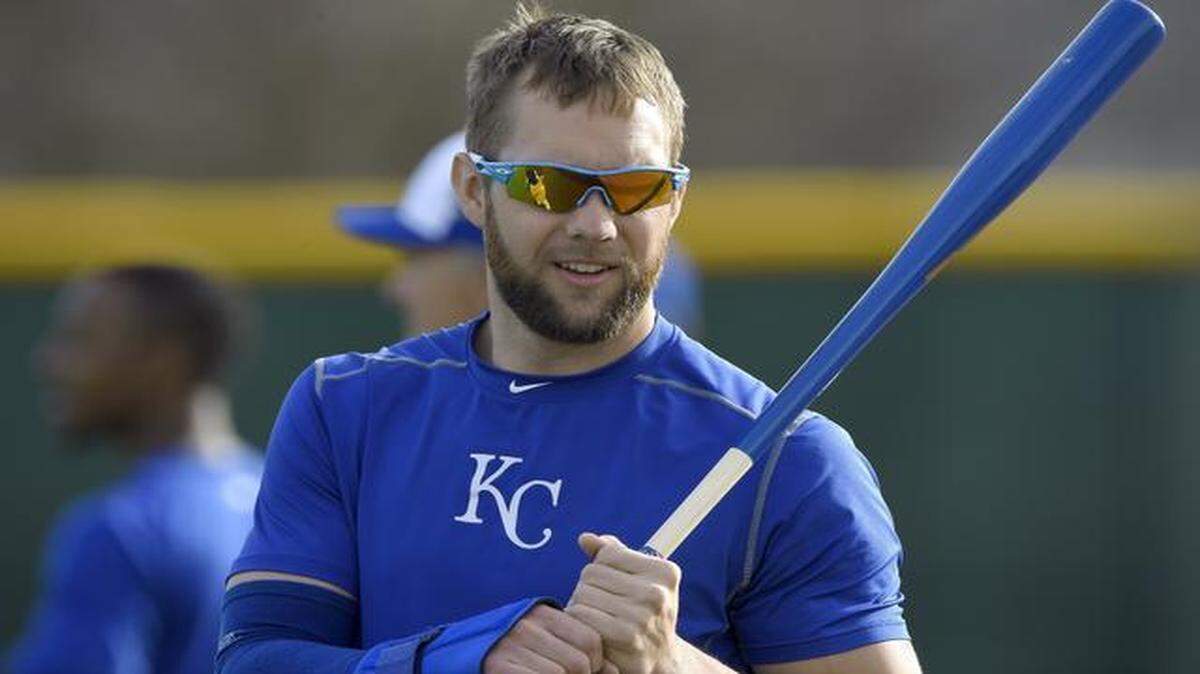
The question did not become The Question until hours after Alex Gordon braked at third base. When he walked off the diamond of Kauffman Stadium, after the final out in the final inning of the final game of the World Series, Gordon did not ponder the wisdom of Mike Jirschele’s stop sign.
It wasn’t until he faced a siege of cameras inside a mournful clubhouse that Gordon noticed the debate raging among the team’s supporters. He never wavered in his support of Jirschele during the countless times he answered. The Question followed him into the winter, along with the recognition and adulation he earned on the game’s biggest stage.
In the weeks after the season, Gordon felt the glow of his newfound fame. Fans recognized him on a plane bound for Seattle, and at gas stations along Interstate 29 on the way to his offseason home in Nebraska. At a car wash in Kansas City, an employee asked The Question. Gordon grew to anticipate the eventual inquisition whenever he ran into someone new.
“Hey, do you think you — ” the person would begin.
“No,” Gordon would say. Then he would change the subject.
The topic did not annoy him. He just felt The Question had a simple answer: Brandon Crawford would have gunned him down at the plate, and the Giants would have celebrated a championship before Salvador Perez could even swing a bat.
What faces him next, as he rehabilitates from offseason surgery and faces an uncertain future, is far more complicated. As the memories of 2014 recede into a new season, The Question will change. No longer will fans ask “Should he have gone?” Now they will ask “Will he stay?” Or, as the rest of the industry phrases it, “Can Kansas City keep him?”
The answer to this question is not as simple. Gordon can become a free agent after this season. He holds a player option for 2016, but he is unsure if he will exercise it. He is already the team’s highest-salaried employee. To retain him, the Royals must grant the largest contract in franchise history, according to the projections of rival officials. Earlier this winter, The New York Post dubbed Gordon the player “most likely to break a region’s heart” in free-agency.
For Kansas City, it will be the most momentous financial decision of general manager Dayton Moore’s tenure. It is a situation complicated by the escalating salaries of his teammates, the paucity of credible replacements in the team’s minor-league system and the uneasiness created by his wrist surgery. It also involves a player with a vested interest in remaining a Royal.
“I want to stay here,” Gordon said. “Absolutely. It’s close to home. Kansas City almost feels like my hometown. We love the city. We love everybody in this organization. And obviously it’s in a good place right now. It’s come a long way. And I want to be a part of the success that I think we’re still going to have.”
Gordon is the only participant who will speak about the issue. His agent, Casey Close, declined comment through a representative. Moore was effusive in his praise for Gordon but elusive in his commentary on the matter.
“I don’t know if there’s a ‘situation,’” Moore said. “Alex is a huge part of our team and our organization. Discussions like that remain confidential. There’s not a whole lot to say about it.”
Gordon offered a window into his mind-set on Saturday morning. He indicated there were no ongoing negotiations. He is willing to discuss an extension at any point during the season. He has not conducted any extensive conversations about the topic with Close. He has not broached the subject with Moore.
When asked last summer, Gordon told The Star he intended to pick up his $13.25 million player option for 2016. A decision like this flies in the face of logic, and would prevent him from reaping the benefits of free- agency for a full season. On Saturday morning, he hedged on that initial position.
“That’s a question that honestly doesn’t need to be answered right now,” Gordon said. “Because I don’t know the answer right now. I don’t know how this year is going to go, or how it’s going to look at the end of the year. Honestly, I don’t know.”
The coming season will help determine his price if he reaches the open market. Gordon presents an interesting case.
Since 2011, Gordon ranks seventh among position players in FanGraphs’ version of wins above replacement. Much of his value relies upon his defense. Gordon has mastered left field, but it also considered a non-essential position, an occasional clearinghouse for defensive also-rans. During that same time period, he placed 45th with an .809 on-base plus slugging percentage. He is considered a good hitter, but far from elite.
A survey of league officials rated Gordon below fellow impending free-agent outfielders Jayson Heyward and Justin Upton, and in a similar class with Yoenis Cespedes. Gordon has drawn comparisons to Hunter Pence, who signed a five-year, $90 million contract to stay with San Francisco. Multiple league officials pegged that price as the baseline to keep Gordon away from free-agency.
“When he is healthy, he is obviously an impact bat and capable of hitting in the middle of a productive lineup,” one rival official said. “And, of course, a great defender. Those guys get paid a good deal of money.”
Kansas City boosted its payroll past the $110 million marker for this coming season. Under Moore’s stewardship, the team’s ownership group continues to pour resources into the on-field product.
Yet the team has still never given out a contract larger than the $55 million packages required for Gil Meche and Mike Sweeney. Given this reality, people around the game wonder about the team’s ability to retain Gordon.
“If he has a great year, you can’t keep him,” another rival official said. “If he has a bad year, he’s untradeable at the deadline, you get nothing for him, and you’re stuck with that expensive option for next season.”
The speculation bothers Moore.
“It is inappropriate, wrong and lacks integrity for a rival executive to comment on what a player is worth while under contract with another team,” he said.
Still, the situation will not resolve itself. The Royals owe at least $66.8 million in payroll commitments for next season. That figure does not include team options for reliever Wade Davis ($8 million) and shortstop Alcides Escobar ($5.25 million). Then there are the arbitration-eligible players, with Greg Holland and his probable eight-figure salary leading a pack that includes Lorenzo Cain, Danny Duffy and Mike Moustakas.
An extensive commitment to Gordon could hamper the team’s flexibility in extending younger players like Eric Hosmer or Yordano Ventura. The team may posses the financial wherewithal for only one such mega-deal. The front office must decide if Gordon fits the bill.
“Is he a real superstar, in the true sense of the word?” one executive said. “I struggle to say he is.”
“Do you want to pay him $18 million when he’s 37?” another official added.
For much of last season, Gordon offered little reason to fret about his future. He looked like an MVP candidate through August. But in the season’s final month, his production disappeared. He remained quiet, save for a couple choice moments, throughout October.
Gordon dealt with a nagging wrist condition after July. He did not miss much time, and he rarely complained. The discomfort still dogged him. When he resumed his offseason workout program, which he splits between Kansas City and his childhood home of Lincoln, Neb., the pain stayed with him.
“Honestly, I don’t think it ever healed,” he said. “At the end of the year, I think it felt good. So I was like ‘OK, I’ll take a couple weeks off and it will be fine.’ And then I started working out, and it just gradually flared up here and there.”
In late December, Gordon placed a call to trainer Nick Kenney. Gordon traveled to Kansas City for an examination. He expected to receive some treatment and depart for Lincoln soon after. Instead, about 10 hours later, he underwent a wrist extensor retinaculum repair.
The injury stole a month from his offseason routine. He wore a cast for weeks. He still intends to start on opening day. He hopes to receive clearance to resume hitting and throwing on Monday.
In the interim, he remains a fixture inside the team’s weight room in Surprise. When he emerged in the clubhouse on Saturday, he cut a familiar figure. Sweat sheathed his skin. He was alone.
The work ethic of Gordon is one reason Royals officials hold him up as their organizational pillar. He sets the team’s standard for commitment, they say.
“He’s the definition of a leader, and how a leader goes about his business,” Hosmer said.
Moustakas added, “He’s the guy you want to emulate.”
Gordon predates Moore by a year in this organization. Moore recognized him as a critical asset upon his arrival. After early hiccups in the majors, Gordon resurrected his career in a fashion that brought Moore joy. His affinity for his player is unquestioned.
Gordon shares this sentiment. He wants to stay, even if he is unsure when the organization will open the discussion. He has not spoken, even in informal terms, with Moore about his long-term future. Gordon joked the team was too busy signing his brother, Derek, a pitcher for the Kansas City T-Bones of the independent leagues, who now has a minor-league deal.
The conversation shifted to Derek Gordon’s 6-6 build and the height of Gordon’s family. Alex considers himself “the shrimp” of the group. He flashed a smile, one that became recognizable to baseball fans from coast to coast last fall.
“See how I tried to change the subject right there?” he said.
His laughter rang through the barren clubhouse, even if the latest version of The Question remains unanswered.
To reach Andy McCullough, call 816-234-4370 or send email to rmccullough@kcstar.com. Follow him on Twitter: @McCulloughStar.
This story was originally published February 21, 2015 at 4:32 PM with the headline "Alex Gordon hopes to stay with Royals, but unsure if he’ll pick up option for 2016."