
In Cuba, Kendry Morales was the best player you'll never see
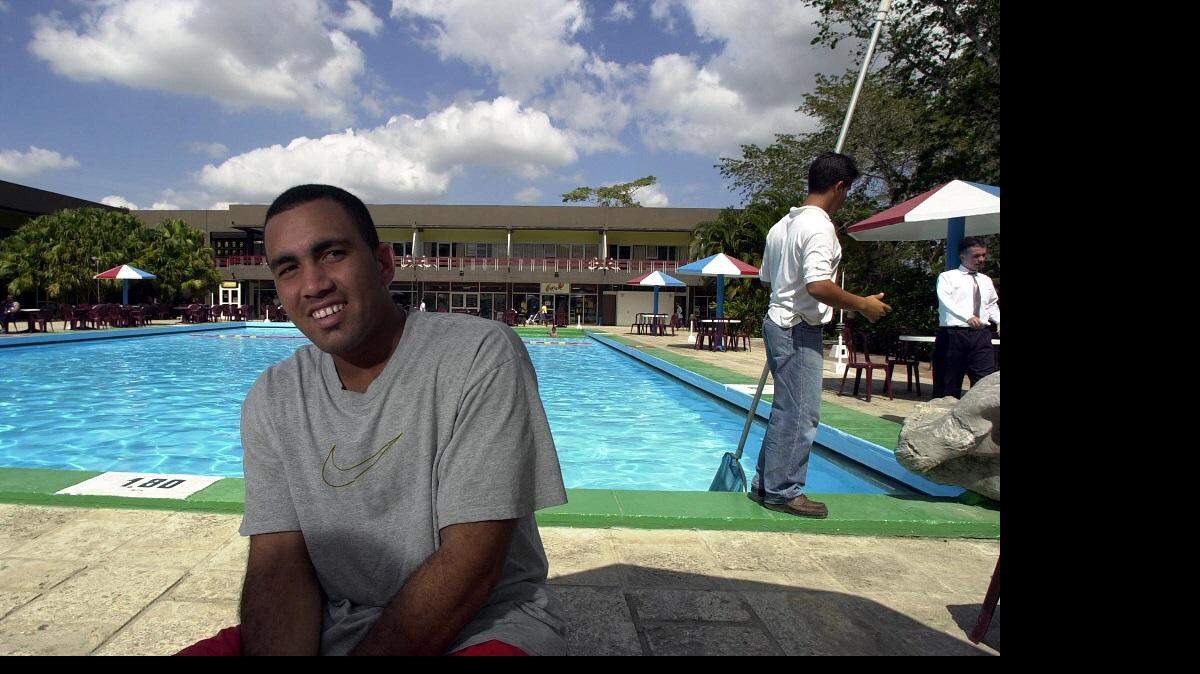
Editor's note: This story originally appeared in the March 30, 2003 editions of The Kansas City Star
There was a 7-year-old boy, named Kendry Morales, who liked to play baseball with his father. He couldn't know then that the next decade of his life would be the most important in the life of his nation. He was too young to fully understand.
There was a 64-year-old man, named Fidel Castro, who had fought in the mountains and in the cities for his revolution. He understood all too well. The Soviet Union was in a free-fall in late September 1990 when he warned the Cuban people of a crisis to come.
"The concept of the Special Period in the Time of Peace has emerged, " Castro said at the time. "It is inevitable that we will fall into this Special Period in all its harshness. We will have to undergo this trial. We must be prepared to work with less and less and less and less and almost with nothing."
When the Soviets fell, their money and goods stopped coming. Almost 90 percent of Cuba's trade evaporated. The agricultural industry didn't have the chemicals and supplies it needed. The island didn't have the power to run its lights, so blackouts were ordered. The country was falling apart.
There was an 8-year-old boy, named Kendry Morales, whose father was gone too, dead of cancer. Food was scarce. Noevia, Morales' mother, tried to be both parents. When the government would later allow foreign investments to kick-start the economy, she would work as a maid in the home of a Spanish businessman. Isn't that what the revolution was supposed to end?
So then there was this 9-year-old boy, named Kendry Morales. His father was dead; his country was collapsing. He played baseball to remember that father and, maybe one day, represent that country. The decade ahead would be hard for the boy and for the island. Who knew if either of them would survive?
She stops to watch the children on the way home from work. They are playing baseball in an empty lot. One of them wears No. 8 - in honor of Kendry Morales, her 19-year-old son. Few know why he wears that number. It's for her: her birthday is Aug. 8.
Just three years ago, he was a nobody - major-league baseball scouts said in their reports that he wasn't even a prospect. But after a record-smashing rookie season in Cuba's top league in 2002, he seems to be The Future - something cherished here in Havana. Police have to calm the swooning crowds that cover the dugouts. Fans have driven from other provinces to hold impromptu parades outside his home.
Cuban baseball, many point out, is a mirror held to Cuban society. And the reflection hasn't been promising in recent years, as the national pastime struggled to redefine itself in the post-Soviet world.
Everything began to change when the USSR crumbled. Attendance was down. Defection was up. Stars retired, men such as Omar Linares - icons and global ambassadors for Castro's revolution. The Cuban national team lost the 2000 Olympics, the first time it hadn't claimed gold. The country waited for the next generation, the players who were 9 and 10 when the Cuban economy hit the floor in the early 1990s.
Perhaps it's finally arriving.
Little-league coaches in Cuba say the most popular number used to be 10, Linares' standard. "Now, " says Raul Rodrguez, head coach of Havana's 9- and 10-year-old team, "it's Kendry."
"I believe that this is a historical moment in my career and life, " said Cuban legend Javier Mendez, who himself is on pace to shatter the Cuban RBI record of 88 this season (he had 60 at the All-Star break).
"He can become Cuba's greatest ballplayer of all-time. Listen to me. What Kendry did last year as a rookie, no one has ever done. Not even Omar Linares - the greatest figure in Cuban baseball."
Noevia Rodriguez still can't believe it. The last six months have been a dream. A new house, with a shrine to Kendry's dead father by the front door. Plenty of pigs to broil. Citizens dancing in the streets, carrying signs.
It wasn't so long ago that she was working non-stop, rushing from her job to the boarding school where Kendry lived to bring him food. She doesn't even like to think about it.
"Remembering bad times, " said Noevia, 37, "is suffering again."
So now, instead of racing somewhere after work, she takes a minute to watch the children play in the vacant lot. When No. 8 comes to the plate, his friends call him Kendry. "Hit it now, " they urge. She decides to play along.
"Who is Kendry Morales?" she asks.
The kid looks at her.
"I am Kendry Morales, " the young fan says, "and I am the best."
Then he digs in and smokes the next pitch. After he runs the bases, she calls to him. She opens her purse and pulls out several photos of her son. The kids swarm and begin hugging and kissing her. They ask if they could visit. They tell her how great Kendry is.
That's just one memory she has. They are piling up, each one more unbelievable than the last. She's looking back now.
She can see it all: the kids emulating her son, her son emulating his father, the funeral, the shortages, the tiny one-room apartment, the uncertainty. She can see the darkness, the endless nights when the entire island was blacked out to save the dwindling fuel. But what's most clear is her little boy, trying to stay strong.
Morales called his mother "La Mocha" and his father "Pipin." No one knows why - just baby terms of endearments. Growing up in the rural town of Sancti Spiritus, Morales had quit baseball and focused on other sports, such as soccer. Then, his father grew ill and died.
After he and his mother got home from the funeral, Morales told her, "I'm not going to call you 'La Mocha' anymore." "Pipin" had died, and Morales had grown out of childish names.
"Kendry's life changed, " his mother said, "and Kendry also changed."
"After my father passed away, " Morales said, "I went back to baseball because he wanted me to be a baseball player. That was his dream, and I wanted his dream to come true, even if he isn't here with me."
Noevia remarried, and the family eventually moved to Havana. Like many peasants, they had a hard time adapting to city life. They were poor, sleeping three to a one-room apartment. Noevia took Kendry to the sports school, where he wasn't wanted. She cried there in the building until she was told not to worry; he was gonna make it.
Rough times forced sports teams to cut down on roster spots, so not as many players had the chance at success. By 1994, with Kendry an 11-year-old, the economy had fallen by 40 percent. The government allowed the hated American dollar to be used openly. That year, amid protests in Havana, Castro finally allowed Cubans to leave.
Men, women and children climbed onto rafts and braved the currents and the sharks and the sun. Things had gotten that bad. The once-powerful sports schools, built in the image of the Soviet Bloc's athletic machine, felt it, too.
"Due to the crisis, the school didn't have the best living conditions, the best dining conditions, " Morales said. "Sometimes, the teachers had to miss a day of class because the school was too far away from downtown. Back then, we were all kids - but we were all kids with a dream."
Morales progressed, moving up steadily. In the 2001 Pan-American Junior Championships, still unknown to American baseball scouts, Morales had a coming-out party. The Cuban team beat the United States 3-2 in the title game. He was selected the tournament MVP, and fans looked forward to his debut with the Havana Industriales - the Yankees of the Cuban baseball league.
Last season, in his first year, Morales broke almost every single rookie record. Fans and players took notice; the little boy who had lost his father was now one of the most popular players in the most popular sport in Cuba. The children of the Special Period had come of age and were, to the joy of an island, as good as those who had come before. Retired legends had been replaced; the game had gone on.
"They are filling this gap that we left behind, " said Lourdes Gourriel, the manager of Sancti Spiritus and a former Cuban great. "They are doing it even better than we did. In the middle of this crisis, there are young ballplayers that have emerged. That shows that Cuba keeps producing baseball."
He may be the man in Havana, but at home, Morales is still a boy. The other night, he called out loudly, "Mommy, mommy, mommy." She came running. "No, it is nothing, " he told her, pleased with his prank.
"He doesn't iron, " she said. "He doesn't cook. He bathes himself, with lots of work. That's slang in Cuba. It means he doesn't do anything with housework. He sits at the table, over there, 'Noevia, Noevia, I'm starving.' I have to start cooking something very quickly."
That's the paradox for the 19-year-old star. His mother needed him to get her own home; he needs her to keep it - and him - from falling apart. They stay quiet when he's home relaxing, even lowering the ringer on the phone. His bedroom is stark, with a king-sized bed and little else. There's one shirt in the closet. The family hardly knows what to do with the space.
"We used to live in a small house the size of the sitting room, and it was the three of us, " Noevia said. "All of a sudden, I found myself living in a big house with independent bedrooms. Everyone could have a room. Just think about it."
She still goes to the games, and Morales makes sure she sits behind the screen. He's very protective. She had surgery this past year, in the middle of the season. With Cuba's faulty economy, the once-proud public health system is iffy. One Cuban said if you go to the hospital really sick and don't know someone, you are as good as dead.
Morales took her to the hospital and called the doctors eight times that day to check on her. They brought her a television, and she cried when he dedicated his performance to her after the game. The staff was super-attentive, not wanting to be the ones who let anything happen to the mother of the great Kendry Morales.
"They were always on top of me, " she said. " 'Are you feeling well? Do you have any pain? Do you want a pill?' "
They roast pigs all the time; the family has had five parties in six months. The last was on New Year's Day. What an amazing year. "Particularly, " she said, "a year full of good surprises." Candido Fabre, his favorite singer, is coming to the house for a party; Fabre, it turns out, is a big fan of Morales' as well.
People stop Morales wherever he goes now. He's an icon. Parents tell him their children are emulating his swing, the same one Morales learned from his father.
In Havana these days, it's all about the dollar. Locals beg for it, coming out of shadows to ask, "Cigars?" or, cutting right to the chase, "What can I do for you?"
The dollar saved the Cuban economy, yes, but it has created a society of haves and have-nots. As a cab driver put it, there are those who can touch the dollars and those who can't. So a hotel maid makes more than a neurosurgeon.
This is the next crisis for the island, now that the Special Period is over. Castro is older and weaker. There are rumors of serious illness. After so many close calls, is Cuba's communist revolution finally done?
In towns, graffiti such as "Down with Fidel" appear on a wall here and there. Buildings are crumbling. Others have been condemned. There's rubble in the streets of Havana.
But there are signs that things are improving, however slightly. There's a major project underfoot to restore Old Havana to its colonial grandeur. On the old square, not far from where coffee was first served in the new world, scaffolding has been put up as buildings are being restored. A town in Italy donated money to have a drug store renovated, and so it goes, building by building.
"In eight years, this town has changed a lot, " a local man says, pointing to new paint and refurbished facades. "I mean, a lot. Just think, three years ago, all of this was in ruins."
He's talking about the buildings, but really it goes further than that. It's the citizens - many of whom live in poverty, but better than before. It's the streets - still full of hustlers, but not swarming with prostitutes as it was five years ago. It's the baseball league - which has been reinvigorated by the play of newcomers such as Morales.
In another part of town, inside the giant Cuban sports complex, the 9- and 10-year-olds are practicing. The next decade for them isn't as frightening as it was for Morales' generation.
When practice is over, the kids rush to their parents, who wait patiently, as Morales' mother once did. By the road, a 36-year-old man watches his son swing, then shows him how to plant his stride foot. He's heard that a swing is born at this age, and he wants to help all he can. When the lesson is done, the man leans down and sweetly kisses the child on the cheek.
And so there is another 9-year-old boy who likes to play baseball with his father.
This story was originally published March 30, 2003 at 12:00 AM.