
Even as college athletic department revenues rise, student subsidies remain
While record television contracts continue to ripple through the nation’s five major college sports conferences, students continue to help pay the bills for many of the largest athletic departments.
Critics have characterized athletic subsidies, including fees paid by students that are earmarked for athletic departments, as a regressive tax, adding to the tonnage of student debt. But athletic departments are reluctant to cut or phase out subsidies, as every dollar of revenue takes on added weight because of NCAA reforms aimed at giving more benefits to athletes.
“How often do companies or people just willingly give up a tax break?” asked Jeff Smith, an economics professor at the University of South Carolina Upstate who has studied national trends in athletic subsidies.
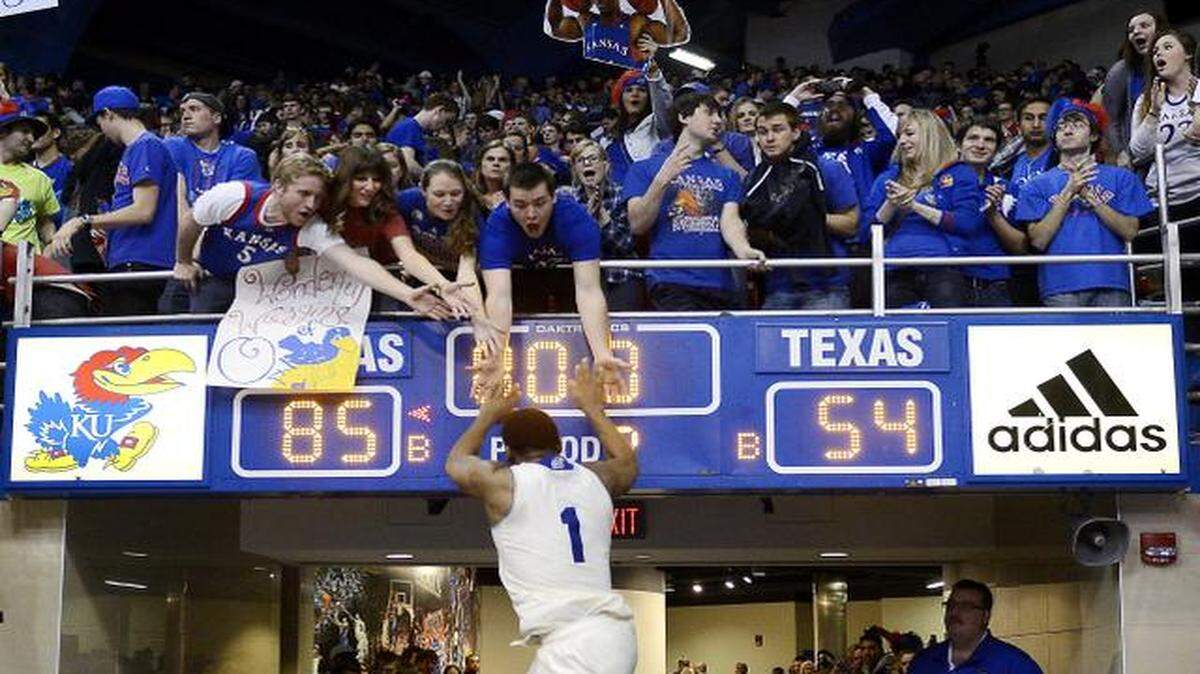
Take the case at the University of Kansas, for example, where the athletic department responded to a reduction in its student fee subsidy by selling some of the best student men’s basketball seats in Allen Fieldhouse to donors and increasing the price of student football and men’s basketball ticket packages to compensate for $350,000 in lost revenue. KU recorded a record $93.11 million in athletic revenue for the 2012-13 financial year, including $1.1 million in subsidies from student fees and $1.7 million in direct support from the university.
David Catt, a KU student senator and former walk-on golfer at Kansas who advocated for the fee reduction, said students and academic departments have faced significant “belt-tightening.” But after meeting with senior KU athletics officials about the fee, Catt said, “it became apparent that these economics do not apply to them.”
An analysis of public schools in the Big 12 and Southeastern conferences by The Star found that five of eight athletic departments in the Big 12 received more than a million dollars in student fee subsidies in 2012-13, and seven of 13 in the SEC received more than $1 million.
The numbers are even more glaring at smaller schools, experts say, where football revenue is scarce and universities and student fees are largely responsible for keeping athletic departments afloat. Subsidies for athletics can surpass $15 million at some of the smaller Division I schools, according to Smith.
Some athletic departments — such as Kansas State, which recorded $70.5 million in revenue for 2012-13 — have pledged to phase out direct institutional subsidies. K-State received more than $500,000 annually in student fees and nearly $800,000 from the university in the past financial year.
Missouri, with revenues of $76.3 million in 2012-13, is in the minority of SEC athletic departments in that it does not receive student fees, though it received $1.5 million in direct support from the university during 2012-13.
But as the rich get richer — and budgets increase — a majority of power conference schools continue to hit up their students for additional fees, on top of ticket prices, often citing the need for equality. Football and men’s basketball programs generally account for most of an athletic department’s revenue, while women’s programs and other men’s sports generally don’t produce revenue.
Still, David Ridpath, an associate professor at Ohio University, said the argument that the fees are designated for women’s or nonrevenue sports is a “sleight of hand.” If schools were more fiscally prudent, he said, they could find ways to operate without subsidies from students.
“Athletic departments are great at getting revenue but terrible at managing a checkbook,” said Ridpath, who also serves as a member of the Drake Group, an organization advocating for academic integrity in college sports. “And we use excuses like competitive equity while spending on unneeded items. Honestly, competitive equity doesn’t exist.”
Marcus Tetwiler was not the first KU student body president to wonder why tuition-paying students with no interest in athletics should be forced to pay money to an athletic department poised to pull in more than $20 million annually from new Big 12 television contracts. It felt, in a way, like corporate welfare.
At Kansas, the history of the student athletics fee mirrored a familiar story across the country. The fee began in 1979 to help KU comply with Title IX by spending equally on men’s and women’s sports programs. Its initial cost: $3 per year. The women’s and nonrevenue sports fee increased throughout the years, peaking at $80 per year at one point in the past decade, when students helped fund the construction of a new boathouse for the KU women’s rowing program.
The fee funneled more than $1 million per year to athletics, and the KU athletic department reciprocated by making bond payments on a newly constructed student recreation center. The arrangement, which dated back to 2004 under former KU athletic director Lew Perkins, also involved the athletic department re-claiming some student seats at Allen Fieldhouse.
But earlier this year, Catt prepared a detailed report that advocated for the fee to be eliminated. Tetwiler, a native of Paola, and other student leaders agreed.
Following the vote, KU Chancellor Bernadette Gray-Little issued a compromise that reduced the fee from $50 to $12 per year and tasked the student senate with paying the remaining bonds on the student recreation center. Even so, the KU athletic department re-allocated some prime student seats at Allen Fieldhouse to boosters.
“When the student government proposed (to eliminate the fee),” KU associate athletic director Jim Marchiony said, “it made it very clear that it wanted the athletic department to find other ways to raise revenue, aside from the student fee. That’s what we did.”
Marchiony said that Kansas athletic officials never had internal discussions about lowering the fee, even as department revenues spiked to a record in 2012-13. The fee, Marchiony said, allowed Kansas to keep student-ticket packages at $150; they will increase to $175 this academic year. The package includes tickets to all home football games and the opportunity to claim tickets for home men’s basketball games.
While Kansas students sparred with athletics over a $50 annual fee, the subsidies among the biggest conferences often pale in comparison to the smallest leagues in Division I. One area example: Wichita State, a member of the Missouri Valley Conference and a school without a football program, received $3 million in student fees in 2013 — more than double what Kansas or Kansas State took in.
In general, the smaller the conference, the more expensive the fees and subsidies become. Schools without high-revenue-producing football programs or healthy television contracts attempt to keep up with the Division I crowd in terms of facilities and pay.
“In the Big Ten, the average subsidy for a public school is $61 a year (per student),” said Smith, professor at South Carolina Upstate. “(In) the Big South Conference, the average subsidy is $1,560. So if a kid is taking five years, that’s $7,500 going toward athletics.”
Smith, who is preparing an academic paper on the future of fees and subsidies, thinks the only way that schools will shake their dependence on subsidies is through federal regulation. He has advocated for a five-year plan that would curb subsidies and bring them down to a more reasonable level.
But he also sees other areas of wasteful spending; although conference realignment has produced record television contracts for some of the bigger conferences, the shift also has driven up travel costs as schools send their softball, swimming and soccer teams across the country to play conference matches.
Now come more potential shifts. The NCAA this month has released its proposal for a new governance structure that could provide the so-called “Big Five” conferences, including the Big 12 and SEC, more autonomy in how they choose to compensate athletes, whether through stipends or legislation to pay athletes the “full cost of attendance.” Earlier this year, the NCAA legislated unlimited meals for student athletes.
“Even in an environment where we have some additional revenue coming in from television resources, primarily,” Big 12 commissioner Bob Bowlsby said, “it is going to be very difficult for many institutions to fund that. It is not hundreds of thousands of dollars a year; it’s millions of dollars a year.”
For schools across the country, costs could be rising again, and Smith and Ridpath are afraid that schools will continue to rely on subsidies to keep up. It’s a lesson in futility, Ridpath said.
Speaking at Big 12 football media days in Dallas, Bowlsby said tighter budgets could cause schools to cut more nonrevenue sports programs and allocate more resources to football and men’s basketball. The revenues are increasing, Bowlsby said, but not at the rate of expenses. Something, he said, will have to give.
“In the end, it’s a somewhat zero-sum game,” Bowlsby said. “There’s only so much money out there. I don’t think that coaches and athletic directors are likely going to take pay cuts. I think that train’s left the station.”
To reach Rustin Dodd, call 816-234-4937 or send email to rdodd@kcstar.com. Follow him on Twitter @rustindodd.
Big 12 and SEC athletic subsidies
An analysis of public schools in the Big 12 and Southeastern conferences by The Star found that five of eight athletic departments in the Big 12 received more than $1 million in student fee subsidies in 2012-13, while seven of 13 in the SEC also received more than $1 million.
Big 12 | Student fee revenue | Other public subsidy | Total subsidy | Total revenue | Total expenses | Revenue minus expenses | Without subsidy |
Iowa State | $1,834,796 | $0 | $1,834,796 | $62,357,761 | $62,224,194 | $133,567 | -$1,701,229 |
Kansas | $1,104,748 | $1,765,878 | $2,870,626 | $93,114,168 | $79,720,036 | $13,394,132 | $10,523,506 |
Kansas State | $500,695 | $778,484 | $1,279,179 | $70,457,283 | $59,325,573 | $11,131,710 | $9,852,531 |
Oklahoma | $0 | $0 | $0 | $123,805,661 | $106,340,398 | $17,465,263 | $17,465,263 |
Oklahoma State | $2,606,182 | $3,237,845 | $5,844,027 | $93,664,337 | $96,551,860 | -$2,887,523 | -$8,731,550 |
Texas | $0 | $0 | $0 | $165,691,486 | $146,807,585 | 18,883,901 | 18,883,901 |
Texas Tech | $3,010,715 | $1,000,000 | $4,010,715 | $72,917,990 | $66,296,446 | $6,621,544 | $2,610,829 |
West Virginia | $4,330,002 | $131,485 | $4,461,487 | $77,706,697 | $73,501,594 | $4,205,103 | -$256,384 |
SEC | Student fee revenue | Other public subsidy | Total subsidy | Total revenue | Total expenses | Revenue minus expenses | Without subsidy |
Alabama | $0 | $5,791,200 | $5,791,200 | $143,776,550 | $122,542,043 | $21,234,507 | $15,443,307 |
Arkansas | $0 | $0 | $0 | $99,769,099 | $93,241,441 | $6,527,658 | $6,527,658 |
Auburn | $4,315,584 | $0 | $4,315,584 | $103,680,609 | $104,546,603 | -$865,994 | -$5,181,578 |
Florida | $2,473,374 | $384,462 | $2,857,836 | $129,505,644 | $114,024,962 | $15,480,682 | $12,622,846 |
Georgia | $3,237,955 | $0 | $3,237,955 | $98,120,889 | $100,904,626 | -$2,783,737 | -$6,021,692 |
Kentucky | $847,079 | $0 | $847,079 | $95,720,724 | $95,083,628 | $637,096 | -$209,983 |
LSU | $0 | $0 | $0 | $117,457,398 | $109,996,620 | $7,460,778 | $7,460,778 |
Mississippi | $1,911,778 | $1,919,820 | $3,831,598 | $73,390,050 | $73,179,939 | $210,111 | -$3,621,487 |
Mississippi State | $3,000,000 | $0 | $3,000,000 | $62,764,025 | $58,112,224 | $4,651,801 | $1,651,801 |
Missouri | $0 | $1,515,000 | $1,515,000 | $76,306,889 | $70,276,015 | $6,030,874 | $4,515,874 |
South Carolina | $2,537,697 | $0 | $2,537,697 | $90,484,422 | $90,115,914 | $368,508 | -$2,169,189 |
Tennessee | $1,000,000 | $0 | $1,000,000 | $111,579,779 | $111,554,194 | $25,585 | -$974,415 |
Texas A&M | $0 | $590,973 | $590,973 | $93,957,906 | $85,114,588 | $8,843,318 | $8,252,345 |
Source: NCAA Membership Financial Reporting System records for 2012-13 financial year
This story was originally published August 3, 2014 at 8:07 PM with the headline "Even as college athletic department revenues rise, student subsidies remain."