
Capitol Watch: Behind the Kansas welfare-to-work success story
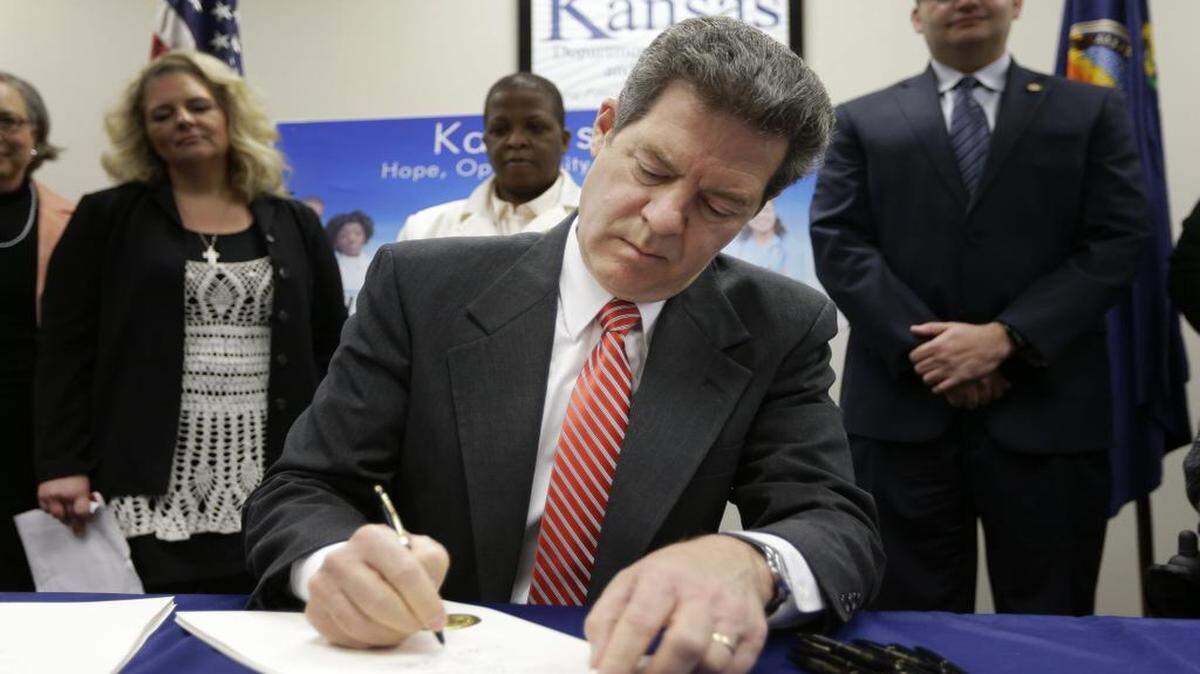
Clearly, 2015 is the year to crack down on welfare recipients. Kansas Gov. Sam Brownback signed a new law this week, and the Missouri General Assembly sent a bill to Gov. Jay Nixon.
The packages set lower limits on how many months someone can receive welfare subsidies in a lifetime. In Kansas it’s now 36 months. If the Missouri bill becomes law, the limit would be 45 months. Both legislative packages require needy parents to keep up a vigorous schedule of work or job hunting to maintain benefits. The Kansas law contains a long list of restrictions on how people can spend welfare subsidies.
Atypical success story
In its quest to enact harsher restrictions on people seeking assistance, the Brownback administration has made good use this session of Kansas City, Kan., resident Valerie Cahill, who speaks eloquently of her own journey from public assistance to self-reliance.
Cahill was Brownback’s guest at his State of the State address. She also testified for the tougher requirements during hearings before the House and Senate. And she joined the governor and others when he signed the bill this week.
But Cahill’s experience probably isn’t typical of a welfare recipient getting into the workforce. On Friday, the Wichita Eagle reported that she is employed as a full-time, temporary employee of the Kansas Department of Children and Families, the agency that requested the more stringent requirements.
That revelation doesn’t diminish Cahill’s accomplishments, which were touted by lawmakers who supported the welfare bill. She received Temporary Aid for Needy Families money for 11 months and got her job with the state after completing the department’s job-training program. With money from her paycheck, she told lawmakers, she was able to purchase a cello for her son.
But not all welfare-to-work recipients will be fortunate enough to land an office job with regular hours and a steady paycheck. Many will end up in the meaner environment of the service sector.
Cahill’s job with the state does solve the mystery of how she was able to get so much time off to testify at committee hearings.
Lights, camera, lawsuit
Progress Missouri, a liberal advocacy group, has a knack for getting under the skin of lawmakers in the Republican-dominated General Assembly. This week tensions ratcheted up to a new level.
The advocacy group sued the Missouri Senate, claiming that on multiple instances its representatives were prevented from filming committee hearings and threatened with exile if they did.
Progress Missouri contends senators violated Missouri’s Sunshine Law, which states that “a public body shall allow for the recording by audiotape, videotape or other electronic means of any open meeting.”
The Senate’s own rules allow cameras and other devices “with the permission of the chairman as long as they do not prove disruptive to the decorum of the committee.”
One wonders which is more disruptive: a person quietly filming the proceedings or a senator kicking that person out?
The Senate generally allows members of the Missouri Capitol News Organization, of which The Star is a member, to film its committee proceedings. There’s no good reason to bar other citizens from doing the same.
Three senators, all Republican committee chairmen, were individually named in Progress Missouri’s lawsuit. The Senate is now hard at work on a measure that would enable them to hire defense lawyers, in case state Attorney General Chris Koster, a Democrat, is not sufficiently supportive.
It’s hard to concede gracefully to a nemesis, but the Senate is on the wrong side here and should not waste taxpayer money digging in.
Speaking of progress …
▪ The Missouri House passed a bill, allowing the Department of Elementary and Secondary Education to help Missourians taking the high school equivalency test for the first time by paying at least half of the test fee.
The catch is the part of the bill that says “subject to appropriations.” That means the department’s generosity is subject to annual appropriations from the legislature — never a sure thing.
▪ The House also approved a bill expanding access to naloxone, an easily administered antidote to potentially fatal overdoses of heroin and opioid painkillers. First responders already have access to the drug, usually in the form of a nasal spray. Now pharmacists and pharmacy assistants can also prescribe its use.
Wider use of naloxone is a key initiative of Sylvia Burwell, secretary of the U.S. Department of Health and Human Services. It’s good to see the Missouri House on the same page, but the bill must still win approval from the Senate.
This story was originally published April 17, 2015 at 6:15 PM with the headline "Capitol Watch: Behind the Kansas welfare-to-work success story."