
Missouri and Kansas could learn lessons on equality from Indiana’s ‘religious freedom’ effort
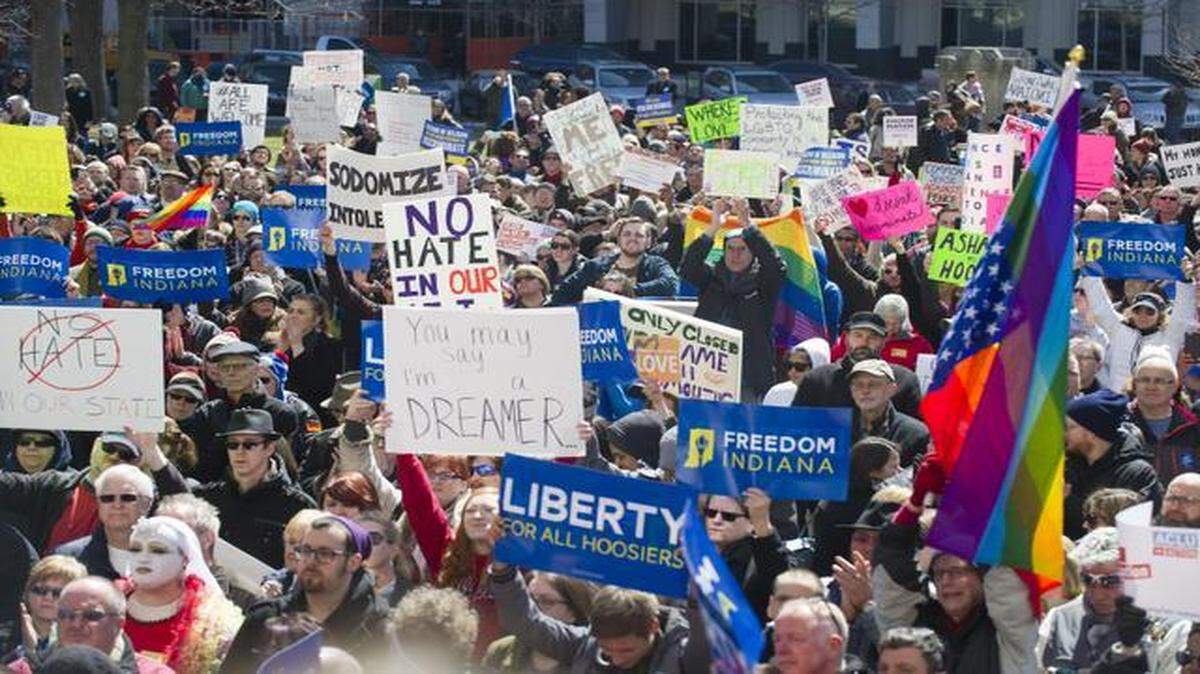
When a firestorm erupted in Indiana over religious freedom and gay rights, readers asked us how Missouri and Kansas fit into the debate. The answer is complex, but it’s worth understanding because the Hoosier state’s experience provides a cautionary tale.
By Thursday, the national uproar over Indiana’s so-called religious freedom law had become so intense that lawmakers were forced to pass new legislation tempering their earlier measure. Gov. Mike Pence signed the altered version. A similar scenario played out in Arkansas, where the legislature also had passed a religious freedom law this week.
Supporters of Indiana’s original law insisted it only reinforced the right of people to act in accordance with their religion. Opponents countered that it legalized discrimination against gays and lesbians under the guise of faith.
Perhaps even more important than the legal reality was the public perception. High-profile organizations and corporations believed the law encouraged discrimination. Apple, the NCAA, the state of Washington, city of Portland, Ore., and many others threatened to boycott Indiana.
Before Indiana, 19 states and the federal government had adopted a religious-freedom law. Yet Indiana’s controversial, original measure differed in some important ways.
Other states allow people to use religion as a legal defense when the government seeks to impose something on them. Indiana allowed them to use it against other citizens, too.
A second difference was in who counted as a religious believer. Usually it’s a person, but in Indiana a business could have found faith and sued.
Finally, unlike some other states, Indiana did not include sexual orientation in its nondiscrimination law, so there was no fallback in the code.
The Arkansas legislature passed a law at least as pernicious as Indiana’s, but corporate behemoth Wal-Mart balked, and its CEO asked Gov. Asa Hutchinson to veto the bill. The legislature adopted revisions and the governor signed the measure.
Both Kansas and Missouri have religious-freedom statutes, but neither goes as far as Indiana’s first version. They do not apply to businesses, and they only protect against government mandates.
Like Indiana, though, Kansas and Missouri don’t forbid discrimination based on sexual orientation.
In Missouri, a bill to add sexual orientation to the state’s nondiscrimination law stalled again this year. In Kansas last year, the House passed a bill to expand its religious freedom law. It died in the Senate, saving the state from Indiana’s fate. Kansas Gov. Sam Brownback, unfortunately, in February rescinded a ban on discrimination against gay state employees.
America has changed tremendously over the last couple of decades. The foremost gay-rights question in 1993, when President Bill Clinton signed the federal religious-freedom law, was whether gays should be allowed to serve in the military. Today, same-sex marriage is a reality.
Religious-freedom laws originally were meant to protect the rights of religious minorities. Now they are unnecessary pandering to the religious majority. The First Amendment to the U.S. Constitution protects faith already.
Rather than enable discrimination, states should seek to prevent it by including sexual orientation in their nondiscrimination laws. Indiana, Arkansas, Kansas and Missouri are doing the least, not the most, on this front.
Indeed, in those and 25 other states, a person can still be fired for being gay. That’s unconscionable in 2015.
This story was originally published April 2, 2015 at 6:00 PM with the headline "Missouri and Kansas could learn lessons on equality from Indiana’s ‘religious freedom’ effort."