
No indictment of Ferguson police officer Darren Wilson for shooting of Michael Brown
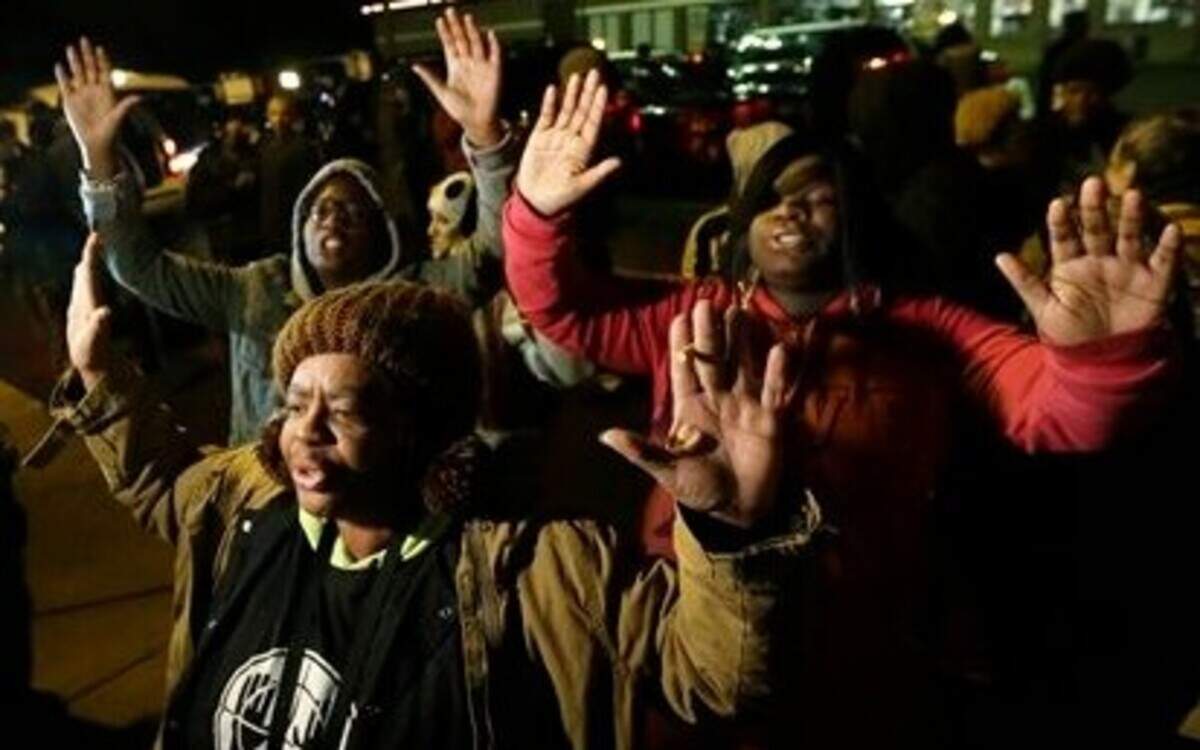
A grand jury has decided not to indict Ferguson, Mo., police officer Darren Wilson for the shooting of unarmed, 18-year-old Michael Brown.
The grand jury’s decision, revealed in a Monday evening press conference, came after months of nearly nightly and sometimes violent protests in the St. Louis suburb. It ratcheted up anxiety that more looting and dangerous protests could erupt from the racially charged case.
Wilson is white. Brown was black.
The panel had pondered evidence presented by St. Louis County Prosecutor Bob McCulloch’s office for months after the Aug. 9 shooting death.
At Monday’s news conference, McCulloch said the grand jury heard testimony from about 60 witnesses and 70 hours of testimony on 25 different days.
“They were extremely engaged in the process, asking questions of every witness,” the prosecutor said.
Largely peaceful protests had simmered through the weekend amid speculation that Wilson would not be charged and that the timing of grand jury’s conclusion was being manipulated to minimize the grand jury’s conclusion.
“People feel like it’s been engineered, so that the results wouldn’t come out until after the (Nov. 4) election and until the weather got cold, and it would be more difficult to protest,” said Susan McGraugh, supervisor of the Criminal Defense Clinic at the Saint Louis University School of Law. “It’s really adding fuel to the fire.”
The 12-person grand jury deliberated in secret, like all such panels, and set its own schedule depending upon when the members were available.
Benjamin Crump, an attorney for Brown’s family, said Sunday that Brown’s relatives were frustrated with the prosecutor. While he had the option to present evidence to a grand jury, he also could have chosen to directly charge Wilson himself.
“You don’t have any direction. You’re just putting all the evidence out there and you’re going to let them figure it out and they can make up their own minds,” Crump said. “You know, it just boggles the mind why he thinks this is fair.”
During Sunday church services, some pastors encouraged their congregations to stay calm. Meanwhile, daily protests continued.
Meanwhile, barriers had been erected over the weekend around the building where the grand jury — six white men, three white women, two black women and one black man — had been meeting.
In the days and weeks leading up to the grand jury’s decision, some businesses in and near Ferguson had boarded up their windows and otherwise fortified against anticipated rioting.
Brown and another young man encountered Wilson when the officer was in a squad car. A scuffle with Wilson ended with the police officer shooting Brown at least six times.
That quickly triggered protests, and sometimes rioting, as it intensified criticism of the Ferguson police force — a unit far more white than the population of Ferguson.
And as the grand jury deliberations stretched over weeks, worry about what its decision might spur prompted all number of preparations. Talks among local police, state authorities and protestors aimed to keep the reaction peaceful.
But none of the parties were confident that violence could be kept at bay.
The FBI reportedly sent nearly 100 additional agents to Ferguson to help law enforcement agencies. Gov. Jay Nixon created a special panel to examine the conditions that spurred the violence and to prevent a repeat of the disturbances that have rocked the city for months.
He said in a Monday night press conference that National Guard troops would be used to protect public buildings and utilities. Joined by other state and St. Louis-area public officials, the governor said a plan pieced together in anticipation of the grand jury decision aimed to protect both protesters’ free speech rights and public safety. Nixon urged “tolerance, mutual respect and restraint.”
“We are all focused on making sure the necessary resources are at hand to protect lives, to protect property and to protect free speech,” the governor said.
The governor had also declared a state of emergency and activated the National Guard to help state and local police in case of civil unrest. Police have undergone training pertaining to protesters’ constitutional rights and have purchased more equipment, such as shields, helmets, smoke canisters and rubber bullets.
Dan Isom, a former St. Louis police chief and the current head of the state Department of Public Safety, said that local law enforcement and the Missouri Highway Patrol planned and trained for any response to the grand jury decision for two months.
“I have great confidence,” he said, “in the design of this plan.”
Specialized computer technicians were deployed to Ferguson to help police and the local government protect against hackers who have pledged to bring down their computer networks. The online hacking group Anonymous has weighed in regularly and was highly critically of the Ferguson Police Department. Intelligence analysts are also in the area to help identify anarchists and others who may use the verdict as an excuse to lash out violently.
Separate from the grand jury, the Justice Department is conducting two civil rights inquiries. One looks at Brown’s shooting. The second examines whether the Ferguson Police Department has fallen into a pattern of civil rights violations.
State and local officials had encouraged the Justice Department to announce the results of its inquiry into the shooting at the same time as the announcement of the grand jury’s decision. They hoped that if no charges were filed against Wilson, Attorney General Eric Holder’s credibility among fellow African-Americans might reassure people that the decision was a result of a thorough investigation.
But Holder and his top aides repeatedly refused, saying their investigation was not complete and that they would not rush it to meet the state’s timeline.
Grand juries, by Missouri law, are put together from people “selected at random from a fair cross-section of the citizens.” The jury was 75 percent white. St. Louis County is 70 percent white, but about two-thirds of Ferguson’s residents are black.
The grand jury’s term was due to expire Sept. 10, but its term was extended to Jan. 7. The jurors typically met once a week.
While grand jurors usually hear abbreviated evidence in a case, McCulloch presented a more complete version in the Ferguson case. Among the witnesses were Wilson and Dr. Michael Baden, who performed a private autopsy on Brown on behalf of his family.
The Associated Press contributed to this report.
This story was originally published November 24, 2014 at 1:12 PM with the headline "No indictment of Ferguson police officer Darren Wilson for shooting of Michael Brown."